
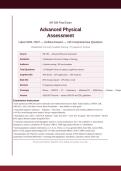
NR 509 Final Exam
Advanced Physical
Assessment
Latest — Verified Answers — 135 Comprehensive Questions
Chamberlain University Graduate Nursing • 9 Competency Sections
Course NR 509 — Advanced Physical Assessment
Institution Chamberlain University College of Nursing
Audience Graduate nursing / NP-track students
Total Questions 135 Multiple-Choice (4 options, single best answer)
Cognitive Mix 30% Recall | 50% Application | 20% Analysis
Style Mix 80% Scenario-based | 20% Direct recall
Sections 9 competency-aligned sections
Coverage History → HEENT → CV → Respiratory → Abdomen/GU → MSK/Neuro → Lifespan → Diagno
Version 2026/2027 Revised — current USPSTF and CDC guidelines
Examination Instructions
• Each question has ONE best answer. Rationales cite evidence-based sources: Bates’ Guide, Bickley, USPSTF, CDC,
AHA/ACC, AAP, AGS Beers Criteria. Read all rationales — they double as a study guide.
• Assessment sequence: Inspection → Palpation → Percussion → Auscultation for most systems (abdomen reverses to
I-A-P-P to avoid altering bowel sounds). Always compare bilaterally.
• Auscultation areas: Aortic = 2nd R ICS; Pulmonic = 2nd L ICS; Erb’s = 3rd L ICS; Tricuspid = 4th L ICS; Mitral = 5th ICS
MCL (apex). Murmurs radiate along blood flow.
• Commonly confused pairs tested throughout: arterial vs. venous insufficiency, S3 vs. S4, conductive vs. sensorineural
hearing loss, central vs. peripheral CN VII palsy, UMN vs. LMN signs, pleural effusion vs. consolidation.
• Special populations: pediatric milestones (2, 4, 6, 9, 12, 18 mo; 2, 4, 5 yr), geriatric (Beers, Katz ADL, Lawton IADL,
MoCA, TUG), pregnant (fundal height, FHT 110–160), mental health (PHQ-9, GAD-7, EPDS, suicide risk).
• Documentation rule: Objective, specific, measurable, with anatomic location. SOAP: Subjective (history), Objective
(exam/labs), Assessment (differential + reasoning), Plan (diagnostics, therapeutics, education, referral, follow-up).
Revised and verified for 2026/2027. Every finding, every patient, every time.
,NR 509 — Advanced Physical Assessment Final Exam Chamberlain 2026/2027 Verified | 135 Questions
Section 1: General Survey, History Taking, and Clinical Reasoning
Comprehensive health history (CC, HPI/OLDCARTS, PMH, FH, SH, ROS), cultural competence, general survey, vital signs
interpretation, and documentation principles.
Q1: A 62-year-old male presents for a new patient visit. The NP begins the encounter with open-ended
questions and observes the patient’s appearance, posture, and behavior as the patient walks to the exam
room. Which component of the health history is the NP completing?
A. Review of systems
B. General survey (the first step of every encounter, providing holistic impression before focused
questioning) [CORRECT]
C. Past medical history
D. Family history
Correct Answer: B
Rationale: The general survey begins the moment the patient is observed and continues throughout the encounter —
assessing appearance, posture, mobility, behavior, hygiene, and distress. It informs the differential before a single question
is asked. ROS, PMH, and FH are explicit verbal components gathered after the general survey. Skipping the general survey
is a common novice error; expert clinicians integrate it continuously.
Q2: When documenting a chief complaint, which of the following is the MOST appropriate format?
A. “Abdominal pain x 3 days” — using the patient’s own words in quotes with duration [CORRECT]
B. “Patient has acute appendicitis” — using the working diagnosis
C. “Patient complains of GI distress” — using medical terminology
D. “Abdominal pain due to spicy food” — including the patient’s attribution
Correct Answer: A
Rationale: The chief complaint is documented in the patient’s own words, enclosed in quotes, with onset/duration (e.g.,
“stomach hurts real bad for 3 days”). The CC is NOT a diagnosis (B), medical terminology (C), or the patient’s causal
attribution (D). The CC frames the HPI that follows. Always use quotes to indicate the patient’s verbatim words.
Q3: A patient describes chest pain. Using the OLDCARTS mnemonic, which element is captured by the
letter "R"?
A. Risk factors
B. Radiation (where the pain spreads) [CORRECT]
C. Relieving factors
D. Recurrent episodes
Correct Answer: B
Rationale: OLDCARTS = Onset, Location, Duration, Character, Aggravating factors, Radiation, Timing, Severity (some
variants substitute Relieving factors for one R or use OPQRST). “R” most commonly = Radiation. A complete HPI uses
OLDCARTS plus associated symptoms, pertinent positives/negatives, and context. Mastering OLDCARTS ensures a
thorough HPI for any symptom.
Chamberlain University Graduate Nursing • Evidence-Based Assessment • Bates’/Bickley standards Page 2
,NR 509 — Advanced Physical Assessment Final Exam Chamberlain 2026/2027 Verified | 135 Questions
Q4: A 45-year-old Vietnamese female presents with fatigue. She avoids eye contact and answers briefly.
The NP interprets this as depression. Which cultural competence principle has the NP violated?
A. Use of interpreter services
B. Avoiding cultural imposition by recognizing that limited eye contact may reflect respect in some
cultures, not psychopathology [CORRECT]
C. Maintaining professional boundaries
D. Using standardized screening tools
Correct Answer: B
Rationale: Eye contact norms vary by culture: in many Asian, Middle Eastern, and some Hispanic cultures, avoiding direct
eye contact with authority figures is a sign of respect, not depression. Cultural imposition occurs when the clinician applies
their own cultural norms as the standard. Always interpret behavior within cultural context and ask clarifying questions.
Use LEARN/ETHNIC mnemonics for cultural assessment.
Q5: When obtaining a family history, which relative’s health information is MOST relevant for
cardiovascular risk stratification?
A. Parent diagnosed with CAD at age 75
B. First-degree relative (parent or sibling) diagnosed with CAD at age <55 (male) or <65 (female) —
premature family history [CORRECT]
C. Grandparent with hypertension at age 70
D. Distant cousin with stroke at age 80
Correct Answer: B
Rationale: Premature family history (first-degree male relative <55 or female <65) is a major non-modifiable
cardiovascular risk factor per AHA/ACC. CAD in relatives at older ages is less predictive. Always specify the age of
diagnosis and the relationship. Document family history with a genogram when possible, including deceased relatives and
cause of death.
Q6: A 58-year-old male’s blood pressure is 148/96 mmHg in the right arm. What is the appropriate next
step in measurement?
A. Document the finding and proceed with the exam
B. Recheck the blood pressure in the opposite arm; a difference >15 mmHg suggests vascular disease and
warrants further evaluation [CORRECT]
C. Recheck in 6 months
D. Begin antihypertensive therapy immediately
Correct Answer: B
Rationale: Per AHA guidelines, BP should be measured in both arms at the first visit. A difference >15 mmHg (systolic)
suggests subclavian stenosis, aortic dissection, or peripheral vascular disease and warrants further evaluation. Use the
higher reading for diagnosis. Proper technique: patient seated, arm supported at heart level, 5 minutes rest, correct cuff
size, no conversation.
Chamberlain University Graduate Nursing • Evidence-Based Assessment • Bates’/Bickley standards Page 3
, NR 509 — Advanced Physical Assessment Final Exam Chamberlain 2026/2027 Verified | 135 Questions
Q7: A 70-year-old female has a respiratory rate of 24 breaths/min. Which interpretation is correct?
A. Normal for an elderly patient
B. Tachypnea (normal adult RR is 12–20; RR >20 is tachypnea and warrants investigation) [CORRECT]
C. Bradypnea
D. Hypoventilation
Correct Answer: B
Rationale: Normal adult respiratory rate is 12–20 breaths/min. RR >20 is tachypnea (often an early sign of respiratory
distress, fever, anxiety, metabolic acidosis, or pulmonary embolism). RR <12 is bradypnea (opioid effect, CNS depression).
Count respirations for a full minute, ideally while pretending to take the pulse so the patient does not alter their breathing.
Tachypnea is never “normal for elderly.”
Q8: A patient’s oxygen saturation is 92% on room air. Which interpretation is correct?
A. Normal; no action needed
B. Mild hypoxemia (SpO₂ <95% is abnormal; 92% suggests V/Q mismatch, hypoventilation, or altitude
and warrants evaluation) [CORRECT]
C. Severe hypoxemia requiring intubation
D. Within normal limits for a smoker
Correct Answer: B
Rationale: Normal SpO₂ is 95–100% at sea level. SpO₂ 91–94% is moderate hypoxemia; ≤90% is severe. SpO₂ 92%
warrants evaluation of respiratory status, cardiac status, and hemoglobin. SpO₂ is unreliable in CO poisoning (falsely
normal) and poor perfusion. In COPD with chronic CO₂ retention, target SpO₂ 88–92% — but that is a specific exception,
not the default. Always interpret SpO₂ with PaCO₂ and clinical context.
Q9: Which vital sign is MOST indicative of hemodynamic instability in an acutely ill adult?
A. Temperature 38.2°C (100.8°F)
B. Respiratory rate 28/min (tachypnea is the most sensitive individual vital sign of impending
deterioration) [CORRECT]
C. Heart rate 92 bpm
D. Blood pressure 118/76 mmHg
Correct Answer: B
Rationale: Tachypnea (RR >20) is the most sensitive individual predictor of deterioration and adverse outcomes in acutely
ill adults (studies by Subbe, Cretikos). RR is the most under-recorded vital sign and often the first to abnormalize. The
National Early Warning Score (NEWS) heavily weights RR. Temperature and HR are less specific. Always interpret vital
signs as a trend, not in isolation.
Chamberlain University Graduate Nursing • Evidence-Based Assessment • Bates’/Bickley standards Page 4


