

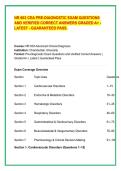
NR 603 CEA PRE-DIAGNOSTIC EXAM QUESTIONS
AND VERIFIED CORRECT ANSWERS GRADED A+ -
LATEST - GUARANTEED PASS.
Course: NR 603 Advanced Clinical Diagnosis
Institution: Chamberlain University
Format: Pre-Diagnostic Exam Questions and Verified Correct Answers |
Graded A+ | Latest | Guaranteed Pass
Exam Coverage Overview
Section Topic Area Questions
Section 1 Cardiovascular Disorders 1–15
Section 2 Endocrine & Metabolic Disorders 16–30
Section 3 Hematologic Disorders 31–45
Section 4 Respiratory Disorders 46–60
Section 5 Gastrointestinal & Genitourinary Disorders 61–75
Section 6 Musculoskeletal & Integumentary Disorders 76–90
Section 7 Pharmacology & Clinical Decision-Making 91–100
Section 1: Cardiovascular Disorders (Questions 1–15)
,Question 1
A 62-year-old male presents to the emergency department with substernal
chest pressure that began 90 minutes ago while shoveling snow. The pain
radiates to his left arm and jaw, and he reports diaphoresis and nausea. His
blood pressure is 155/95 mmHg, heart rate 110 bpm. What is the most
appropriate initial diagnostic test?
A. Chest X-ray
B. 12-lead ECG
C. Cardiac troponin
D. Stress echocardiogram
Answer: B. 12-lead ECG
Rationale: For any patient presenting with symptoms suggestive of acute
coronary syndrome (ACS), a 12-lead ECG should be obtained within 10
minutes of arrival. The ECG can identify ST-elevation myocardial infarction
(STEMI) requiring immediate reperfusion therapy. While troponin is
important for diagnosis, the ECG provides immediate actionable
information for time-sensitive interventions.
Question 2
The ECG shows ST-segment elevation in leads V1-V4. Which coronary
artery is most likely occluded?
A. Right coronary artery
B. Left circumflex artery
C. Left anterior descending artery
D. Posterior descending artery
Answer: C. Left anterior descending artery
Rationale: ST-segment elevation in the anterior precordial leads (V1-V4)
indicates an anterior wall myocardial infarction, which is typically caused by
occlusion of the left anterior descending artery (LAD). The LAD supplies
the anterior wall of the left ventricle and the interventricular septum.
,Question 3
A 55-year-old woman with a history of hypertension presents with
intermittent chest tightness that occurs when she walks briskly and
resolves with rest. Her ECG is normal at rest. Which diagnostic test is most
appropriate next?
A. Coronary angiography
B. Exercise stress test
C. Echocardiogram
D. Serum troponin
Answer: B. Exercise stress test
Rationale: The patient has stable angina symptoms. An exercise stress
test is indicated to evaluate for inducible ischemia. It is safe and
noninvasive. Coronary angiography is reserved for patients with high-risk
features or positive stress test.
Question 4
A 70-year-old man presents with syncope while mowing the lawn. He has a
history of heart failure with reduced ejection fraction (EF 30%). On exam,
heart rate is 140 bpm, irregularly irregular, with variable S1 intensity. What
is the most likely diagnosis?
A. Atrial flutter
B. Atrial fibrillation
C. Multifocal atrial tachycardia
D. Ventricular tachycardia
Answer: B. Atrial fibrillation
Rationale: Atrial fibrillation is characterized by irregularly irregular rhythm
with no discernible P waves. It is common in patients with heart failure.
Atrial flutter typically has regular rhythm with sawtooth waves. Ventricular
tachycardia is usually regular and wide-complex.
Question 5
A 45-year-old obese male with a history of obstructive sleep apnea reports
, sudden onset of sharp, stabbing chest pain that worsens with deep
inspiration. He is afebrile, heart rate 105 bpm, respiratory rate 24, oxygen
saturation 96% on room air. Which diagnosis is most likely?
A. Unstable angina
B. Pericarditis
C. Pulmonary embolism
D. Pneumothorax
Answer: B. Pericarditis
Rationale: Pleuritic chest pain (worsening with inspiration) is classic for
pericarditis, especially when positional. The patient is not hypoxic, which
makes pulmonary embolism less likely. Pericarditis often follows viral
illness and may have a pericardial friction rub.
Question 6
An older adult presents with the single complaint of bilateral pedal edema.
The patient has a history of diabetes and high blood pressure and is on oral
medications. Which of the following medications is the MOST likely cause
of the patient's complaint?
A. Metformin
B. Amlodipine (Norvasc)
C. Lisinopril
D. Atorvastatin
Answer: B. Amlodipine (Norvasc)
Rationale: Amlodipine is a calcium channel blocker commonly associated
with peripheral edema due to arterial vasodilation. This is a well-known side
effect that often requires dose reduction or addition of an ACE
inhibitor/ARB.
Question 7
A 50-year-old woman with a history of hypertension presents with dyspnea
on exertion and orthopnea. She has jugular venous distention and bilateral
crackles. What is the priority diagnosis?
AND VERIFIED CORRECT ANSWERS GRADED A+ -
LATEST - GUARANTEED PASS.
Course: NR 603 Advanced Clinical Diagnosis
Institution: Chamberlain University
Format: Pre-Diagnostic Exam Questions and Verified Correct Answers |
Graded A+ | Latest | Guaranteed Pass
Exam Coverage Overview
Section Topic Area Questions
Section 1 Cardiovascular Disorders 1–15
Section 2 Endocrine & Metabolic Disorders 16–30
Section 3 Hematologic Disorders 31–45
Section 4 Respiratory Disorders 46–60
Section 5 Gastrointestinal & Genitourinary Disorders 61–75
Section 6 Musculoskeletal & Integumentary Disorders 76–90
Section 7 Pharmacology & Clinical Decision-Making 91–100
Section 1: Cardiovascular Disorders (Questions 1–15)
,Question 1
A 62-year-old male presents to the emergency department with substernal
chest pressure that began 90 minutes ago while shoveling snow. The pain
radiates to his left arm and jaw, and he reports diaphoresis and nausea. His
blood pressure is 155/95 mmHg, heart rate 110 bpm. What is the most
appropriate initial diagnostic test?
A. Chest X-ray
B. 12-lead ECG
C. Cardiac troponin
D. Stress echocardiogram
Answer: B. 12-lead ECG
Rationale: For any patient presenting with symptoms suggestive of acute
coronary syndrome (ACS), a 12-lead ECG should be obtained within 10
minutes of arrival. The ECG can identify ST-elevation myocardial infarction
(STEMI) requiring immediate reperfusion therapy. While troponin is
important for diagnosis, the ECG provides immediate actionable
information for time-sensitive interventions.
Question 2
The ECG shows ST-segment elevation in leads V1-V4. Which coronary
artery is most likely occluded?
A. Right coronary artery
B. Left circumflex artery
C. Left anterior descending artery
D. Posterior descending artery
Answer: C. Left anterior descending artery
Rationale: ST-segment elevation in the anterior precordial leads (V1-V4)
indicates an anterior wall myocardial infarction, which is typically caused by
occlusion of the left anterior descending artery (LAD). The LAD supplies
the anterior wall of the left ventricle and the interventricular septum.
,Question 3
A 55-year-old woman with a history of hypertension presents with
intermittent chest tightness that occurs when she walks briskly and
resolves with rest. Her ECG is normal at rest. Which diagnostic test is most
appropriate next?
A. Coronary angiography
B. Exercise stress test
C. Echocardiogram
D. Serum troponin
Answer: B. Exercise stress test
Rationale: The patient has stable angina symptoms. An exercise stress
test is indicated to evaluate for inducible ischemia. It is safe and
noninvasive. Coronary angiography is reserved for patients with high-risk
features or positive stress test.
Question 4
A 70-year-old man presents with syncope while mowing the lawn. He has a
history of heart failure with reduced ejection fraction (EF 30%). On exam,
heart rate is 140 bpm, irregularly irregular, with variable S1 intensity. What
is the most likely diagnosis?
A. Atrial flutter
B. Atrial fibrillation
C. Multifocal atrial tachycardia
D. Ventricular tachycardia
Answer: B. Atrial fibrillation
Rationale: Atrial fibrillation is characterized by irregularly irregular rhythm
with no discernible P waves. It is common in patients with heart failure.
Atrial flutter typically has regular rhythm with sawtooth waves. Ventricular
tachycardia is usually regular and wide-complex.
Question 5
A 45-year-old obese male with a history of obstructive sleep apnea reports
, sudden onset of sharp, stabbing chest pain that worsens with deep
inspiration. He is afebrile, heart rate 105 bpm, respiratory rate 24, oxygen
saturation 96% on room air. Which diagnosis is most likely?
A. Unstable angina
B. Pericarditis
C. Pulmonary embolism
D. Pneumothorax
Answer: B. Pericarditis
Rationale: Pleuritic chest pain (worsening with inspiration) is classic for
pericarditis, especially when positional. The patient is not hypoxic, which
makes pulmonary embolism less likely. Pericarditis often follows viral
illness and may have a pericardial friction rub.
Question 6
An older adult presents with the single complaint of bilateral pedal edema.
The patient has a history of diabetes and high blood pressure and is on oral
medications. Which of the following medications is the MOST likely cause
of the patient's complaint?
A. Metformin
B. Amlodipine (Norvasc)
C. Lisinopril
D. Atorvastatin
Answer: B. Amlodipine (Norvasc)
Rationale: Amlodipine is a calcium channel blocker commonly associated
with peripheral edema due to arterial vasodilation. This is a well-known side
effect that often requires dose reduction or addition of an ACE
inhibitor/ARB.
Question 7
A 50-year-old woman with a history of hypertension presents with dyspnea
on exertion and orthopnea. She has jugular venous distention and bilateral
crackles. What is the priority diagnosis?


