

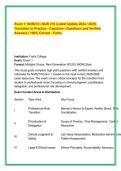
Exam 1: NUR210 / NUR 210 (Latest Update )
Transition to Practice - Capstone | Questions and Verified
Answers | 100% Correct - Fortis
Institution: Fortis College
Exam: Exam 1
Format: Multiple Choice, Next Generation NCLEX (NGN) Style
This study guide compiles high-yield questions with verified answers and
rationales for NUR210 Exam 1, based on the most current 2025/2026
exam resources. The exam covers critical concepts for the transition from
student to professional nurse, focusing on clinical judgment, prioritization,
delegation, and professional role development.
Exam Content Areas & Distribution
Section Topic Area Key Focus
Professional Role Benner's Novice to Expert, Reality Shock, Role
I
Transition Socialization
Prioritization & Scope of Practice, Time Management, Conflict
II
Delegation Resolution
Clinical Judgment & Lab Value Interpretation, Medication Administratio
III
Safety Patient Assessment
IV Legal & Ethical Issues Ethical Principles, Accountability, Advocacy
, Section I: Professional Role Transition
Question 1
A new graduate nurse is struggling with the transition from student to
professional nurse. According to Benner's stages of clinical competence,
the new graduate is best described as:
A. Expert
B. Proficient
C. Competent
D. Advanced beginner
Answer: D. Advanced beginner
Rationale: Benner identifies new graduate nurses as advanced beginners
who have gained enough experience to recognize recurring meaningful
patterns but still rely on rules and guidelines to guide practice.
Question 2
A nurse who has been practicing for 2 years and can manage most patient
care situations but still requires guidance for complex or unexpected events
is BEST described as:
A. Novice
B. Advanced beginner
C. Competent
D. Expert
Answer: C. Competent
Rationale: Benner's Competent stage (typically 2-3 years) is characterized
by the ability to see actions in relation to long-range goals, manage multiple
patient care tasks, and coordinate care; the nurse still benefits from
guidance for complex situations but functions independently in routine care.
Question 3
A new graduate nurse experiences a period of "shock and rejection"
Transition to Practice - Capstone | Questions and Verified
Answers | 100% Correct - Fortis
Institution: Fortis College
Exam: Exam 1
Format: Multiple Choice, Next Generation NCLEX (NGN) Style
This study guide compiles high-yield questions with verified answers and
rationales for NUR210 Exam 1, based on the most current 2025/2026
exam resources. The exam covers critical concepts for the transition from
student to professional nurse, focusing on clinical judgment, prioritization,
delegation, and professional role development.
Exam Content Areas & Distribution
Section Topic Area Key Focus
Professional Role Benner's Novice to Expert, Reality Shock, Role
I
Transition Socialization
Prioritization & Scope of Practice, Time Management, Conflict
II
Delegation Resolution
Clinical Judgment & Lab Value Interpretation, Medication Administratio
III
Safety Patient Assessment
IV Legal & Ethical Issues Ethical Principles, Accountability, Advocacy
, Section I: Professional Role Transition
Question 1
A new graduate nurse is struggling with the transition from student to
professional nurse. According to Benner's stages of clinical competence,
the new graduate is best described as:
A. Expert
B. Proficient
C. Competent
D. Advanced beginner
Answer: D. Advanced beginner
Rationale: Benner identifies new graduate nurses as advanced beginners
who have gained enough experience to recognize recurring meaningful
patterns but still rely on rules and guidelines to guide practice.
Question 2
A nurse who has been practicing for 2 years and can manage most patient
care situations but still requires guidance for complex or unexpected events
is BEST described as:
A. Novice
B. Advanced beginner
C. Competent
D. Expert
Answer: C. Competent
Rationale: Benner's Competent stage (typically 2-3 years) is characterized
by the ability to see actions in relation to long-range goals, manage multiple
patient care tasks, and coordinate care; the nurse still benefits from
guidance for complex situations but functions independently in routine care.
Question 3
A new graduate nurse experiences a period of "shock and rejection"


