

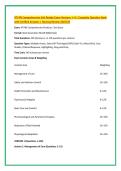
ATI RN Comprehensive Exit Retake Exam Versions 1–4 | Complete Question Bank
with Verified Answers | Nursing Review 2025/26
Exam: ATI RN Comprehensive Predictor / Exit Exam
Format: Next Generation NCLEX (NGN) Style
Total Questions: 420 (Versions 1–4, 105 questions per version)
Question Types: Multiple-choice, Select-All-That-Apply (SATA), Bow-Tie, Matrix/Grid, Case
Studies, Ordered Response, Highlighting, Drag-and-Drop
Time Limit: 240 minutes per version
Exam Content Areas & Weighting
Content Area Weighting
Management of Care 15–20%
Safety and Infection Control 10–15%
Health Promotion and Maintenance 6–12%
Psychosocial Integrity 6–12%
Basic Care and Comfort 6–12%
Pharmacological and Parenteral Therapies 10–15%
Reduction of Risk Potential 10–15%
Physiological Adaptation 10–15%
VERSION 1 (Questions 1–105)
Section 1: Management of Care (Questions 1–15)
,Question 1
A nurse manager is reviewing informed consent with staff. Which statement indicates
understanding?
A) “The nurse is responsible for explaining the procedure.”
B) “A witness signature confirms the client gave voluntary consent.”
C) “Informed consent is only required for surgical procedures.”
D) “A family member can sign for any adult client.”
Answer: B
Rationale: The witness signature confirms that the client signed voluntarily and appeared
competent to give consent. The provider (not the nurse) is responsible for explaining the
procedure. Informed consent is required for many procedures, not just surgical ones.
Question 2
A charge nurse is assigning clients. Which client should be assigned to a newly licensed RN?
A) Client with chest tube and continuous bubbling
B) Client with new-onset atrial fibrillation on a heparin drip
C) Client with stable pneumonia receiving oral antibiotics
D) Client with a tracheostomy requiring suctioning q2h
Answer: C
Rationale: Newly licensed RNs should care for stable, predictable clients with routine care
needs. Clients with chest tubes, unstable cardiac conditions, or tracheostomies require more
experienced nurses.
Question 3
A nurse is assisting with mass casualty triage after an explosion. Which client should be
identified as the priority?
A) Client with massive head trauma
B) Client with full-thickness burns to face and trunk
C) Client with indications of hypovolemic shock
D) Client with an open fracture of the lower extremity
Answer: C
,Rationale: In mass casualty triage, clients with potentially survivable but critical conditions (e.g.,
hypovolemic shock) are prioritized over those with non-survivable injuries or stable conditions.
Question 4
A nurse is caring for a client who is in restraints. A verbal prescription was obtained. Which
action should the nurse take?
A) Implement restraints immediately
B) Document the verbal order within 24 hours
C) Request a renewal of the prescription every 8 hours
D) Obtain a written order within 1 hour
Answer: C
Rationale: Restraint orders must be renewed every 8 hours for adults. The nurse should also
obtain a written order as soon as possible.
Question 5
A nurse is reviewing incident reports. Which statement by a staff member indicates
understanding of their purpose?
A) “The incident report is used to discipline the staff member involved.”
B) “The incident report is used to identify risks and improve safety.”
C) “The incident report is placed in the client’s medical record.”
D) “The incident report is used to assign blame for the incident.”
Answer: B
Rationale: Incident reports are quality improvement tools used to identify risks and improve
safety. They are not placed in the client’s medical record and are not used for discipline or
blame.
Question 6
A nurse in a mental health facility receives a change-of-shift report on four clients. Which client
should the nurse plan to assess first?
A) A client who is newly admitted and is sleeping
B) A client who is attending a group therapy session
, C) A client who was placed in restraints for aggressive behavior earlier in the shift
D) A client who is requesting a PRN medication for anxiety
Answer: C
Rationale: A client who was placed in restraints requires ongoing assessment and monitoring
for safety. This client should be assessed first to ensure the restraint is still appropriate and that
the client is not experiencing any adverse effects.
Question 7
A nurse in a County Jail health clinic is leading a group therapy session. A client who was
incarcerated for theft is addressing the group. Which of the following is an example of reaction
formation?
A) The client describes the theft as “no big deal, everyone does it.”
B) The client becomes overly helpful and charitable toward others.
C) The client forgets the details of the theft entirely.
D) The client blames the victim for leaving valuables visible.
Answer: B
Rationale: Reaction formation is a defense mechanism where unacceptable impulses are
replaced by their opposites. Becoming overly helpful and charitable (opposite of stealing) is an
example.
Question 8
A nurse is preparing to discharge a patient who speaks a different language. What is the
appropriate action?
A) Ask the patient's family member to interpret the discharge instructions
B) Use a commercial translator application on a smartphone
C) Obtain a certified medical interpreter per facility policy
D) Write the instructions in English and let the patient translate later
Answer: C
Rationale: Certified medical interpreters should be used for discharge instructions to ensure
accurate communication of critical information. Family members may not be fluent in medical
terminology, and commercial apps may lack accuracy.
with Verified Answers | Nursing Review 2025/26
Exam: ATI RN Comprehensive Predictor / Exit Exam
Format: Next Generation NCLEX (NGN) Style
Total Questions: 420 (Versions 1–4, 105 questions per version)
Question Types: Multiple-choice, Select-All-That-Apply (SATA), Bow-Tie, Matrix/Grid, Case
Studies, Ordered Response, Highlighting, Drag-and-Drop
Time Limit: 240 minutes per version
Exam Content Areas & Weighting
Content Area Weighting
Management of Care 15–20%
Safety and Infection Control 10–15%
Health Promotion and Maintenance 6–12%
Psychosocial Integrity 6–12%
Basic Care and Comfort 6–12%
Pharmacological and Parenteral Therapies 10–15%
Reduction of Risk Potential 10–15%
Physiological Adaptation 10–15%
VERSION 1 (Questions 1–105)
Section 1: Management of Care (Questions 1–15)
,Question 1
A nurse manager is reviewing informed consent with staff. Which statement indicates
understanding?
A) “The nurse is responsible for explaining the procedure.”
B) “A witness signature confirms the client gave voluntary consent.”
C) “Informed consent is only required for surgical procedures.”
D) “A family member can sign for any adult client.”
Answer: B
Rationale: The witness signature confirms that the client signed voluntarily and appeared
competent to give consent. The provider (not the nurse) is responsible for explaining the
procedure. Informed consent is required for many procedures, not just surgical ones.
Question 2
A charge nurse is assigning clients. Which client should be assigned to a newly licensed RN?
A) Client with chest tube and continuous bubbling
B) Client with new-onset atrial fibrillation on a heparin drip
C) Client with stable pneumonia receiving oral antibiotics
D) Client with a tracheostomy requiring suctioning q2h
Answer: C
Rationale: Newly licensed RNs should care for stable, predictable clients with routine care
needs. Clients with chest tubes, unstable cardiac conditions, or tracheostomies require more
experienced nurses.
Question 3
A nurse is assisting with mass casualty triage after an explosion. Which client should be
identified as the priority?
A) Client with massive head trauma
B) Client with full-thickness burns to face and trunk
C) Client with indications of hypovolemic shock
D) Client with an open fracture of the lower extremity
Answer: C
,Rationale: In mass casualty triage, clients with potentially survivable but critical conditions (e.g.,
hypovolemic shock) are prioritized over those with non-survivable injuries or stable conditions.
Question 4
A nurse is caring for a client who is in restraints. A verbal prescription was obtained. Which
action should the nurse take?
A) Implement restraints immediately
B) Document the verbal order within 24 hours
C) Request a renewal of the prescription every 8 hours
D) Obtain a written order within 1 hour
Answer: C
Rationale: Restraint orders must be renewed every 8 hours for adults. The nurse should also
obtain a written order as soon as possible.
Question 5
A nurse is reviewing incident reports. Which statement by a staff member indicates
understanding of their purpose?
A) “The incident report is used to discipline the staff member involved.”
B) “The incident report is used to identify risks and improve safety.”
C) “The incident report is placed in the client’s medical record.”
D) “The incident report is used to assign blame for the incident.”
Answer: B
Rationale: Incident reports are quality improvement tools used to identify risks and improve
safety. They are not placed in the client’s medical record and are not used for discipline or
blame.
Question 6
A nurse in a mental health facility receives a change-of-shift report on four clients. Which client
should the nurse plan to assess first?
A) A client who is newly admitted and is sleeping
B) A client who is attending a group therapy session
, C) A client who was placed in restraints for aggressive behavior earlier in the shift
D) A client who is requesting a PRN medication for anxiety
Answer: C
Rationale: A client who was placed in restraints requires ongoing assessment and monitoring
for safety. This client should be assessed first to ensure the restraint is still appropriate and that
the client is not experiencing any adverse effects.
Question 7
A nurse in a County Jail health clinic is leading a group therapy session. A client who was
incarcerated for theft is addressing the group. Which of the following is an example of reaction
formation?
A) The client describes the theft as “no big deal, everyone does it.”
B) The client becomes overly helpful and charitable toward others.
C) The client forgets the details of the theft entirely.
D) The client blames the victim for leaving valuables visible.
Answer: B
Rationale: Reaction formation is a defense mechanism where unacceptable impulses are
replaced by their opposites. Becoming overly helpful and charitable (opposite of stealing) is an
example.
Question 8
A nurse is preparing to discharge a patient who speaks a different language. What is the
appropriate action?
A) Ask the patient's family member to interpret the discharge instructions
B) Use a commercial translator application on a smartphone
C) Obtain a certified medical interpreter per facility policy
D) Write the instructions in English and let the patient translate later
Answer: C
Rationale: Certified medical interpreters should be used for discharge instructions to ensure
accurate communication of critical information. Family members may not be fluent in medical
terminology, and commercial apps may lack accuracy.


