

CLINICAL CERTIFICATION · OBJECTIVE ASSESSMENT A+ VERIFIED
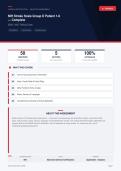
NIH Stroke Scale Group D Patient 1-6
— Complete
Official Exam
50 Questions Full Rationales Verified Answers
50 5 100%
QUESTIONS SECTIONS RATIONALES
Complete coverage Core exam domains Every answer explained
WHAT THIS COVERS
01 Level of Consciousness & Orientation
02 Gaze, Visual Fields & Facial Palsy
03 Motor Function (Arms & Legs)
04 Ataxia, Sensory & Language
05 Comprehensive Scoring & Clinical Application
ABOUT THIS ASSESSMENT
Build mastery in NIH Stroke Scale assessment — from level of consciousness and orientation to gaze, visual fields, facial
palsy, motor function, ataxia, sensory, language, and comprehensive scoring. This original study bank targets application and
analysis skills for the NIHSS Group D certification, with full rationales for every answer. For review use only; not an
institutional proctored assessment.
PASSING SCORE LEVEL FORMAT
80% Advanced (Clinical Certification) Application / Analysis
STUVIA ACTUAL EXAM Page 1
, SECTION 1: Level of Consciousness & Orientation
Q1. A stroke patient opens eyes only to repeated loud verbal stimuli and then drifts back to sleep. When you ask the month and
age, the patient answers incorrectly both times. For NIHSS item 1a (Level of Consciousness), which score is most appropriate?
A. 0 – Alert; keenly responsive
B. 1 – Not alert, but arousable by minor stimulation to obey, answer, or respond
C. 2 – Not alert; requires repeated stimulation to attend, or is obtunded and requires strong or painful stimulation to make movements
D. 3 – Responds only with reflex motor or autonomic effects, or totally unresponsive
Correct Answer: C
Rationale:
Score 2 is used when the patient requires repeated stimulation to attend. Score 1 is for minor stimulation; score 3 is for reflex-only or unresponsive
states. The incorrect answers to orientation questions are scored separately under 1b.
Q2. You are scoring NIHSS item 1b (LOC Questions). The patient correctly states the month but gives an incorrect age. The pati
is not aphasic. Which score do you assign for 1b?
A. 1 – Answers one question correctly
B. 0 – Answers both questions correctly
C. 2 – Answers neither question correctly
D. UN – Untestable because of intubation
Correct Answer: A
Rationale:
Item 1b awards 1 point when only one of the two questions (month and age) is answered correctly. Both correct = 0; neither correct = 2. Intubation is
not present in this scenario.
Q3. A patient is intubated and cannot speak. For NIHSS item 1b (LOC Questions), the standard instruction is to score the item a
untestable only under specific conditions. In routine NIHSS certification scoring, how is an intubated patient typically handled for 1b?
A. Always score 0 because the patient is alert
B. Omit the entire NIHSS
C. Score 2 if the patient cannot answer, or follow the certification rules that treat intubation as a reason the item may be scored as
untestable when speech is impossible
D. Score 3 automatically
Correct Answer: C
Rationale:
When a patient is intubated or otherwise unable to speak, 1b may be scored as untestable per protocol, or scored 2 if answers cannot be obtained.
The key is consistent application of the published rules rather than assuming alertness equals a zero score.
Q4. For NIHSS item 1c (LOC Commands), the patient is asked to open and close the eyes and then to grip and release the
non-paretic hand. The patient performs only the eye command correctly. Which score is assigned?
A. 0 – Performs both tasks correctly
B. 1 – Performs one task correctly
C. 2 – Performs neither task correctly
D. 3 – Cannot be tested
Correct Answer: B
Rationale:
Item 1c is scored 1 when only one of the two commands is performed correctly. Both correct = 0; neither = 2. The commands are given one at a time
and may be demonstrated if needed.
Q5. A patient with dense aphasia does not follow verbal commands for item 1c. You pantomime the eye-opening and hand-grip
tasks; the patient then performs both correctly. How should 1c be scored?
A. 2 – because verbal commands were not understood
B. UN – aphasia makes the item untestable
C. 1 – only partial credit is allowed after pantomime
D. 0 – performs both tasks correctly after demonstration
Correct Answer: D
Rationale:
NIHSS allows pantomime or demonstration for 1c. If the patient then performs both tasks, the score is 0. Aphasia does not automatically make 1c
untestable when non-verbal cues succeed.
STUVIA ACTUAL EXAM · Page 2
NIH Stroke Scale Group D Patient 1-6
— Complete
Official Exam
50 Questions Full Rationales Verified Answers
50 5 100%
QUESTIONS SECTIONS RATIONALES
Complete coverage Core exam domains Every answer explained
WHAT THIS COVERS
01 Level of Consciousness & Orientation
02 Gaze, Visual Fields & Facial Palsy
03 Motor Function (Arms & Legs)
04 Ataxia, Sensory & Language
05 Comprehensive Scoring & Clinical Application
ABOUT THIS ASSESSMENT
Build mastery in NIH Stroke Scale assessment — from level of consciousness and orientation to gaze, visual fields, facial
palsy, motor function, ataxia, sensory, language, and comprehensive scoring. This original study bank targets application and
analysis skills for the NIHSS Group D certification, with full rationales for every answer. For review use only; not an
institutional proctored assessment.
PASSING SCORE LEVEL FORMAT
80% Advanced (Clinical Certification) Application / Analysis
STUVIA ACTUAL EXAM Page 1
, SECTION 1: Level of Consciousness & Orientation
Q1. A stroke patient opens eyes only to repeated loud verbal stimuli and then drifts back to sleep. When you ask the month and
age, the patient answers incorrectly both times. For NIHSS item 1a (Level of Consciousness), which score is most appropriate?
A. 0 – Alert; keenly responsive
B. 1 – Not alert, but arousable by minor stimulation to obey, answer, or respond
C. 2 – Not alert; requires repeated stimulation to attend, or is obtunded and requires strong or painful stimulation to make movements
D. 3 – Responds only with reflex motor or autonomic effects, or totally unresponsive
Correct Answer: C
Rationale:
Score 2 is used when the patient requires repeated stimulation to attend. Score 1 is for minor stimulation; score 3 is for reflex-only or unresponsive
states. The incorrect answers to orientation questions are scored separately under 1b.
Q2. You are scoring NIHSS item 1b (LOC Questions). The patient correctly states the month but gives an incorrect age. The pati
is not aphasic. Which score do you assign for 1b?
A. 1 – Answers one question correctly
B. 0 – Answers both questions correctly
C. 2 – Answers neither question correctly
D. UN – Untestable because of intubation
Correct Answer: A
Rationale:
Item 1b awards 1 point when only one of the two questions (month and age) is answered correctly. Both correct = 0; neither correct = 2. Intubation is
not present in this scenario.
Q3. A patient is intubated and cannot speak. For NIHSS item 1b (LOC Questions), the standard instruction is to score the item a
untestable only under specific conditions. In routine NIHSS certification scoring, how is an intubated patient typically handled for 1b?
A. Always score 0 because the patient is alert
B. Omit the entire NIHSS
C. Score 2 if the patient cannot answer, or follow the certification rules that treat intubation as a reason the item may be scored as
untestable when speech is impossible
D. Score 3 automatically
Correct Answer: C
Rationale:
When a patient is intubated or otherwise unable to speak, 1b may be scored as untestable per protocol, or scored 2 if answers cannot be obtained.
The key is consistent application of the published rules rather than assuming alertness equals a zero score.
Q4. For NIHSS item 1c (LOC Commands), the patient is asked to open and close the eyes and then to grip and release the
non-paretic hand. The patient performs only the eye command correctly. Which score is assigned?
A. 0 – Performs both tasks correctly
B. 1 – Performs one task correctly
C. 2 – Performs neither task correctly
D. 3 – Cannot be tested
Correct Answer: B
Rationale:
Item 1c is scored 1 when only one of the two commands is performed correctly. Both correct = 0; neither = 2. The commands are given one at a time
and may be demonstrated if needed.
Q5. A patient with dense aphasia does not follow verbal commands for item 1c. You pantomime the eye-opening and hand-grip
tasks; the patient then performs both correctly. How should 1c be scored?
A. 2 – because verbal commands were not understood
B. UN – aphasia makes the item untestable
C. 1 – only partial credit is allowed after pantomime
D. 0 – performs both tasks correctly after demonstration
Correct Answer: D
Rationale:
NIHSS allows pantomime or demonstration for 1c. If the patient then performs both tasks, the score is 0. Aphasia does not automatically make 1c
untestable when non-verbal cues succeed.
STUVIA ACTUAL EXAM · Page 2


