
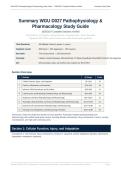
WGU D027 Pathophysiology & Pharmacology Study Guide — 2026/2027 Complete Solutions Verified Summary Study Guide
Summary WGU D027 Pathophysiology &
Pharmacology Study Guide
2026/2027 Complete Solutions Verified
180 Questions • 8 Competency-Aligned Sections • Integrated Patho + Pharm Rationales
Aligned with WGU D027 course structure and current clinical practice guidelines
Total Questions 180 Multiple Choice (4 options, 1 correct)
Cognitive Levels 30% Recall • 50% Application • 20% Analysis
Item Style 75% Scenario-based • 25% Direct Recall
Coverage Cellular, Genetics/Immunity, Infection/Fluids, CV/Heme, Resp/Renal, Neuro/MSK, Endo/GI, Oncology/Pain
Use Self-assessment, study, and verified exam readiness for WGU D027
Section Overview
# Section Q Range Count
1 Cellular Function, Injury, and Adaptation Q1–Q18 18
2 Genetics, Inflammation, and Immunity Q19–Q38 20
3 Infection, Fluid, Electrolytes, and Acid-Base Q39–Q60 22
4 Cardiovascular and Hematologic Pathophysiology and Pharmacology Q61–Q90 30
5 Respiratory and Renal Pathophysiology and Pharmacology Q91–Q114 24
6 Neurologic, Musculoskeletal, and Sensory Pathophysiology and Pharmacology Q115–Q136 22
7 Endocrine and Gastrointestinal Pathophysiology and Pharmacology Q137–Q160 24
8 Oncology, Pain Management, and Pharmacologic Principles Q161–Q180 20
Instructions: Select the single best answer for each question. Rationales integrate pathophysiology and
pharmacology with verified study guide content, including disease mechanisms, drug mechanisms of action, nursing
considerations, and high-yield summary points.
Section 1: Cellular Function, Injury, and Adaptation
Competency 1: Cell structure, injury mechanisms, necrosis vs. apoptosis, cellular adaptations (atrophy, hypertrophy,
hyperplasia, metaplasia, dysplasia).
Aligned with WGU D027 competencies • Integrated pathophysiology + pharmacology • Evidence-based guidelines Page 1
,WGU D027 Pathophysiology & Pharmacology Study Guide — 2026/2027 Complete Solutions Verified Summary Study Guide
Q1: A 65-year-old patient with a long-standing leg fracture develops muscle wasting in the affected limb after
months of disuse. This cellular adaptation is best described as:
A. Hypertrophy (increase in cell size).
B. Atrophy (decrease in cell size due to decreased workload, denervation, or inadequate nutrition).
[CORRECT]
C. Hyperplasia (increase in cell number).
D. Metaplasia (reversible replacement of one cell type by another).
Correct Answer: B
Rationale: Atrophy is the decrease in cell size due to decreased workload (disuse), denervation, diminished blood supply, or
inadequate nutrition. In this case, prolonged disuse of the fractured limb led to muscle atrophy. Hypertrophy is an increase in
cell size (e.g., cardiac muscle in hypertension); hyperplasia is an increase in cell number (e.g., endometrial proliferation);
metaplasia is reversible replacement of one adult cell type by another (e.g., Barrett esophagus). Study tip: 'A'trophy = 'A'trophy
shrinks; hyper-trophy/troplasia = grows.
Q2: A patient with chronic hypertension develops an enlarged left ventricle. The cardiomyocytes increase in
size but not in number. This adaptation is:
A. Hyperplasia, because the heart muscle grows.
B. Hypertrophy, an increase in cell size in response to increased workload. [CORRECT]
C. Metaplasia, because one cell type replaces another.
D. Dysplasia, because cells appear abnormal.
Correct Answer: B
Rationale: Hypertrophy is an increase in cell size (not number) in response to increased workload or hormonal stimulation;
cardiac and skeletal muscle cells (which cannot divide) respond by hypertrophy. Hyperplasia is an increase in cell number
(occurs in cells capable of division, e.g., endometrium, liver). Metaplasia replaces one cell type with another; dysplasia is
disordered growth. Verified: cardiac muscle hypertrophy is the classic response to chronic pressure overload (afterload) in
hypertension.
Q3: A chronic smoker undergoes bronchoscopy; biopsy shows replacement of normal ciliated columnar
epithelium with stratified squamous epithelium. This adaptation is:
A. Atrophy.
B. Hypertrophy.
C. Metaplasia (reversible replacement of one adult cell type by another, often more resilient to stress).
[CORRECT]
D. Dysplasia.
Correct Answer: C
Rationale: Metaplasia is the reversible replacement of one adult cell type by another; in smokers, ciliated columnar epithelium
of the bronchus is replaced by stratified squamous epithelium, which is more resistant to smoke irritants but loses ciliary
function (increasing infection risk). If irritation persists, metaplasia may progress to dysplasia and neoplasia. Verified:
metaplasia is reversible upon removal of the injurious stimulus (smoking cessation).
Aligned with WGU D027 competencies • Integrated pathophysiology + pharmacology • Evidence-based guidelines Page 2
,WGU D027 Pathophysiology & Pharmacology Study Guide — 2026/2027 Complete Solutions Verified Summary Study Guide
Q4: A Pap smear reveals disordered, atypical cells with increased nuclear-to-cytoplasmic ratio and
pleomorphism, but the basement membrane remains intact. This describes:
A. Metaplasia.
B. Dysplasia (disordered cellular development; may progress to cancer if untreated, but is potentially
reversible). [CORRECT]
C. Anaplasia.
D. Hyperplasia.
Correct Answer: B
Rationale: Dysplasia is abnormal, disordered cellular development with pleomorphism, hyperchromatic nuclei, and increased
mitotic figures, but the basement membrane remains intact (pre-malignant). It may be reversible if the injurious stimulus is
removed. Anaplasia is a feature of malignant cells (loss of differentiation). Metaplasia is reversible replacement of one cell
type by another; hyperplasia is increased cell number. Verified: cervical dysplasia (CIN) detected by Pap smear can progress to
carcinoma in situ if untreated.
Q5: A patient suffers severe ischemia following a myocardial infarction. Cell death with release of
intracellular enzymes (e.g., troponin), inflammation, and surrounding tissue damage occurs. This is:
A. Apoptosis (programmed cell death without inflammation).
B. Necrosis (pathologic cell death with inflammation, enzyme release, and tissue damage). [CORRECT]
C. Atrophy.
D. Metaplasia.
Correct Answer: B
Rationale: Necrosis is pathologic cell death characterized by membrane rupture, enzyme release (e.g., troponin in MI),
inflammation, and surrounding tissue damage. Apoptosis is programmed, controlled cell death without inflammation (e.g.,
embryonic development, senescent cell turnover). MI cell death is coagulative necrosis (architecture preserved) except in brain
(liquefactive). Verified: troponin elevation in MI reflects necrotic cardiomyocyte enzyme release.
Q6: A pathologist examines a brain infarct and finds softening and liquefaction of tissue with neutrophil
infiltration. This pattern is:
A. Coagulative necrosis (typical of ischemic injury in most organs except brain).
B. Liquefactive necrosis (typical in brain ischemia and bacterial abscesses). [CORRECT]
C. Caseous necrosis (cheese-like, seen in tuberculosis).
D. Fat necrosis.
Correct Answer: B
Rationale: Liquefactive necrosis occurs when tissue is digested by enzymes (neutrophils in bacterial abscesses, or tissue
enzymes in brain ischemia) producing liquid debris. Brain infarcts undergo liquefactive necrosis because of the brain's high
lipid content and lack of connective tissue framework. Coagulative necrosis preserves tissue architecture (seen in MI, kidney,
spleen infarcts). Caseous necrosis is seen in TB. Fat necrosis occurs in pancreatic enzyme release and breast trauma.
Aligned with WGU D027 competencies • Integrated pathophysiology + pharmacology • Evidence-based guidelines Page 3
, WGU D027 Pathophysiology & Pharmacology Study Guide — 2026/2027 Complete Solutions Verified Summary Study Guide
Q7: Which mechanism of cell injury involves the formation of reactive oxygen species (ROS) that damage
lipids, proteins, and DNA?
A. Hypoxic injury only.
B. Oxidative stress / free radical injury, which can result from ischemia-reperfusion, radiation, inflammation,
and certain toxins. [CORRECT]
C. Chemical injury only.
D. Apoptotic injury only.
Correct Answer: B
Rationale: Free radicals (ROS) cause oxidative stress by damaging lipids (peroxidation), proteins (denaturation), and DNA,
leading to cell injury. Sources include ischemia-reperfusion, radiation, inflammation, and toxins (e.g., CCl4). Antioxidant
defenses (superoxide dismutase, catalase, glutathione, vitamins C and E) protect cells. Verified: ischemia-reperfusion injury
(e.g., post-MI, post-thrombolysis) generates ROS that paradoxically worsen tissue damage.
Q8: A patient develops edema following an ischemic event. The intracellular accumulation of sodium and
water that causes cellular swelling is most directly caused by:
A. Increased ATP production.
B. Failure of the Na+/K+-ATPase pump due to ATP depletion, allowing sodium and water to enter the cell.
[CORRECT]
C. Decreased intracellular calcium.
D. Activation of apoptosis.
Correct Answer: B
Rationale: Hypoxia reduces ATP production by oxidative phosphorylation; the Na+/K+-ATPase pump fails, Na+ accumulates
intracellularly, and water follows osmotically, producing cellular swelling (reversible injury). Continued ischemia causes
intracellular Ca2+ accumulation, activating enzymes (proteases, phospholipases, endonucleases) that mediate irreversible
injury and death. Verified: cellular swelling is a hallmark of reversible hypoxic injury; membrane rupture marks irreversible
injury.
Q9: Which cellular organelle is the 'powerhouse' of the cell and produces ATP through oxidative
phosphorylation, making it especially vulnerable to hypoxic injury?
A. Endoplasmic reticulum.
B. Golgi apparatus.
C. Mitochondria. [CORRECT]
D. Lysosomes.
Correct Answer: C
Rationale: Mitochondria generate ATP via oxidative phosphorylation. Hypoxia disrupts the electron transport chain, reducing
ATP synthesis and producing ROS, opening the mitochondrial permeability transition pore (MPTP), releasing cytochrome c
(triggering apoptosis), and causing cell death. Verified: mitochondria are central to both necrotic (ATP depletion) and
apoptotic (cytochrome c release) cell death pathways.
Aligned with WGU D027 competencies • Integrated pathophysiology + pharmacology • Evidence-based guidelines Page 4
Summary WGU D027 Pathophysiology &
Pharmacology Study Guide
2026/2027 Complete Solutions Verified
180 Questions • 8 Competency-Aligned Sections • Integrated Patho + Pharm Rationales
Aligned with WGU D027 course structure and current clinical practice guidelines
Total Questions 180 Multiple Choice (4 options, 1 correct)
Cognitive Levels 30% Recall • 50% Application • 20% Analysis
Item Style 75% Scenario-based • 25% Direct Recall
Coverage Cellular, Genetics/Immunity, Infection/Fluids, CV/Heme, Resp/Renal, Neuro/MSK, Endo/GI, Oncology/Pain
Use Self-assessment, study, and verified exam readiness for WGU D027
Section Overview
# Section Q Range Count
1 Cellular Function, Injury, and Adaptation Q1–Q18 18
2 Genetics, Inflammation, and Immunity Q19–Q38 20
3 Infection, Fluid, Electrolytes, and Acid-Base Q39–Q60 22
4 Cardiovascular and Hematologic Pathophysiology and Pharmacology Q61–Q90 30
5 Respiratory and Renal Pathophysiology and Pharmacology Q91–Q114 24
6 Neurologic, Musculoskeletal, and Sensory Pathophysiology and Pharmacology Q115–Q136 22
7 Endocrine and Gastrointestinal Pathophysiology and Pharmacology Q137–Q160 24
8 Oncology, Pain Management, and Pharmacologic Principles Q161–Q180 20
Instructions: Select the single best answer for each question. Rationales integrate pathophysiology and
pharmacology with verified study guide content, including disease mechanisms, drug mechanisms of action, nursing
considerations, and high-yield summary points.
Section 1: Cellular Function, Injury, and Adaptation
Competency 1: Cell structure, injury mechanisms, necrosis vs. apoptosis, cellular adaptations (atrophy, hypertrophy,
hyperplasia, metaplasia, dysplasia).
Aligned with WGU D027 competencies • Integrated pathophysiology + pharmacology • Evidence-based guidelines Page 1
,WGU D027 Pathophysiology & Pharmacology Study Guide — 2026/2027 Complete Solutions Verified Summary Study Guide
Q1: A 65-year-old patient with a long-standing leg fracture develops muscle wasting in the affected limb after
months of disuse. This cellular adaptation is best described as:
A. Hypertrophy (increase in cell size).
B. Atrophy (decrease in cell size due to decreased workload, denervation, or inadequate nutrition).
[CORRECT]
C. Hyperplasia (increase in cell number).
D. Metaplasia (reversible replacement of one cell type by another).
Correct Answer: B
Rationale: Atrophy is the decrease in cell size due to decreased workload (disuse), denervation, diminished blood supply, or
inadequate nutrition. In this case, prolonged disuse of the fractured limb led to muscle atrophy. Hypertrophy is an increase in
cell size (e.g., cardiac muscle in hypertension); hyperplasia is an increase in cell number (e.g., endometrial proliferation);
metaplasia is reversible replacement of one adult cell type by another (e.g., Barrett esophagus). Study tip: 'A'trophy = 'A'trophy
shrinks; hyper-trophy/troplasia = grows.
Q2: A patient with chronic hypertension develops an enlarged left ventricle. The cardiomyocytes increase in
size but not in number. This adaptation is:
A. Hyperplasia, because the heart muscle grows.
B. Hypertrophy, an increase in cell size in response to increased workload. [CORRECT]
C. Metaplasia, because one cell type replaces another.
D. Dysplasia, because cells appear abnormal.
Correct Answer: B
Rationale: Hypertrophy is an increase in cell size (not number) in response to increased workload or hormonal stimulation;
cardiac and skeletal muscle cells (which cannot divide) respond by hypertrophy. Hyperplasia is an increase in cell number
(occurs in cells capable of division, e.g., endometrium, liver). Metaplasia replaces one cell type with another; dysplasia is
disordered growth. Verified: cardiac muscle hypertrophy is the classic response to chronic pressure overload (afterload) in
hypertension.
Q3: A chronic smoker undergoes bronchoscopy; biopsy shows replacement of normal ciliated columnar
epithelium with stratified squamous epithelium. This adaptation is:
A. Atrophy.
B. Hypertrophy.
C. Metaplasia (reversible replacement of one adult cell type by another, often more resilient to stress).
[CORRECT]
D. Dysplasia.
Correct Answer: C
Rationale: Metaplasia is the reversible replacement of one adult cell type by another; in smokers, ciliated columnar epithelium
of the bronchus is replaced by stratified squamous epithelium, which is more resistant to smoke irritants but loses ciliary
function (increasing infection risk). If irritation persists, metaplasia may progress to dysplasia and neoplasia. Verified:
metaplasia is reversible upon removal of the injurious stimulus (smoking cessation).
Aligned with WGU D027 competencies • Integrated pathophysiology + pharmacology • Evidence-based guidelines Page 2
,WGU D027 Pathophysiology & Pharmacology Study Guide — 2026/2027 Complete Solutions Verified Summary Study Guide
Q4: A Pap smear reveals disordered, atypical cells with increased nuclear-to-cytoplasmic ratio and
pleomorphism, but the basement membrane remains intact. This describes:
A. Metaplasia.
B. Dysplasia (disordered cellular development; may progress to cancer if untreated, but is potentially
reversible). [CORRECT]
C. Anaplasia.
D. Hyperplasia.
Correct Answer: B
Rationale: Dysplasia is abnormal, disordered cellular development with pleomorphism, hyperchromatic nuclei, and increased
mitotic figures, but the basement membrane remains intact (pre-malignant). It may be reversible if the injurious stimulus is
removed. Anaplasia is a feature of malignant cells (loss of differentiation). Metaplasia is reversible replacement of one cell
type by another; hyperplasia is increased cell number. Verified: cervical dysplasia (CIN) detected by Pap smear can progress to
carcinoma in situ if untreated.
Q5: A patient suffers severe ischemia following a myocardial infarction. Cell death with release of
intracellular enzymes (e.g., troponin), inflammation, and surrounding tissue damage occurs. This is:
A. Apoptosis (programmed cell death without inflammation).
B. Necrosis (pathologic cell death with inflammation, enzyme release, and tissue damage). [CORRECT]
C. Atrophy.
D. Metaplasia.
Correct Answer: B
Rationale: Necrosis is pathologic cell death characterized by membrane rupture, enzyme release (e.g., troponin in MI),
inflammation, and surrounding tissue damage. Apoptosis is programmed, controlled cell death without inflammation (e.g.,
embryonic development, senescent cell turnover). MI cell death is coagulative necrosis (architecture preserved) except in brain
(liquefactive). Verified: troponin elevation in MI reflects necrotic cardiomyocyte enzyme release.
Q6: A pathologist examines a brain infarct and finds softening and liquefaction of tissue with neutrophil
infiltration. This pattern is:
A. Coagulative necrosis (typical of ischemic injury in most organs except brain).
B. Liquefactive necrosis (typical in brain ischemia and bacterial abscesses). [CORRECT]
C. Caseous necrosis (cheese-like, seen in tuberculosis).
D. Fat necrosis.
Correct Answer: B
Rationale: Liquefactive necrosis occurs when tissue is digested by enzymes (neutrophils in bacterial abscesses, or tissue
enzymes in brain ischemia) producing liquid debris. Brain infarcts undergo liquefactive necrosis because of the brain's high
lipid content and lack of connective tissue framework. Coagulative necrosis preserves tissue architecture (seen in MI, kidney,
spleen infarcts). Caseous necrosis is seen in TB. Fat necrosis occurs in pancreatic enzyme release and breast trauma.
Aligned with WGU D027 competencies • Integrated pathophysiology + pharmacology • Evidence-based guidelines Page 3
, WGU D027 Pathophysiology & Pharmacology Study Guide — 2026/2027 Complete Solutions Verified Summary Study Guide
Q7: Which mechanism of cell injury involves the formation of reactive oxygen species (ROS) that damage
lipids, proteins, and DNA?
A. Hypoxic injury only.
B. Oxidative stress / free radical injury, which can result from ischemia-reperfusion, radiation, inflammation,
and certain toxins. [CORRECT]
C. Chemical injury only.
D. Apoptotic injury only.
Correct Answer: B
Rationale: Free radicals (ROS) cause oxidative stress by damaging lipids (peroxidation), proteins (denaturation), and DNA,
leading to cell injury. Sources include ischemia-reperfusion, radiation, inflammation, and toxins (e.g., CCl4). Antioxidant
defenses (superoxide dismutase, catalase, glutathione, vitamins C and E) protect cells. Verified: ischemia-reperfusion injury
(e.g., post-MI, post-thrombolysis) generates ROS that paradoxically worsen tissue damage.
Q8: A patient develops edema following an ischemic event. The intracellular accumulation of sodium and
water that causes cellular swelling is most directly caused by:
A. Increased ATP production.
B. Failure of the Na+/K+-ATPase pump due to ATP depletion, allowing sodium and water to enter the cell.
[CORRECT]
C. Decreased intracellular calcium.
D. Activation of apoptosis.
Correct Answer: B
Rationale: Hypoxia reduces ATP production by oxidative phosphorylation; the Na+/K+-ATPase pump fails, Na+ accumulates
intracellularly, and water follows osmotically, producing cellular swelling (reversible injury). Continued ischemia causes
intracellular Ca2+ accumulation, activating enzymes (proteases, phospholipases, endonucleases) that mediate irreversible
injury and death. Verified: cellular swelling is a hallmark of reversible hypoxic injury; membrane rupture marks irreversible
injury.
Q9: Which cellular organelle is the 'powerhouse' of the cell and produces ATP through oxidative
phosphorylation, making it especially vulnerable to hypoxic injury?
A. Endoplasmic reticulum.
B. Golgi apparatus.
C. Mitochondria. [CORRECT]
D. Lysosomes.
Correct Answer: C
Rationale: Mitochondria generate ATP via oxidative phosphorylation. Hypoxia disrupts the electron transport chain, reducing
ATP synthesis and producing ROS, opening the mitochondrial permeability transition pore (MPTP), releasing cytochrome c
(triggering apoptosis), and causing cell death. Verified: mitochondria are central to both necrotic (ATP depletion) and
apoptotic (cytochrome c release) cell death pathways.
Aligned with WGU D027 competencies • Integrated pathophysiology + pharmacology • Evidence-based guidelines Page 4


