
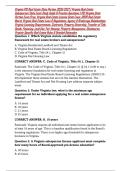
Virginia PSI Real Estate State Portion 2026/2027 | Virginia Real Estate
Salesperson State Exam Study Guide & Practice Questions | PSI Virginia State
Portion Exam Prep, Virginia Real Estate License State Exam, DPOR Real Estate
Board, Virginia Real Estate Laws & Regulations, Agency & Brokerage Relationships,
Virginia Licensing Requirements, Contracts, Property Ownership, Transfer of Title,
Deeds, Financing, Land Use, Fair Housing, Property Management, Disclosures,
Virginia-Specific Real Estate Rules & Detailed Rationales
Question 1: Which Virginia statute establishes the regulatory
framework for real estate brokers and salespersons?
A. Virginia Residential Landlord and Tenant Act
B. Virginia Real Estate Board Licensing Regulations
C. Code of Virginia, Title 54.1, Chapter 21
D. Virginia Fair Housing Law
CORRECT ANSWER: C. Code of Virginia, Title 54.1, Chapter 21
Rationale: The Code of Virginia, Title 54.1, Chapter 21 (§ 54.1-2100 et seq.)
is the statutory foundation for real estate licensing and regulation in
Virginia. The Virginia Real Estate Board Licensing Regulations (18VAC135-
20) implement those statutes but are not the statutes themselves. The
Landlord and Tenant Act and Fair Housing Law address separate subject
areas.
Question 2: Under Virginia law, what is the minimum age
requirement for an individual applying for a real estate salesperson
license?
A. 16 years
B. 18 years
C. 21 years
D. 25 years
CORRECT ANSWER: B. 18 years
Rationale: Virginia requires all individual real estate license applicants to be
at least 18 years of age. This is a baseline qualification found in the Board's
licensing regulations. There is no higher age threshold for salesperson
licensure in Virginia.
Question 3: A Virginia salesperson license applicant must complete
how many hours of Board-approved pre-license education?
A. 30 hours
B. 45 hours
,C. 60 hours
D. 90 hours
CORRECT ANSWER: C. 60 hours
Rationale: Virginia requires 60 class/clock hours of a Board-approved
Principles of Real Estate pre-license course for salesperson licensure. This
is a strict statutory and regulatory requirement. Broker applicants must
complete 180 hours.
Question 4: In Virginia, who is legally authorized to prepare deeds
and other settlement documents for real estate closings?
A. Licensed real estate brokers
B. Licensed real estate salespersons
C. Licensed Virginia attorneys
D. Certified settlement agents
CORRECT ANSWER: C. Licensed Virginia attorneys
Rationale: Virginia follows the attorney-state model for real estate
settlements. Only licensed Virginia attorneys may prepare deeds and
conduct settlements. Real estate licensees may facilitate the transaction but
cannot perform the legal function of settlement.
Question 5: What is the recordation tax rate in Virginia for a
standard real estate deed?
A. $0.10 per $100 of consideration
B. $0.25 per $100 of consideration
C. $0.50 per $500 of consideration
D. $1.00 per $1,000 of consideration
CORRECT ANSWER: B. $0.25 per $100 of consideration
Rationale: Virginia imposes a recordation tax of $0.25 per $100 of the
consideration for deeds. This is distinct from the grantor's tax, which is
$0.50 per $500. Licensees must understand both taxes for settlement
purposes.
Question 6: What is the Virginia grantor's tax rate for a standard
real estate transfer?
A. $0.10 per $100
B. $0.25 per $100
,C. $0.50 per $500
D. $1.00 per $500
CORRECT ANSWER: C. $0.50 per $500
Rationale: The Virginia grantor's tax is imposed at a rate of $0.50 per $500
of the property's sale price. This tax is typically paid by the seller. It is
separate from the recordation tax paid by the buyer.
Question 7: Under Virginia's Residential Property Disclosure Act,
what must a seller provide to a prospective purchaser?
A. A warranty that the property is free from all defects
B. A disclosure statement listing known material defects
C. A completed home inspection report
D. A structural engineering certification
CORRECT ANSWER: B. A disclosure statement listing known
material defects
Rationale: Virginia requires sellers of residential property to provide a
disclosure statement informing buyers of known material defects. The
disclosure is not a warranty and does not obligate the seller to inspect the
property.
Question 8: Virginia's Residential Property Disclosure Act applies
to which type of property?
A. Commercial office buildings
B. Industrial warehouses
C. Residential dwellings with one to four units
D. Vacant agricultural land
CORRECT ANSWER: C. Residential dwellings with one to four units
Rationale: The Residential Property Disclosure Act specifically covers
residential properties containing one to four dwelling units. Commercial
and industrial properties are not covered, and certain other exemptions
exist for specific transfer types.
Question 9: What is the primary purpose of Virginia's Residential
Property Disclosure Statement?
A. To guarantee the property's condition to the buyer
B. To inform buyers of known material defects
, C. To satisfy lender underwriting requirements
D. To establish the property's market value
CORRECT ANSWER: B. To inform buyers of known material defects
Rationale: The disclosure statement ensures buyers are aware of known
material defects before purchasing. It is an information tool, not a guarantee
or warranty. It also does not establish value or replace lender requirements.
Question 10: Under Virginia agency law, what is a "standard
agent"?
A. An agent who represents both buyer and seller
B. An agent who represents only the seller
C. A licensee who acts for or represents a client in an agency relationship
D. An agent who works without a brokerage affiliation
CORRECT ANSWER: C. A licensee who acts for or represents a
client in an agency relationship
Rationale: Virginia regulations define "standard agent" as a licensee who
acts for or represents a client in an agency relationship. The standard agent
owes statutory duties to the client. The term is not limited to seller
representation.
Question 11: In Virginia, when must a licensee disclose brokerage
relationships to a prospective client?
A. Only at the time of contract ratification
B. At the earliest practical time, before the client discloses confidential
information
C. Within 30 days of first contact
D. Only when requested by the client
CORRECT ANSWER: B. At the earliest practical time, before the
client discloses confidential information
Rationale: Virginia requires disclosure of brokerage relationships at the
earliest practical time so the client can make informed decisions about
what information to share. Waiting until contract ratification defeats the
protective purpose of the disclosure requirement.
Salesperson State Exam Study Guide & Practice Questions | PSI Virginia State
Portion Exam Prep, Virginia Real Estate License State Exam, DPOR Real Estate
Board, Virginia Real Estate Laws & Regulations, Agency & Brokerage Relationships,
Virginia Licensing Requirements, Contracts, Property Ownership, Transfer of Title,
Deeds, Financing, Land Use, Fair Housing, Property Management, Disclosures,
Virginia-Specific Real Estate Rules & Detailed Rationales
Question 1: Which Virginia statute establishes the regulatory
framework for real estate brokers and salespersons?
A. Virginia Residential Landlord and Tenant Act
B. Virginia Real Estate Board Licensing Regulations
C. Code of Virginia, Title 54.1, Chapter 21
D. Virginia Fair Housing Law
CORRECT ANSWER: C. Code of Virginia, Title 54.1, Chapter 21
Rationale: The Code of Virginia, Title 54.1, Chapter 21 (§ 54.1-2100 et seq.)
is the statutory foundation for real estate licensing and regulation in
Virginia. The Virginia Real Estate Board Licensing Regulations (18VAC135-
20) implement those statutes but are not the statutes themselves. The
Landlord and Tenant Act and Fair Housing Law address separate subject
areas.
Question 2: Under Virginia law, what is the minimum age
requirement for an individual applying for a real estate salesperson
license?
A. 16 years
B. 18 years
C. 21 years
D. 25 years
CORRECT ANSWER: B. 18 years
Rationale: Virginia requires all individual real estate license applicants to be
at least 18 years of age. This is a baseline qualification found in the Board's
licensing regulations. There is no higher age threshold for salesperson
licensure in Virginia.
Question 3: A Virginia salesperson license applicant must complete
how many hours of Board-approved pre-license education?
A. 30 hours
B. 45 hours
,C. 60 hours
D. 90 hours
CORRECT ANSWER: C. 60 hours
Rationale: Virginia requires 60 class/clock hours of a Board-approved
Principles of Real Estate pre-license course for salesperson licensure. This
is a strict statutory and regulatory requirement. Broker applicants must
complete 180 hours.
Question 4: In Virginia, who is legally authorized to prepare deeds
and other settlement documents for real estate closings?
A. Licensed real estate brokers
B. Licensed real estate salespersons
C. Licensed Virginia attorneys
D. Certified settlement agents
CORRECT ANSWER: C. Licensed Virginia attorneys
Rationale: Virginia follows the attorney-state model for real estate
settlements. Only licensed Virginia attorneys may prepare deeds and
conduct settlements. Real estate licensees may facilitate the transaction but
cannot perform the legal function of settlement.
Question 5: What is the recordation tax rate in Virginia for a
standard real estate deed?
A. $0.10 per $100 of consideration
B. $0.25 per $100 of consideration
C. $0.50 per $500 of consideration
D. $1.00 per $1,000 of consideration
CORRECT ANSWER: B. $0.25 per $100 of consideration
Rationale: Virginia imposes a recordation tax of $0.25 per $100 of the
consideration for deeds. This is distinct from the grantor's tax, which is
$0.50 per $500. Licensees must understand both taxes for settlement
purposes.
Question 6: What is the Virginia grantor's tax rate for a standard
real estate transfer?
A. $0.10 per $100
B. $0.25 per $100
,C. $0.50 per $500
D. $1.00 per $500
CORRECT ANSWER: C. $0.50 per $500
Rationale: The Virginia grantor's tax is imposed at a rate of $0.50 per $500
of the property's sale price. This tax is typically paid by the seller. It is
separate from the recordation tax paid by the buyer.
Question 7: Under Virginia's Residential Property Disclosure Act,
what must a seller provide to a prospective purchaser?
A. A warranty that the property is free from all defects
B. A disclosure statement listing known material defects
C. A completed home inspection report
D. A structural engineering certification
CORRECT ANSWER: B. A disclosure statement listing known
material defects
Rationale: Virginia requires sellers of residential property to provide a
disclosure statement informing buyers of known material defects. The
disclosure is not a warranty and does not obligate the seller to inspect the
property.
Question 8: Virginia's Residential Property Disclosure Act applies
to which type of property?
A. Commercial office buildings
B. Industrial warehouses
C. Residential dwellings with one to four units
D. Vacant agricultural land
CORRECT ANSWER: C. Residential dwellings with one to four units
Rationale: The Residential Property Disclosure Act specifically covers
residential properties containing one to four dwelling units. Commercial
and industrial properties are not covered, and certain other exemptions
exist for specific transfer types.
Question 9: What is the primary purpose of Virginia's Residential
Property Disclosure Statement?
A. To guarantee the property's condition to the buyer
B. To inform buyers of known material defects
, C. To satisfy lender underwriting requirements
D. To establish the property's market value
CORRECT ANSWER: B. To inform buyers of known material defects
Rationale: The disclosure statement ensures buyers are aware of known
material defects before purchasing. It is an information tool, not a guarantee
or warranty. It also does not establish value or replace lender requirements.
Question 10: Under Virginia agency law, what is a "standard
agent"?
A. An agent who represents both buyer and seller
B. An agent who represents only the seller
C. A licensee who acts for or represents a client in an agency relationship
D. An agent who works without a brokerage affiliation
CORRECT ANSWER: C. A licensee who acts for or represents a
client in an agency relationship
Rationale: Virginia regulations define "standard agent" as a licensee who
acts for or represents a client in an agency relationship. The standard agent
owes statutory duties to the client. The term is not limited to seller
representation.
Question 11: In Virginia, when must a licensee disclose brokerage
relationships to a prospective client?
A. Only at the time of contract ratification
B. At the earliest practical time, before the client discloses confidential
information
C. Within 30 days of first contact
D. Only when requested by the client
CORRECT ANSWER: B. At the earliest practical time, before the
client discloses confidential information
Rationale: Virginia requires disclosure of brokerage relationships at the
earliest practical time so the client can make informed decisions about
what information to share. Waiting until contract ratification defeats the
protective purpose of the disclosure requirement.


