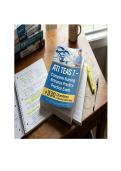
,ATI TEAS 7 — Complete Nursing Entrance
Practice Exam + 330 Questions & Detailed
Rationales
1. A patient education brochure states: "Regular physical activity strengthens the heart muscle,
lowers blood pressure, and improves overall cardiovascular function. Walking briskly for 30
minutes a day can reduce the risk of heart disease by up to 40%." Which sentence best states
the main idea?
A. Walking briskly for 30 minutes a day can reduce heart disease risk by 40%.
B. Regular physical activity strengthens the heart muscle, lowers blood pressure, and improves
overall cardiovascular function.
C. Many people find it helpful to track their steps with a pedometer.
D. Always consult a healthcare provider before beginning a new exercise program.
Correct Answer: B. The main idea is the central claim that the rest of the passage supports.
Choice B captures the overarching benefit of exercise for cardiovascular health, while A is a
supporting detail (statistic), C is tangential, and D is a disclaimer.
Rationale: The main idea encompasses the full scope of the passage. Choice A is too narrow
(only one statistic), Choice C is not mentioned in the passage, and Choice D is a general
disclaimer rather than the central point.
2. Read the following passage: "Nurses must wash their hands before and after every patient
contact. Hand hygiene remains the single most effective measure to prevent healthcare-
,associated infections, yet compliance rates among healthcare workers often fall below 50%."
What is the topic of this passage?
A. Causes of healthcare-associated infections
B. Hand hygiene practices in healthcare settings
C. Reasons nurses fail to wash their hands
D. Statistics on hospital infection rates
Correct Answer: B. The topic is the subject of the passage in a word or short phrase. The
passage is consistently about hand hygiene in healthcare settings.
Rationale: Topic = subject (hand hygiene). Main idea = claim about the subject (hand hygiene is
critical but compliance is low). Choice A is too broad, C is too narrow, and D overweights a single
statistic.
3. A passage describes the steps of wound care: cleansing, applying antibiotic ointment,
covering with a sterile dressing, and changing the dressing daily. According to the passage, what
should be done immediately after cleansing the wound?
A. Cover with a sterile dressing
B. Apply antibiotic ointment
C. Change the dressing
D. Assess for signs of infection
Correct Answer: B. The passage states the sequence: cleansing → applying antibiotic ointment
→ covering with a sterile dressing → changing daily. Antibiotic ointment follows cleansing.
, Rationale: Following directions requires attention to sequence. The passage explicitly lists the
order of steps. Choice A follows ointment application, C is the final step, and D is not mentioned
in the sequence.
4. A nurse reads a research article stating: "Patients who received preoperative education
reported lower anxiety levels and shorter hospital stays compared to those who did not receive
education." Which of the following can be inferred from this statement?
A. Preoperative education causes shorter hospital stays.
B. Preoperative education is associated with lower anxiety and shorter stays.
C. All patients who receive education will have shorter stays.
D. Anxiety is the only factor affecting hospital stay length.
Correct Answer: B. The statement describes an association (correlation), not causation. Choice B
correctly uses "associated with" rather than claiming causation.
Rationale: "Reported lower" and "shorter" indicate correlation. Choice A claims causation (not
supported), C is an overgeneralization, and D is not stated.
5. A passage about diabetes management states: "Monitoring blood glucose levels is essential
for preventing complications. Patients should check their levels before meals and at bedtime.
However, many patients find it difficult to maintain this schedule due to work and family
obligations." What is the author's purpose?
Practice Exam + 330 Questions & Detailed
Rationales
1. A patient education brochure states: "Regular physical activity strengthens the heart muscle,
lowers blood pressure, and improves overall cardiovascular function. Walking briskly for 30
minutes a day can reduce the risk of heart disease by up to 40%." Which sentence best states
the main idea?
A. Walking briskly for 30 minutes a day can reduce heart disease risk by 40%.
B. Regular physical activity strengthens the heart muscle, lowers blood pressure, and improves
overall cardiovascular function.
C. Many people find it helpful to track their steps with a pedometer.
D. Always consult a healthcare provider before beginning a new exercise program.
Correct Answer: B. The main idea is the central claim that the rest of the passage supports.
Choice B captures the overarching benefit of exercise for cardiovascular health, while A is a
supporting detail (statistic), C is tangential, and D is a disclaimer.
Rationale: The main idea encompasses the full scope of the passage. Choice A is too narrow
(only one statistic), Choice C is not mentioned in the passage, and Choice D is a general
disclaimer rather than the central point.
2. Read the following passage: "Nurses must wash their hands before and after every patient
contact. Hand hygiene remains the single most effective measure to prevent healthcare-
,associated infections, yet compliance rates among healthcare workers often fall below 50%."
What is the topic of this passage?
A. Causes of healthcare-associated infections
B. Hand hygiene practices in healthcare settings
C. Reasons nurses fail to wash their hands
D. Statistics on hospital infection rates
Correct Answer: B. The topic is the subject of the passage in a word or short phrase. The
passage is consistently about hand hygiene in healthcare settings.
Rationale: Topic = subject (hand hygiene). Main idea = claim about the subject (hand hygiene is
critical but compliance is low). Choice A is too broad, C is too narrow, and D overweights a single
statistic.
3. A passage describes the steps of wound care: cleansing, applying antibiotic ointment,
covering with a sterile dressing, and changing the dressing daily. According to the passage, what
should be done immediately after cleansing the wound?
A. Cover with a sterile dressing
B. Apply antibiotic ointment
C. Change the dressing
D. Assess for signs of infection
Correct Answer: B. The passage states the sequence: cleansing → applying antibiotic ointment
→ covering with a sterile dressing → changing daily. Antibiotic ointment follows cleansing.
, Rationale: Following directions requires attention to sequence. The passage explicitly lists the
order of steps. Choice A follows ointment application, C is the final step, and D is not mentioned
in the sequence.
4. A nurse reads a research article stating: "Patients who received preoperative education
reported lower anxiety levels and shorter hospital stays compared to those who did not receive
education." Which of the following can be inferred from this statement?
A. Preoperative education causes shorter hospital stays.
B. Preoperative education is associated with lower anxiety and shorter stays.
C. All patients who receive education will have shorter stays.
D. Anxiety is the only factor affecting hospital stay length.
Correct Answer: B. The statement describes an association (correlation), not causation. Choice B
correctly uses "associated with" rather than claiming causation.
Rationale: "Reported lower" and "shorter" indicate correlation. Choice A claims causation (not
supported), C is an overgeneralization, and D is not stated.
5. A passage about diabetes management states: "Monitoring blood glucose levels is essential
for preventing complications. Patients should check their levels before meals and at bedtime.
However, many patients find it difficult to maintain this schedule due to work and family
obligations." What is the author's purpose?