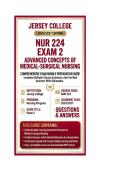
,NUR 224 Exam 2 Advanced Concepts of Medical-Surgical Nursing
Questions And Answers 2026/2027 Jersey College
Q1. A patient wearing a newly applied lower-leg cast reports
increasing numbness in the toes. Which additional finding requires
the most immediate action?
A) Mild swelling around the injury
B) Bruising near the fracture site
C) Pain rated 4/10 with movement
D) Pale cool toes with markedly diminished distal pulses
Correct Answer: D) Pale cool toes with markedly diminished distal pulses
Rationale: Pallor, coolness, sensory changes, and diminished pulses suggest
significant neurovascular compromise and require urgent evaluation.
Q2. Which finding is particularly concerning for evolving acute
compartment syndrome after a tibial fracture?
A) Mild bruising around the fracture
B) Expected swelling during the first several hours
C) Pain that improves with elevation
D) Severe pain with passive stretching that is disproportionate to the
apparent injury
Correct Answer: D) Severe pain with passive stretching that is
disproportionate to the apparent injury
Rationale: Disproportionate pain, especially with passive muscle stretch, is
an important early manifestation of rising compartment pressure and tissue
ischemia.
Q3. Which diagnostic test is most commonly used to measure bone
mineral density when evaluating osteoporosis?
A) Dual-energy x-ray absorptiometry
B) Arthrocentesis
C) Electromyography
D) Bone marrow biopsy
Correct Answer: A) Dual-energy x-ray absorptiometry
Rationale: Dual-energy x-ray absorptiometry measures bone mineral
density and is widely used to diagnose osteoporosis and estimate fracture
risk.
,Q4. Which symptom pattern is most characteristic of osteoarthritis?
A) Prolonged systemic fever with joint pain
B) Symmetrical inflammatory small-joint disease with prolonged morning
stiffness
C) Migratory arthritis associated with a rash
D) Joint pain that commonly worsens with use and improves with rest
Correct Answer: D) Joint pain that commonly worsens with use and improves
with rest
Rationale: Osteoarthritis is a degenerative joint disorder that commonly
causes activity-related pain and relatively brief stiffness after inactivity.
Q5. Which instruction is important for a patient prescribed an oral
bisphosphonate for osteoporosis?
A) Take the medication at bedtime with milk
B) Chew the tablet after meals
C) Take it with plain water and remain upright for the prescribed period
afterward
D) Take it together with calcium supplements to increase absorption
Correct Answer: C) Take it with plain water and remain upright for the
prescribed period afterward
Rationale: Oral bisphosphonates can irritate the esophagus. Appropriate
administration improves absorption and reduces esophageal injury.
Q6. Which diagnostic procedure provides the most definitive
identification of the causative organism in suspected osteomyelitis?
A) Serum calcium measurement
B) Plain radiography alone
C) Bone biopsy with culture
D) Urinalysis
Correct Answer: C) Bone biopsy with culture
Rationale: Bone biopsy allows direct microbiologic identification of the
infecting organism and can guide targeted antimicrobial therapy.
Q7. Which presentation is most characteristic of rheumatoid
arthritis?
, A) Isolated mechanical knee pain after activity
B) Pain affecting only weight-bearing joints
C) Brief stiffness lasting several minutes after rest
D) Symmetrical inflammatory joint pain with prolonged morning stiffness
Correct Answer: D) Symmetrical inflammatory joint pain with prolonged
morning stiffness
Rationale: Rheumatoid arthritis is a systemic inflammatory disease that
commonly affects joints symmetrically and causes prolonged morning
stiffness.
Q8. A patient develops an acutely swollen, hot, extremely painful
knee accompanied by fever. Which diagnostic action is most
important when septic arthritis is suspected?
A) Begin vigorous range-of-motion exercises
B) Apply continuous heat before assessment
C) Obtain synovial fluid for analysis and culture as prescribed
D) Delay evaluation until swelling decreases
Correct Answer: C) Obtain synovial fluid for analysis and culture as
prescribed
Rationale: Septic arthritis can rapidly destroy joint structures. Synovial-fluid
analysis helps identify infection and guide antimicrobial treatment.
Q9. Which finding in a patient with severe low-back pain requires
urgent evaluation for possible cauda equina syndrome?
A) Pain after prolonged standing
B) Muscle soreness following exercise
C) Saddle anesthesia accompanied by new bladder dysfunction
D) Pain relieved by lying down
Correct Answer: C) Saddle anesthesia accompanied by new bladder
dysfunction
Rationale: Saddle sensory loss and new bowel or bladder dysfunction can
indicate compression of the cauda equina and require emergency evaluation.
Q10. Which movement should generally be avoided after a
posterior-approach total hip arthroplasty until restrictions are
lifted?
Questions And Answers 2026/2027 Jersey College
Q1. A patient wearing a newly applied lower-leg cast reports
increasing numbness in the toes. Which additional finding requires
the most immediate action?
A) Mild swelling around the injury
B) Bruising near the fracture site
C) Pain rated 4/10 with movement
D) Pale cool toes with markedly diminished distal pulses
Correct Answer: D) Pale cool toes with markedly diminished distal pulses
Rationale: Pallor, coolness, sensory changes, and diminished pulses suggest
significant neurovascular compromise and require urgent evaluation.
Q2. Which finding is particularly concerning for evolving acute
compartment syndrome after a tibial fracture?
A) Mild bruising around the fracture
B) Expected swelling during the first several hours
C) Pain that improves with elevation
D) Severe pain with passive stretching that is disproportionate to the
apparent injury
Correct Answer: D) Severe pain with passive stretching that is
disproportionate to the apparent injury
Rationale: Disproportionate pain, especially with passive muscle stretch, is
an important early manifestation of rising compartment pressure and tissue
ischemia.
Q3. Which diagnostic test is most commonly used to measure bone
mineral density when evaluating osteoporosis?
A) Dual-energy x-ray absorptiometry
B) Arthrocentesis
C) Electromyography
D) Bone marrow biopsy
Correct Answer: A) Dual-energy x-ray absorptiometry
Rationale: Dual-energy x-ray absorptiometry measures bone mineral
density and is widely used to diagnose osteoporosis and estimate fracture
risk.
,Q4. Which symptom pattern is most characteristic of osteoarthritis?
A) Prolonged systemic fever with joint pain
B) Symmetrical inflammatory small-joint disease with prolonged morning
stiffness
C) Migratory arthritis associated with a rash
D) Joint pain that commonly worsens with use and improves with rest
Correct Answer: D) Joint pain that commonly worsens with use and improves
with rest
Rationale: Osteoarthritis is a degenerative joint disorder that commonly
causes activity-related pain and relatively brief stiffness after inactivity.
Q5. Which instruction is important for a patient prescribed an oral
bisphosphonate for osteoporosis?
A) Take the medication at bedtime with milk
B) Chew the tablet after meals
C) Take it with plain water and remain upright for the prescribed period
afterward
D) Take it together with calcium supplements to increase absorption
Correct Answer: C) Take it with plain water and remain upright for the
prescribed period afterward
Rationale: Oral bisphosphonates can irritate the esophagus. Appropriate
administration improves absorption and reduces esophageal injury.
Q6. Which diagnostic procedure provides the most definitive
identification of the causative organism in suspected osteomyelitis?
A) Serum calcium measurement
B) Plain radiography alone
C) Bone biopsy with culture
D) Urinalysis
Correct Answer: C) Bone biopsy with culture
Rationale: Bone biopsy allows direct microbiologic identification of the
infecting organism and can guide targeted antimicrobial therapy.
Q7. Which presentation is most characteristic of rheumatoid
arthritis?
, A) Isolated mechanical knee pain after activity
B) Pain affecting only weight-bearing joints
C) Brief stiffness lasting several minutes after rest
D) Symmetrical inflammatory joint pain with prolonged morning stiffness
Correct Answer: D) Symmetrical inflammatory joint pain with prolonged
morning stiffness
Rationale: Rheumatoid arthritis is a systemic inflammatory disease that
commonly affects joints symmetrically and causes prolonged morning
stiffness.
Q8. A patient develops an acutely swollen, hot, extremely painful
knee accompanied by fever. Which diagnostic action is most
important when septic arthritis is suspected?
A) Begin vigorous range-of-motion exercises
B) Apply continuous heat before assessment
C) Obtain synovial fluid for analysis and culture as prescribed
D) Delay evaluation until swelling decreases
Correct Answer: C) Obtain synovial fluid for analysis and culture as
prescribed
Rationale: Septic arthritis can rapidly destroy joint structures. Synovial-fluid
analysis helps identify infection and guide antimicrobial treatment.
Q9. Which finding in a patient with severe low-back pain requires
urgent evaluation for possible cauda equina syndrome?
A) Pain after prolonged standing
B) Muscle soreness following exercise
C) Saddle anesthesia accompanied by new bladder dysfunction
D) Pain relieved by lying down
Correct Answer: C) Saddle anesthesia accompanied by new bladder
dysfunction
Rationale: Saddle sensory loss and new bowel or bladder dysfunction can
indicate compression of the cauda equina and require emergency evaluation.
Q10. Which movement should generally be avoided after a
posterior-approach total hip arthroplasty until restrictions are
lifted?