
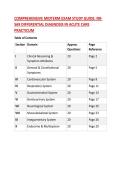
COMPREHENSIVE MIDTERM EXAM STUDY GUIDE: NR-
569 DIFFERENTIAL DIAGNOSIS IN ACUTE CARE
PRACTICUM
Table of Contents
Section Domain Approx. Page
Questions Reference
I Clinical Reasoning & 20 Page 2
Symptom Attributes
II General & Constitutional 20 Page 5
Symptoms
III Cardiovascular System 20 Page 8
IV Respiratory System 20 Page 11
V Gastrointestinal System 20 Page 14
VI Genitourinary System 20 Page 17
VII Neurological System 20 Page 20
VIII Musculoskeletal System 20 Page 23
IX Integumentary System 20 Page 26
X Endocrine & Multisystem 20 Page 29
,Section I: Clinical Reasoning & Symptom Attributes (Questions 1-20)
1. Which attribute of a symptom refers to the specific anatomical area
where the patient feels the sensation?
A. Quality
B. Location
C. Timing
D. Severity
B. Location
Rationale: Location is the anatomical site or spatial distribution of the
symptom.
2. A patient describes their pain as "burning" or "stabbing." Which
attribute of the symptom is the provider assessing?
A. Location
B. Quantity
C. Quality
D. Duration
C. Quality
Rationale: Quality describes the character or nature of the symptom.
3. When assessing the "Timing" of a symptom, which of the following
sub-attributes should the provider evaluate?
A. Onset, Duration, Frequency
B. Severity, Location, Quality
C. Modifying factors, Associated manifestations
D. Quantity, Quality, Location
A. Onset, Duration, Frequency
,Rationale: Timing encompasses when the symptom started (onset),
how long it lasts (duration), and how often it occurs (frequency).
4. A patient reports that their headache is relieved by lying down in a
dark room. This information falls under which symptom attribute?
A. Associated Manifestations
B. Quality
C. Modifying Factors
D. Severity
C. Modifying Factors
Rationale: Modifying factors are the actions, medications, or
environmental changes that alleviate or exacerbate the symptom.
5. A patient presents with nausea and vomiting alongside their severe
headache. The vomiting is considered which attribute of the
headache?
A. Associated Manifestations
B. Quantity
C. Timing
D. Location
A. Associated Manifestations
Rationale: Associated manifestations are other symptoms that occur
concurrently with the primary problem.
6. Which attribute asks the patient to rate their pain on a scale of 0 to
10?
A. Quality
B. Quantity or Severity
C. Timing
D. Modifying Factors
, B. Quantity or Severity
Rationale: Quantity or severity assesses the intensity, volume, or
magnitude of the symptom.
7. The patient states the pain started suddenly 2 hours ago. Which
attribute is being described?
A. Duration
B. Onset
C. Frequency
D. Timing
B. Onset
Rationale: Onset refers to the specific time and manner in which the
symptom began.
8. A patient reports experiencing heart palpitations three times a
week. This describes which timing sub-attribute?
A. Duration
B. Onset
C. Frequency
D. Severity
C. Frequency
Rationale: Frequency describes how often the symptom occurs over a
given period.
9. Which of the following is NOT considered one of the core attributes
of a symptom?
A. Location
B. Quality
C. Insurance Status
D. Modifying Factors
569 DIFFERENTIAL DIAGNOSIS IN ACUTE CARE
PRACTICUM
Table of Contents
Section Domain Approx. Page
Questions Reference
I Clinical Reasoning & 20 Page 2
Symptom Attributes
II General & Constitutional 20 Page 5
Symptoms
III Cardiovascular System 20 Page 8
IV Respiratory System 20 Page 11
V Gastrointestinal System 20 Page 14
VI Genitourinary System 20 Page 17
VII Neurological System 20 Page 20
VIII Musculoskeletal System 20 Page 23
IX Integumentary System 20 Page 26
X Endocrine & Multisystem 20 Page 29
,Section I: Clinical Reasoning & Symptom Attributes (Questions 1-20)
1. Which attribute of a symptom refers to the specific anatomical area
where the patient feels the sensation?
A. Quality
B. Location
C. Timing
D. Severity
B. Location
Rationale: Location is the anatomical site or spatial distribution of the
symptom.
2. A patient describes their pain as "burning" or "stabbing." Which
attribute of the symptom is the provider assessing?
A. Location
B. Quantity
C. Quality
D. Duration
C. Quality
Rationale: Quality describes the character or nature of the symptom.
3. When assessing the "Timing" of a symptom, which of the following
sub-attributes should the provider evaluate?
A. Onset, Duration, Frequency
B. Severity, Location, Quality
C. Modifying factors, Associated manifestations
D. Quantity, Quality, Location
A. Onset, Duration, Frequency
,Rationale: Timing encompasses when the symptom started (onset),
how long it lasts (duration), and how often it occurs (frequency).
4. A patient reports that their headache is relieved by lying down in a
dark room. This information falls under which symptom attribute?
A. Associated Manifestations
B. Quality
C. Modifying Factors
D. Severity
C. Modifying Factors
Rationale: Modifying factors are the actions, medications, or
environmental changes that alleviate or exacerbate the symptom.
5. A patient presents with nausea and vomiting alongside their severe
headache. The vomiting is considered which attribute of the
headache?
A. Associated Manifestations
B. Quantity
C. Timing
D. Location
A. Associated Manifestations
Rationale: Associated manifestations are other symptoms that occur
concurrently with the primary problem.
6. Which attribute asks the patient to rate their pain on a scale of 0 to
10?
A. Quality
B. Quantity or Severity
C. Timing
D. Modifying Factors
, B. Quantity or Severity
Rationale: Quantity or severity assesses the intensity, volume, or
magnitude of the symptom.
7. The patient states the pain started suddenly 2 hours ago. Which
attribute is being described?
A. Duration
B. Onset
C. Frequency
D. Timing
B. Onset
Rationale: Onset refers to the specific time and manner in which the
symptom began.
8. A patient reports experiencing heart palpitations three times a
week. This describes which timing sub-attribute?
A. Duration
B. Onset
C. Frequency
D. Severity
C. Frequency
Rationale: Frequency describes how often the symptom occurs over a
given period.
9. Which of the following is NOT considered one of the core attributes
of a symptom?
A. Location
B. Quality
C. Insurance Status
D. Modifying Factors


