D823 - Product Management and Leadership (PVO1) | OA-Aligned V1 Independent 2026 exam-style preparation set
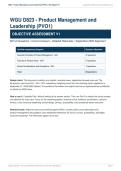
WGU D823 - Product Management and
Leadership (PVO1)
OBJECTIVE ASSESSMENT V1
68 Full Questions • Correct Answers • Detailed Rationales • September 2026 Alignment
Verified competency blueprint Question allocation
Essential Concepts of Product Management - 40% 27 questions
Execute on Product Vision - 40% 27 questions
Ethical Considerations and Compliance - 20% 14 questions
Total 68 questions
Design intent. This document is written as a realistic, scenario-heavy, application-focused exam set. The
68-question count and 40% / 40% / 20% competency weighting come from the coaching report supplied for a
September 21, 2026 D823 attempt. The questions themselves are original and are not represented as confidential
or official live WGU items.
How to use it. Complete Part I without looking at the answer section. Then use Part II to review the correct answer
and rationale for every item. Focus on the reasoning pattern: customer value, evidence, prioritization, outcome
metrics, cross-functional leadership, ethical design, privacy, accessibility, and compliance-aware execution.
Research basis. Alignment was cross-checked against WGU's current public course description and
product-management role guidance, plus established references for Scrum, privacy, accessibility, and digital
consumer protection. Full references appear at the end.
Original questions. Not an official WGU question bank or live exam reproduction. Page 1
,D823 - Product Management and Leadership (PVO1) | OA-Aligned V1 Independent 2026 exam-style preparation set
PART I - EXAM BOOKLET
Select the BEST answer for each question. Some distractors may be partly true; choose the option that most
directly addresses the product-management decision in the scenario.
Format 68 multiple-choice questions
Competency weighting 40% / 40% / 20%
Recommended first pass Answer from product principles before reading the rationale section
Question style Conceptual + scenario-based application
Original questions. Not an official WGU question bank or live exam reproduction. Page 2
,D823 - Product Management and Leadership (PVO1) | OA-Aligned V1 Independent 2026 exam-style preparation set
Competency 1: Explains Essential Concepts of Product
Management
40% of assessment • Questions 1-27
1. A product manager is asked to explain how the role differs from a project manager. Which
statement BEST distinguishes the two roles?
A. A product manager primarily manages team schedules, while a project manager defines customer value.
B. A product manager owns the product's direction and value outcomes, while a project manager is primarily
accountable for coordinating scope, schedule, resources, and delivery execution.
C. A product manager supervises engineers, while a project manager supervises designers and marketers.
D. A product manager is responsible only for launch, while a project manager is responsible only for development.
2. A team has a concise statement describing the future state it wants its product to create for
customers. What product-management artifact is this MOST likely to be?
A. Product vision
B. Sprint backlog
C. Release checklist
D. Defect log
3. A mature software product has stable demand, slowing growth, many competitors, and a strong
installed customer base. Which product-lifecycle stage BEST describes this situation?
A. Maturity
B. Introduction
C. Growth
D. Development
4. Before building a new scheduling feature, a product manager interviews target users to learn how
they currently solve the problem, what causes frustration, and what outcomes matter. What is the
PRIMARY purpose of this activity?
A. Estimate the engineering team's velocity
B. Finalize the launch date
C. Validate the problem and customer need before committing to a solution
D. Determine the product's accounting treatment
Original questions. Not an official WGU question bank or live exam reproduction. Page 3
, D823 - Product Management and Leadership (PVO1) | OA-Aligned V1 Independent 2026 exam-style preparation set
5. A product team creates a detailed description of a representative user segment, including goals,
behaviors, needs, and constraints. Which tool is the team using?
A. Persona
B. Burndown chart
C. Risk register
D. Release train
6. Which statement BEST describes a strong value proposition?
A. A list of all features planned for the next twelve months
B. A technical architecture diagram for the product
C. A statement explaining why a target customer should choose the product by connecting a meaningful need to
differentiated value
D. A summary of internal departmental responsibilities
7. A team wants to test whether customers will use a new workflow while investing the least amount of
effort necessary to obtain meaningful learning. Which concept BEST fits this objective?
A. Minimum viable product (MVP)
B. Full-featured release
C. Technical debt register
D. Service-level agreement
8. Which evidence would MOST strongly suggest that a product is approaching product-market fit?
A. The team has completed every planned feature.
B. Engineering velocity has increased for three consecutive sprints.
C. The marketing budget is larger than last quarter.
D. A growing segment of target customers repeatedly uses the product, gains meaningful value, and would be
disappointed if it disappeared.
9. A product manager uses RICE to compare feature ideas. Which factor is NOT part of the standard
RICE framework?
A. Reach
B. Impact
C. Revenue recognition
D. Confidence
Original questions. Not an official WGU question bank or live exam reproduction. Page 4
WGU D823 - Product Management and
Leadership (PVO1)
OBJECTIVE ASSESSMENT V1
68 Full Questions • Correct Answers • Detailed Rationales • September 2026 Alignment
Verified competency blueprint Question allocation
Essential Concepts of Product Management - 40% 27 questions
Execute on Product Vision - 40% 27 questions
Ethical Considerations and Compliance - 20% 14 questions
Total 68 questions
Design intent. This document is written as a realistic, scenario-heavy, application-focused exam set. The
68-question count and 40% / 40% / 20% competency weighting come from the coaching report supplied for a
September 21, 2026 D823 attempt. The questions themselves are original and are not represented as confidential
or official live WGU items.
How to use it. Complete Part I without looking at the answer section. Then use Part II to review the correct answer
and rationale for every item. Focus on the reasoning pattern: customer value, evidence, prioritization, outcome
metrics, cross-functional leadership, ethical design, privacy, accessibility, and compliance-aware execution.
Research basis. Alignment was cross-checked against WGU's current public course description and
product-management role guidance, plus established references for Scrum, privacy, accessibility, and digital
consumer protection. Full references appear at the end.
Original questions. Not an official WGU question bank or live exam reproduction. Page 1
,D823 - Product Management and Leadership (PVO1) | OA-Aligned V1 Independent 2026 exam-style preparation set
PART I - EXAM BOOKLET
Select the BEST answer for each question. Some distractors may be partly true; choose the option that most
directly addresses the product-management decision in the scenario.
Format 68 multiple-choice questions
Competency weighting 40% / 40% / 20%
Recommended first pass Answer from product principles before reading the rationale section
Question style Conceptual + scenario-based application
Original questions. Not an official WGU question bank or live exam reproduction. Page 2
,D823 - Product Management and Leadership (PVO1) | OA-Aligned V1 Independent 2026 exam-style preparation set
Competency 1: Explains Essential Concepts of Product
Management
40% of assessment • Questions 1-27
1. A product manager is asked to explain how the role differs from a project manager. Which
statement BEST distinguishes the two roles?
A. A product manager primarily manages team schedules, while a project manager defines customer value.
B. A product manager owns the product's direction and value outcomes, while a project manager is primarily
accountable for coordinating scope, schedule, resources, and delivery execution.
C. A product manager supervises engineers, while a project manager supervises designers and marketers.
D. A product manager is responsible only for launch, while a project manager is responsible only for development.
2. A team has a concise statement describing the future state it wants its product to create for
customers. What product-management artifact is this MOST likely to be?
A. Product vision
B. Sprint backlog
C. Release checklist
D. Defect log
3. A mature software product has stable demand, slowing growth, many competitors, and a strong
installed customer base. Which product-lifecycle stage BEST describes this situation?
A. Maturity
B. Introduction
C. Growth
D. Development
4. Before building a new scheduling feature, a product manager interviews target users to learn how
they currently solve the problem, what causes frustration, and what outcomes matter. What is the
PRIMARY purpose of this activity?
A. Estimate the engineering team's velocity
B. Finalize the launch date
C. Validate the problem and customer need before committing to a solution
D. Determine the product's accounting treatment
Original questions. Not an official WGU question bank or live exam reproduction. Page 3
, D823 - Product Management and Leadership (PVO1) | OA-Aligned V1 Independent 2026 exam-style preparation set
5. A product team creates a detailed description of a representative user segment, including goals,
behaviors, needs, and constraints. Which tool is the team using?
A. Persona
B. Burndown chart
C. Risk register
D. Release train
6. Which statement BEST describes a strong value proposition?
A. A list of all features planned for the next twelve months
B. A technical architecture diagram for the product
C. A statement explaining why a target customer should choose the product by connecting a meaningful need to
differentiated value
D. A summary of internal departmental responsibilities
7. A team wants to test whether customers will use a new workflow while investing the least amount of
effort necessary to obtain meaningful learning. Which concept BEST fits this objective?
A. Minimum viable product (MVP)
B. Full-featured release
C. Technical debt register
D. Service-level agreement
8. Which evidence would MOST strongly suggest that a product is approaching product-market fit?
A. The team has completed every planned feature.
B. Engineering velocity has increased for three consecutive sprints.
C. The marketing budget is larger than last quarter.
D. A growing segment of target customers repeatedly uses the product, gains meaningful value, and would be
disappointed if it disappeared.
9. A product manager uses RICE to compare feature ideas. Which factor is NOT part of the standard
RICE framework?
A. Reach
B. Impact
C. Revenue recognition
D. Confidence
Original questions. Not an official WGU question bank or live exam reproduction. Page 4