
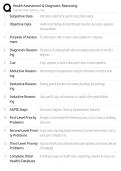
Health Assessment & Diagnostic Reasoning
Study online at https://quizlet.com/_k1akst
1. Subjective Data Information stated by the patient during history taking.
2. Objective Data Health record findings observed through inspection, percussion, palpation,
and auscultation.
3. Purpose of Assess- To collect data in order to make a clinical judgment or diagnosis.
ment
4. Diagnostic Reason- The process of analyzing health data and drawing conclusions to identify a
ing diagnosis.
5. Cue A sign, symptom, or piece of data used to form a clinical hypothesis.
6. Abductive Reason- Determining the best explanation using the information currently at hand.
ing
7. Deductive Reason- Drawing general principles from known physiology and pathology.
ing
8. Inductive Reason- Using specific signs and symptoms as a guide to form generalizations.
ing
9. ADPIE Steps Assessment, Diagnosis, Planning, Implementation, Evaluation.
10. First-Level Priority Emergent and immediate life-threatening issues, such as airway or breathing
Problems obstruction.
11. Second-Level Priori- Urgent issues requiring prompt intervention to prevent deterioration, such as
ty Problems acute pain or infection risk.
12. Third-Level Priority Important health issues addressed after urgent problems are resolved, like lack
Problems of knowledge.
13. Complete (Total A full physical exam and health history establishing a baseline for future care.
Health) Database
1/3
Study online at https://quizlet.com/_k1akst
1. Subjective Data Information stated by the patient during history taking.
2. Objective Data Health record findings observed through inspection, percussion, palpation,
and auscultation.
3. Purpose of Assess- To collect data in order to make a clinical judgment or diagnosis.
ment
4. Diagnostic Reason- The process of analyzing health data and drawing conclusions to identify a
ing diagnosis.
5. Cue A sign, symptom, or piece of data used to form a clinical hypothesis.
6. Abductive Reason- Determining the best explanation using the information currently at hand.
ing
7. Deductive Reason- Drawing general principles from known physiology and pathology.
ing
8. Inductive Reason- Using specific signs and symptoms as a guide to form generalizations.
ing
9. ADPIE Steps Assessment, Diagnosis, Planning, Implementation, Evaluation.
10. First-Level Priority Emergent and immediate life-threatening issues, such as airway or breathing
Problems obstruction.
11. Second-Level Priori- Urgent issues requiring prompt intervention to prevent deterioration, such as
ty Problems acute pain or infection risk.
12. Third-Level Priority Important health issues addressed after urgent problems are resolved, like lack
Problems of knowledge.
13. Complete (Total A full physical exam and health history establishing a baseline for future care.
Health) Database
1/3


