

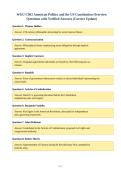
WGU C963 American Politics and the US Constitution Overview
Questions with Verified Answers (Correct Update)
Question 1: Thomas Hobbes
Answer: 17th-century philosopher advocating for social contract theory.
Question 2: Contractarianism
Answer: Philosophical theory emphasizing moral obligations through implicit
agreements.
Question 3: Implicit Contracts
Answer: Unspoken agreements individuals are bound by, like following laws as
citizens.
Question 4: Republic
Answer: Form of government where power resides in elected individuals representing the
citizen body.
Question 5: Articles of Confederation
Answer: Initial U.S. governing document before the Constitution,
emphasizing state sovereignty.
Question 6: Benjamin Franklin
Answer: Key figure in the American Revolution, advocated for independence
and a governing framework.
Question 7: John Dickinson
Answer: Contributed to the Articles of Confederation, proposed civil rights and
congressional authority.
Question 8: Robert Morris
Answer: Superintendent of Finance during the Revolutionary War, attempted to
fund the army.
Page 1
, Question 9: Boston Tea Party
Answer: Protest where colonists dumped tea in Boston Harbor against British
taxation.
Question 10: Continental Congress
Answer: Gathering of colonies to address grievances, eventually leading to
independence.
Question 11: Declaration of Independence
Answer: 1776 document declaring the American colonies'
independence from Britain.
Question 12: George Washington
Answer: Commander of the Continental Army during the American
Revolution.
Question 13: Alexander Hamilton
Answer: Key figure in post-war governance, advocating for a stronger federal
financial system.
Question 14: Legislative Branch
Answer: Branch of government responsible for making laws, includes the U.S.
Congress.
Question 15: Executive Branch
Answer: Branch of government enforcing laws, led by the president and
administrative agencies.
Question 16: Judiciary Branch
Answer: Branch of government interpreting laws, comprised of courts like the
Supreme Court.
Question 17: Checks and Balances
Answer: System ensuring no branch of government becomes too powerful by
limiting each other's powers.
Page 2
Questions with Verified Answers (Correct Update)
Question 1: Thomas Hobbes
Answer: 17th-century philosopher advocating for social contract theory.
Question 2: Contractarianism
Answer: Philosophical theory emphasizing moral obligations through implicit
agreements.
Question 3: Implicit Contracts
Answer: Unspoken agreements individuals are bound by, like following laws as
citizens.
Question 4: Republic
Answer: Form of government where power resides in elected individuals representing the
citizen body.
Question 5: Articles of Confederation
Answer: Initial U.S. governing document before the Constitution,
emphasizing state sovereignty.
Question 6: Benjamin Franklin
Answer: Key figure in the American Revolution, advocated for independence
and a governing framework.
Question 7: John Dickinson
Answer: Contributed to the Articles of Confederation, proposed civil rights and
congressional authority.
Question 8: Robert Morris
Answer: Superintendent of Finance during the Revolutionary War, attempted to
fund the army.
Page 1
, Question 9: Boston Tea Party
Answer: Protest where colonists dumped tea in Boston Harbor against British
taxation.
Question 10: Continental Congress
Answer: Gathering of colonies to address grievances, eventually leading to
independence.
Question 11: Declaration of Independence
Answer: 1776 document declaring the American colonies'
independence from Britain.
Question 12: George Washington
Answer: Commander of the Continental Army during the American
Revolution.
Question 13: Alexander Hamilton
Answer: Key figure in post-war governance, advocating for a stronger federal
financial system.
Question 14: Legislative Branch
Answer: Branch of government responsible for making laws, includes the U.S.
Congress.
Question 15: Executive Branch
Answer: Branch of government enforcing laws, led by the president and
administrative agencies.
Question 16: Judiciary Branch
Answer: Branch of government interpreting laws, comprised of courts like the
Supreme Court.
Question 17: Checks and Balances
Answer: System ensuring no branch of government becomes too powerful by
limiting each other's powers.
Page 2


