
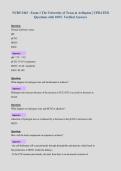
NURS 5463 - Exam 1 The University of Texas at Arlington | UPDATED
Questions with 100% Verified Answers
Question:
Normal acid base values
pH:
pCO2:
HCO3:
PaO2:
Answer:
pH: 7.35 - 7.45
pCO2: 35-45 / respiratory
HCO3: 22-26 / metabolic
PaO2: 80-100
Question:
What happens to hydrogen ions and bicarbonate in acidosis?
Answer:
Hydrogen ions increase because of the increase in CO2 (CO2 is an acid) or decrease in
bicarb.
Question:
What happens to hydrogens ions and HCO3 in alkalosis?
Answer:
reduction of hydrogen ions as evidenced by a decrease in the pCO2 or increase in the
HCO3.
Question:
How will the body compensate in respiratory acidosis?
Answer:
- the cell buffering will occur primarily through hemoglobin and proteins which leads to
the production of HCO3 within the kidneys.
- If the CO2 remains persistently elevated, then there is an increased excretion of
Questions with 100% Verified Answers
Question:
Normal acid base values
pH:
pCO2:
HCO3:
PaO2:
Answer:
pH: 7.35 - 7.45
pCO2: 35-45 / respiratory
HCO3: 22-26 / metabolic
PaO2: 80-100
Question:
What happens to hydrogen ions and bicarbonate in acidosis?
Answer:
Hydrogen ions increase because of the increase in CO2 (CO2 is an acid) or decrease in
bicarb.
Question:
What happens to hydrogens ions and HCO3 in alkalosis?
Answer:
reduction of hydrogen ions as evidenced by a decrease in the pCO2 or increase in the
HCO3.
Question:
How will the body compensate in respiratory acidosis?
Answer:
- the cell buffering will occur primarily through hemoglobin and proteins which leads to
the production of HCO3 within the kidneys.
- If the CO2 remains persistently elevated, then there is an increased excretion of


