
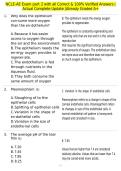
NCLE-AE Exam part 2 with all Correct & 100% Verified Answers |
Actual Complete Update |Already Graded A+
1. Why does the epithelium
B. The epithelium needs the energy oxygen
con-sume more oxygen
provides to regenerate.
than the en-dothelium?
The epithelium is constantly regenerating and
A. Because it has easier
replacing cells that are lost and it is this cellular
access to oxygen through
reproduction
the air and the environment
that requires the significant energy provided by
B. The epithelium needs the
large amounts of oxygen. The endothelium does
en-ergy oxygen provides to
not repro-duce and therefore does not require
regener-ate.
as much oxygen as the epithelium.
C. The endothelium is fed
through nutrients in the
Aqueous fluid.
D. They both consume the
same amount of oxygen
2. Pleomorphism is:
C. Variation in the shape of endothelial cells
A. Sloughing of to the
Pleomorphism refers to a change in shape of the
epithelial cells
corneal endothelial cells. Polymegathism refers
B. Splitting of epithelial cells to changes in size of the endothelial cells. A
C. Variation in the shape of normal endothelial cell pattern is honeycomb
en-dothelial cells shaped and consistent in size.
D.Variation in the size of
endothe-lial cells
3. The average pH of the tear
film is:
B. 7.45
A. 7.20
Values that are higher than 7.4 are considered
B. 7.45
relatively alkaline. Values that are lower than 7.4
C. 7.85
may be consid-ered more acidic.
D. 8.25
, NCLE-AE Exam part 2 with all Correct & 100% Verified Answers |
Actual Complete Update |Already Graded A+
4.
, NCLE-AE Exam part 2 with all Correct & 100% Verified Answers |
Actual Complete Update |Already Graded A+
You observe epithelial microcysts D. 7 microns
on a contact lens patient
and have discontinued the
patient's lens wear. Upon
rechecking the patient in
the next 2 to 4 weeks, you
observe:
A. More microcysts
B. Less microcysts
C. No microcysts
D. No change the microcysts
will always be there
5. Pinpoint lesions on the
cornea that stain with
flourescein are of-ten
indicative of:
A. Superficial punctuate
keratitis
B. Microbial keratitis
C. Superior arcuate
epithelial le-sions
D. Superior limbic
keratoconjunc-tivitis
6. The thickness of the tear film
is:
A. 0.007 microns
B. 0.07 microns
C. 0.7 microns
, NCLE-AE Exam part 2 with all Correct & 100% Verified Answers |
Actual Complete Update |Already Graded A+
More microcysts micron thick and the mucin layer 0.2 to0.5
microns thick.
scontinuing lens wear increases the epithelium's
metabolic function. The deeper layers or disorganized
epithelial tissues are brought to the surface,
causing more microcysts to appear. Complete
resolution may take several months.
Microbial keratitis
e cornea is one of the few avascular tissues in the
body and yet is one of the most heavily innervated
and sensitive tissues.
7 microns
e tear film is an invaluable part of the overall opti-
cal system. It provides protection from
dehydration, a smooth optical surface, and
nutrients for the cornea all
a very thin layer. The entire tear film is only 7 microns
thick with the aqueous layer comprising about
98% of this vital fluid. The lipid layer is only 0.1
Actual Complete Update |Already Graded A+
1. Why does the epithelium
B. The epithelium needs the energy oxygen
con-sume more oxygen
provides to regenerate.
than the en-dothelium?
The epithelium is constantly regenerating and
A. Because it has easier
replacing cells that are lost and it is this cellular
access to oxygen through
reproduction
the air and the environment
that requires the significant energy provided by
B. The epithelium needs the
large amounts of oxygen. The endothelium does
en-ergy oxygen provides to
not repro-duce and therefore does not require
regener-ate.
as much oxygen as the epithelium.
C. The endothelium is fed
through nutrients in the
Aqueous fluid.
D. They both consume the
same amount of oxygen
2. Pleomorphism is:
C. Variation in the shape of endothelial cells
A. Sloughing of to the
Pleomorphism refers to a change in shape of the
epithelial cells
corneal endothelial cells. Polymegathism refers
B. Splitting of epithelial cells to changes in size of the endothelial cells. A
C. Variation in the shape of normal endothelial cell pattern is honeycomb
en-dothelial cells shaped and consistent in size.
D.Variation in the size of
endothe-lial cells
3. The average pH of the tear
film is:
B. 7.45
A. 7.20
Values that are higher than 7.4 are considered
B. 7.45
relatively alkaline. Values that are lower than 7.4
C. 7.85
may be consid-ered more acidic.
D. 8.25
, NCLE-AE Exam part 2 with all Correct & 100% Verified Answers |
Actual Complete Update |Already Graded A+
4.
, NCLE-AE Exam part 2 with all Correct & 100% Verified Answers |
Actual Complete Update |Already Graded A+
You observe epithelial microcysts D. 7 microns
on a contact lens patient
and have discontinued the
patient's lens wear. Upon
rechecking the patient in
the next 2 to 4 weeks, you
observe:
A. More microcysts
B. Less microcysts
C. No microcysts
D. No change the microcysts
will always be there
5. Pinpoint lesions on the
cornea that stain with
flourescein are of-ten
indicative of:
A. Superficial punctuate
keratitis
B. Microbial keratitis
C. Superior arcuate
epithelial le-sions
D. Superior limbic
keratoconjunc-tivitis
6. The thickness of the tear film
is:
A. 0.007 microns
B. 0.07 microns
C. 0.7 microns
, NCLE-AE Exam part 2 with all Correct & 100% Verified Answers |
Actual Complete Update |Already Graded A+
More microcysts micron thick and the mucin layer 0.2 to0.5
microns thick.
scontinuing lens wear increases the epithelium's
metabolic function. The deeper layers or disorganized
epithelial tissues are brought to the surface,
causing more microcysts to appear. Complete
resolution may take several months.
Microbial keratitis
e cornea is one of the few avascular tissues in the
body and yet is one of the most heavily innervated
and sensitive tissues.
7 microns
e tear film is an invaluable part of the overall opti-
cal system. It provides protection from
dehydration, a smooth optical surface, and
nutrients for the cornea all
a very thin layer. The entire tear film is only 7 microns
thick with the aqueous layer comprising about
98% of this vital fluid. The lipid layer is only 0.1


