
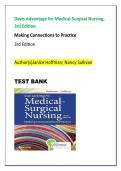
Davis Advantage for Medical-Surgical Nursing,
3rd Edition
Making Connections to Practice
3rd Edition
Author(s)Janice Hoffman; Nancy Sullivan
TEST BANK
,
,Question 1
A nurse is beginning care for a newly admitted medical-surgical patient.
Which action best demonstrates patient-centered care?
A. Completing the assessment quickly so medications can be
administered on time
B. Asking the patient about personal preferences and incorporating
them into the plan of care
C. Using the standard care plan without modification
D. Asking the patient's family to make all routine care decisions
Correct Answer:
B. Asking the patient about personal preferences and incorporating
them into the plan of care
Rationale:
Patient-centered care respects the patient's preferences, values, needs,
and goals and incorporates them into care decisions. Option A
prioritizes task completion over individualized care. Option C fails to
individualize the plan. Option D excludes the competent patient from
decisions.
Question 2
A medical-surgical nurse reviews a patient's plan of care before
beginning a shift. Which activity reflects the nursing process?
A. Identifying a patient's response to a nursing intervention
B. Prescribing a diagnostic test
, C. Selecting a medical diagnosis
D. Ordering a medication
Correct Answer:
A. Identifying a patient's response to a nursing intervention
Rationale:
Evaluating the patient's response to nursing interventions is part of the
nursing process. Nurses do not independently establish medical
diagnoses, prescribe diagnostic tests, or prescribe medications.
Question 3
Which action by the nurse best demonstrates clinical judgment?
A. Performing every intervention listed on the care plan in the same
sequence
B. Recognizing a change in patient condition and determining which
finding requires immediate action
C. Completing documentation before reassessing the patient
D. Waiting for the provider to identify changes in the patient's condition
Correct Answer:
B. Recognizing a change in patient condition and determining which
finding requires immediate action
Rationale:
Clinical judgment involves recognizing important cues, interpreting
findings, prioritizing problems, taking appropriate action, and evaluating
outcomes. The other options do not demonstrate independent clinical
reasoning.
3rd Edition
Making Connections to Practice
3rd Edition
Author(s)Janice Hoffman; Nancy Sullivan
TEST BANK
,
,Question 1
A nurse is beginning care for a newly admitted medical-surgical patient.
Which action best demonstrates patient-centered care?
A. Completing the assessment quickly so medications can be
administered on time
B. Asking the patient about personal preferences and incorporating
them into the plan of care
C. Using the standard care plan without modification
D. Asking the patient's family to make all routine care decisions
Correct Answer:
B. Asking the patient about personal preferences and incorporating
them into the plan of care
Rationale:
Patient-centered care respects the patient's preferences, values, needs,
and goals and incorporates them into care decisions. Option A
prioritizes task completion over individualized care. Option C fails to
individualize the plan. Option D excludes the competent patient from
decisions.
Question 2
A medical-surgical nurse reviews a patient's plan of care before
beginning a shift. Which activity reflects the nursing process?
A. Identifying a patient's response to a nursing intervention
B. Prescribing a diagnostic test
, C. Selecting a medical diagnosis
D. Ordering a medication
Correct Answer:
A. Identifying a patient's response to a nursing intervention
Rationale:
Evaluating the patient's response to nursing interventions is part of the
nursing process. Nurses do not independently establish medical
diagnoses, prescribe diagnostic tests, or prescribe medications.
Question 3
Which action by the nurse best demonstrates clinical judgment?
A. Performing every intervention listed on the care plan in the same
sequence
B. Recognizing a change in patient condition and determining which
finding requires immediate action
C. Completing documentation before reassessing the patient
D. Waiting for the provider to identify changes in the patient's condition
Correct Answer:
B. Recognizing a change in patient condition and determining which
finding requires immediate action
Rationale:
Clinical judgment involves recognizing important cues, interpreting
findings, prioritizing problems, taking appropriate action, and evaluating
outcomes. The other options do not demonstrate independent clinical
reasoning.


