
NCCT Surgical Technology Preliminary Exam Questions with
Verified Answers (Correct Update)
Question 1: Which of the following retractors has sharp disposable inserts that must be disposed
of in an appropriate sharps container following the end of the surgical case? Mayfield Cloward
Bookwalter Greenfield
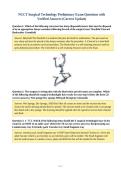
Answer: Mayfield The Mayfield is a headrest that pins the head for stabilization. The pins used are
very sharp and must be placed in the sharps container after the procedure. A Cloward is a hand held
retractor used in an anterior cervical procedure. The Bookwalter is a self-retaining retractor used for
open abdominal procedure. The Greenfield is a self-retaining retractor used on the brain.
Question 2: The surgeon is closing skin with the final stitch and all counts are complete. Which
of the following should the surgical technologist have ready for next step? (Select the three (3)
correct answers.) Wet sponge Dry sponge ABD pad Duraprep Cottonoids
Answer: Wet Sponge, Dry Sponge, ABD Pad After all counts are done and the incision has been
closed, the sterile dressing should then be opened. The incision needs to be cleaned with a wet sponge
then dried with a dry sponge. The dressing should be applied after the operative site has been cleaned
and dried.
Question 3: 3. Which of the following items should the E surgical technologist have in the
room for an ORIF of an ankle case? (Select the Th two (2) correct answers.) Reciprocating saw
Laminectomy tray Extremity pack Vascular tray Small fragment tray
Answer: xtremity pack, Small fragment tray e ORIF Open Reduction Internal Fixation in- volves the
ankle fracture which is an extremity so an extremity pack will be needed. The Small fragment will
also be need because it contains screws, plates and drill bits that will be needed for the fixation.
Page 1
,Question 4: In a sterilized package, a chemical indi- co cator is used to: -verify elimination of
living flora on the package. -confirm that the package was exposed na to sterilization. -show that
no moisture entered the package. -ensure that the package is sterile.
Answer: onfirm that the package was exposed to sterilization.
Rationale: The chemical indicator is used interally and externally to show that the package has been
exposed to the sterilization process. They do not verify the sterility of the items in the packages. They
only mean that the package has had the right temperature, humidity, and sterilant. It will not verify
elimination of living flora on the package or that moisture is in the package.
Question 5: 5. During an I&D of a back wound with the C patient in the prone position the
anesthesiologist announces that the patient is turning blue and calls a code. Which of the
following actions should the sur- is gical technologist take to assist? -Assist the surgeon in
closing the wound, remove the drapes, and flip the a patient. -Cover the wound and remove the
Mayo and back table. -Flip the patient immediately. -Assist anesthesia with the patient while the
surgeon continues surgery.
Answer: over the wound and remove the Mayo and back t table.
Rationale: The first thing that needs to be done to maintain the patient's airway. The wound should be
covered and the mayo should be removed so the patient can be flipped in order for anesthesia to take
care of the airway, then assist anesthesia with the patient.
Question 6: When closing fascia after a laparotomy, which of the following is the suture of
choice? Gore-Tex PDS Plain Nurolon
Answer: PDS
Rationale: PDS has a longer absorption rate of 183-238 days, which makes it ideal for the
slow-healing fascia. Gore-Tex is typically used for anastomosis of vascular grafts or in valve repairs.
Plain gut suture is not to be used on tissue under stress. Nurolon is a nonabsorbable suture that loses
some of its tensile strength over time.
Question 7: The surgical technologist observed a patient fall during the transfer from the
gurney to the operating bed. Which of the following items are required in the incident report?
(Select the three (3) correct answers.) Patient's name Personnel involved Type of anesthesia
used Location of the incident Patient's weight
Answer: Patient's name, Personnel involved, Location of the incident
Page 2
,Question 8: 8. Which member of the surgical team is A in charge of the transfer of an
immobile or unconscious patient from the OR Ra table to the stretcher? Surgeon Circulator
Anesthesia provider Surgical technologist
Answer: Anesthesia provider ationale: The anesthesia provider is in control of the patient transfer and
coordinates the move. They have control of the head and the patient's airway. The surgeon most likely
has already left the room and cannot help with the transfer. The circulator is on the other side of the
bed waiting on the transfer device when anesthesia gives the permission. The surgical technologist is
on the other side waiting to help transfer the patient. There should always be 4 people to transfer a
patient. Anesthesia is at the head of the bed and one person is on each side with one at the end of the
bed to help transfer the feet.
Question 9: Which of the following steps are taken after the surgery has finished and the
surgical technologist is breaking scrub? -Wipe blood off of gloves and remove them, then
remove the gown. -Using a gloved hand, untie the neck of the gown and pull away from the body
keeping all blood on the gown. -Wipe the gloves off, grasp the gown at the shoulders, and roll the
gown forward into a ball. -Ask the circulator to assist in removing the gown and gloves.
Answer: f Wipe the gloves ott, grasp the gown at the shoulders, and roll the gown forward into a ball.
Question 10: 10. The scheduled case is a prostatectomy. The surgeon has requested
chromic gut suture for reanastomosis. If Chromic gut is unavailable, which of the following
sutures is a viable substitute? Polyester/Dacron Silk Nylon Vicryl
Answer: Vicryl
Rationale: The acceptable substitute for a Chromic Gut suture would be a Vicryl suture. Vicryl, like
Chromic Gut, it absorbable and would be the next best choice for re-anastomosis in a prostatectomy.
Question 11: A patient presents to the operating room for irrigation and debridement of a
wound caused by penetrating trauma. The surgeon states that the wound th will heal by
secondary intention. Which g of the following dressing types should the surgical technologist ask
the circulator for? Steri-Strips Bio-occlusive Opsite ABD Bolsters
Answer: ABD
Rationale: The ABD would be used because of e drainage that will follow after doing the irriation and
debridement so it can absorb fluid. Steri strips and the bio-occlusive opsite have an adhesive backing
and would stick to the incision, so they are not the appropriate dressing. Bolsters are used over suture
strands to keep them from cutting into the skin when suture is placed in a high tension area. A wound
that will heal by secondary intention is not sutured closed.
Page 3
, Question 12: During the initial pre-operative count, the surgical technologist and circulator
noticed that there were 11 Raytecs in a package instead of 10. Which of the fol- R lowing should
they do about the extra sponge? -Include the extra sponge in the count. -Throw out one sponge
to make it 10. -Discard the entire package into a kick bucket and remove it from count. -Remove
the package and the sponges from room.
Answer: Remove the package and the sponges from room. ationale: If the patient has not entered the
room the Raytecs are to be removed from the sterile field. They are then taken out of the room.
Sponges used during the case are counted in the kick bucket so the incorrect sponges should not be
placed in it. Raytec sponges come in a total of 10, so subtracting one from the count would complicate
the surgery if relief would come in.
Question 13: 13. An OB-GYN surgeon has posted a laparoscopic partial hysterectomy and
has informed the surgical team that the R ovaries are remaining. However, the fal- iz lopian
tubes will require ligation involv- a ing the tubes being clipped and cauterized. Which of the
following instruments should the surgical technologist p open? -Filshie and Kleppinger
-Harmonic scalpel and hemoclip applier -Filshie and hemoclip applier -Kleppinger and
harmonic scalpel
Answer: Filshie and Kleppinger ationale: A Filshie is a small titanium clip with a soft lining used
specifically for female steril- ation. The Kleppinger would be used next as secondary measure to
cauterize the exposed ends of the Fallopian tubes. A harmonic scalpel is used to cut and coagulate
tissue, but the Klepnger otters a smaller, more precise coagulation area. Hemoclip appliers are not
used as a sterilization method.
Question 14: The surgical team prepares the room for a trauma case. The nurse is notified by
the ER that the patient is a 3-year-old female with a gunshot wound. In preparing the room for
the patient's arrival, the surgical technologist should ensure that the room is: -ventilated to force
positive airflow from unrestricted to restricted areas. -maintained at 75 degrees F (23 C).
-humidity controlled to prevent growth of bacteria. -maintained at 68 degrees F (20 C).
Answer: maintained at 75 degrees F (23 C).
Rationale: It is very diflcult for pediatric patients to maintain a normal body temperature. Blood loss
due to injury and shock for trauma patients makes it even more diflcult. Protocol for pediatric cases in
the OR is to keep the room temperature at 80-85 F for children under 25 lbs, and 75-80F for older
children.
Page 4
Verified Answers (Correct Update)
Question 1: Which of the following retractors has sharp disposable inserts that must be disposed
of in an appropriate sharps container following the end of the surgical case? Mayfield Cloward
Bookwalter Greenfield
Answer: Mayfield The Mayfield is a headrest that pins the head for stabilization. The pins used are
very sharp and must be placed in the sharps container after the procedure. A Cloward is a hand held
retractor used in an anterior cervical procedure. The Bookwalter is a self-retaining retractor used for
open abdominal procedure. The Greenfield is a self-retaining retractor used on the brain.
Question 2: The surgeon is closing skin with the final stitch and all counts are complete. Which
of the following should the surgical technologist have ready for next step? (Select the three (3)
correct answers.) Wet sponge Dry sponge ABD pad Duraprep Cottonoids
Answer: Wet Sponge, Dry Sponge, ABD Pad After all counts are done and the incision has been
closed, the sterile dressing should then be opened. The incision needs to be cleaned with a wet sponge
then dried with a dry sponge. The dressing should be applied after the operative site has been cleaned
and dried.
Question 3: 3. Which of the following items should the E surgical technologist have in the
room for an ORIF of an ankle case? (Select the Th two (2) correct answers.) Reciprocating saw
Laminectomy tray Extremity pack Vascular tray Small fragment tray
Answer: xtremity pack, Small fragment tray e ORIF Open Reduction Internal Fixation in- volves the
ankle fracture which is an extremity so an extremity pack will be needed. The Small fragment will
also be need because it contains screws, plates and drill bits that will be needed for the fixation.
Page 1
,Question 4: In a sterilized package, a chemical indi- co cator is used to: -verify elimination of
living flora on the package. -confirm that the package was exposed na to sterilization. -show that
no moisture entered the package. -ensure that the package is sterile.
Answer: onfirm that the package was exposed to sterilization.
Rationale: The chemical indicator is used interally and externally to show that the package has been
exposed to the sterilization process. They do not verify the sterility of the items in the packages. They
only mean that the package has had the right temperature, humidity, and sterilant. It will not verify
elimination of living flora on the package or that moisture is in the package.
Question 5: 5. During an I&D of a back wound with the C patient in the prone position the
anesthesiologist announces that the patient is turning blue and calls a code. Which of the
following actions should the sur- is gical technologist take to assist? -Assist the surgeon in
closing the wound, remove the drapes, and flip the a patient. -Cover the wound and remove the
Mayo and back table. -Flip the patient immediately. -Assist anesthesia with the patient while the
surgeon continues surgery.
Answer: over the wound and remove the Mayo and back t table.
Rationale: The first thing that needs to be done to maintain the patient's airway. The wound should be
covered and the mayo should be removed so the patient can be flipped in order for anesthesia to take
care of the airway, then assist anesthesia with the patient.
Question 6: When closing fascia after a laparotomy, which of the following is the suture of
choice? Gore-Tex PDS Plain Nurolon
Answer: PDS
Rationale: PDS has a longer absorption rate of 183-238 days, which makes it ideal for the
slow-healing fascia. Gore-Tex is typically used for anastomosis of vascular grafts or in valve repairs.
Plain gut suture is not to be used on tissue under stress. Nurolon is a nonabsorbable suture that loses
some of its tensile strength over time.
Question 7: The surgical technologist observed a patient fall during the transfer from the
gurney to the operating bed. Which of the following items are required in the incident report?
(Select the three (3) correct answers.) Patient's name Personnel involved Type of anesthesia
used Location of the incident Patient's weight
Answer: Patient's name, Personnel involved, Location of the incident
Page 2
,Question 8: 8. Which member of the surgical team is A in charge of the transfer of an
immobile or unconscious patient from the OR Ra table to the stretcher? Surgeon Circulator
Anesthesia provider Surgical technologist
Answer: Anesthesia provider ationale: The anesthesia provider is in control of the patient transfer and
coordinates the move. They have control of the head and the patient's airway. The surgeon most likely
has already left the room and cannot help with the transfer. The circulator is on the other side of the
bed waiting on the transfer device when anesthesia gives the permission. The surgical technologist is
on the other side waiting to help transfer the patient. There should always be 4 people to transfer a
patient. Anesthesia is at the head of the bed and one person is on each side with one at the end of the
bed to help transfer the feet.
Question 9: Which of the following steps are taken after the surgery has finished and the
surgical technologist is breaking scrub? -Wipe blood off of gloves and remove them, then
remove the gown. -Using a gloved hand, untie the neck of the gown and pull away from the body
keeping all blood on the gown. -Wipe the gloves off, grasp the gown at the shoulders, and roll the
gown forward into a ball. -Ask the circulator to assist in removing the gown and gloves.
Answer: f Wipe the gloves ott, grasp the gown at the shoulders, and roll the gown forward into a ball.
Question 10: 10. The scheduled case is a prostatectomy. The surgeon has requested
chromic gut suture for reanastomosis. If Chromic gut is unavailable, which of the following
sutures is a viable substitute? Polyester/Dacron Silk Nylon Vicryl
Answer: Vicryl
Rationale: The acceptable substitute for a Chromic Gut suture would be a Vicryl suture. Vicryl, like
Chromic Gut, it absorbable and would be the next best choice for re-anastomosis in a prostatectomy.
Question 11: A patient presents to the operating room for irrigation and debridement of a
wound caused by penetrating trauma. The surgeon states that the wound th will heal by
secondary intention. Which g of the following dressing types should the surgical technologist ask
the circulator for? Steri-Strips Bio-occlusive Opsite ABD Bolsters
Answer: ABD
Rationale: The ABD would be used because of e drainage that will follow after doing the irriation and
debridement so it can absorb fluid. Steri strips and the bio-occlusive opsite have an adhesive backing
and would stick to the incision, so they are not the appropriate dressing. Bolsters are used over suture
strands to keep them from cutting into the skin when suture is placed in a high tension area. A wound
that will heal by secondary intention is not sutured closed.
Page 3
, Question 12: During the initial pre-operative count, the surgical technologist and circulator
noticed that there were 11 Raytecs in a package instead of 10. Which of the fol- R lowing should
they do about the extra sponge? -Include the extra sponge in the count. -Throw out one sponge
to make it 10. -Discard the entire package into a kick bucket and remove it from count. -Remove
the package and the sponges from room.
Answer: Remove the package and the sponges from room. ationale: If the patient has not entered the
room the Raytecs are to be removed from the sterile field. They are then taken out of the room.
Sponges used during the case are counted in the kick bucket so the incorrect sponges should not be
placed in it. Raytec sponges come in a total of 10, so subtracting one from the count would complicate
the surgery if relief would come in.
Question 13: 13. An OB-GYN surgeon has posted a laparoscopic partial hysterectomy and
has informed the surgical team that the R ovaries are remaining. However, the fal- iz lopian
tubes will require ligation involv- a ing the tubes being clipped and cauterized. Which of the
following instruments should the surgical technologist p open? -Filshie and Kleppinger
-Harmonic scalpel and hemoclip applier -Filshie and hemoclip applier -Kleppinger and
harmonic scalpel
Answer: Filshie and Kleppinger ationale: A Filshie is a small titanium clip with a soft lining used
specifically for female steril- ation. The Kleppinger would be used next as secondary measure to
cauterize the exposed ends of the Fallopian tubes. A harmonic scalpel is used to cut and coagulate
tissue, but the Klepnger otters a smaller, more precise coagulation area. Hemoclip appliers are not
used as a sterilization method.
Question 14: The surgical team prepares the room for a trauma case. The nurse is notified by
the ER that the patient is a 3-year-old female with a gunshot wound. In preparing the room for
the patient's arrival, the surgical technologist should ensure that the room is: -ventilated to force
positive airflow from unrestricted to restricted areas. -maintained at 75 degrees F (23 C).
-humidity controlled to prevent growth of bacteria. -maintained at 68 degrees F (20 C).
Answer: maintained at 75 degrees F (23 C).
Rationale: It is very diflcult for pediatric patients to maintain a normal body temperature. Blood loss
due to injury and shock for trauma patients makes it even more diflcult. Protocol for pediatric cases in
the OR is to keep the room temperature at 80-85 F for children under 25 lbs, and 75-80F for older
children.
Page 4


