
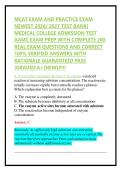
MCAT EXAM AND PRACTICE EXAM
NEWEST 2026/ 2027 TEST BANK|
MEDICAL COLLEGE ADMISSION TEST
AAMC EXAM PREP WITH COMPLETE 200
REAL EXAM QUESTIONS AND CORRECT
100% VERIFIED ANSWERS WITH
RATIONALE GUARANTEED PASS
(GRADED A+)NEWLY!!!
1. A researcher measures the rate of an enzyme-catalyzed
reaction at increasing substrate concentrations. The reaction rate
initially increases rapidly but eventually reaches a plateau.
Which explanation best accounts for the plateau?
A. The enzyme is completely denatured
B. The substrate becomes inhibitory at all concentrations
C. The enzyme active sites become saturated with substrate
D. The reaction has become independent of enzyme
concentration
Answer: C
Rationale: At sufficiently high substrate concentration,
essentially all available enzyme active sites are occupied. The
reaction therefore approaches Vmax and cannot increase
substantially without additional enzyme.
,2. A weak acid HA has a pKa of 4.8. At which pH will the
concentrations of HA and A⁻ be approximately equal?
A. 2.4
B. 4.8
C. 7.0
D. 9.6
Answer: B
Rationale: According to the Henderson–Hasselbalch equation,
when pH = pKa, the ratio [A⁻]/[HA] equals 1, so the
concentrations of the protonated and deprotonated forms are
approximately equal.
3. Which amino acid contains a side chain capable of forming a
disulfide bond with another amino acid residue?
A. Methionine
B. Serine
C. Cysteine
D. Tyrosine
Answer: C
Rationale: Two cysteine side chains can undergo oxidation to
form a covalent disulfide bond. Disulfide bonds can stabilize the
tertiary or quaternary structure of proteins.
,4. A red blood cell is placed in a solution with a lower effective
solute concentration than the cell interior. What will most likely
occur?
A. Water leaves the cell and it shrinks
B. Sodium rapidly leaves the cell
C. Water enters the cell and it swells
D. No net water movement occurs
Answer: C
Rationale: A hypotonic extracellular solution has a lower
effective osmolarity than the cell. Water therefore moves into the
cell by osmosis, potentially causing swelling and lysis.
5. An object travels at a constant velocity of 20 m/s for 15
seconds. What distance does it travel?
A. 35 m
B. 100 m
C. 300 m
D. 600 m
Answer: C
Rationale: For constant velocity, distance equals velocity
multiplied by time: d = vt = (20 m/s)(15 s) = 300 m.
6. Which cellular structure is primarily responsible for
generating ATP through oxidative phosphorylation?
, A. Lysosome
B. Golgi apparatus
C. Endoplasmic reticulum
D. Mitochondrion
Answer: D
Rationale: The mitochondrial inner membrane contains the
electron transport chain and ATP synthase. The proton gradient
generated across this membrane drives oxidative
phosphorylation.
7. A mutation changes a codon from UAU to UAA. What type
of mutation has occurred?
A. Missense
B. Silent
C. Frameshift
D. Nonsense
Answer: D
Rationale: UAU encodes tyrosine, whereas UAA is a stop
codon. Conversion of a coding codon into a premature stop
codon is a nonsense mutation.
8. Which process directly produces the greatest amount of
genetic variation during meiosis?
NEWEST 2026/ 2027 TEST BANK|
MEDICAL COLLEGE ADMISSION TEST
AAMC EXAM PREP WITH COMPLETE 200
REAL EXAM QUESTIONS AND CORRECT
100% VERIFIED ANSWERS WITH
RATIONALE GUARANTEED PASS
(GRADED A+)NEWLY!!!
1. A researcher measures the rate of an enzyme-catalyzed
reaction at increasing substrate concentrations. The reaction rate
initially increases rapidly but eventually reaches a plateau.
Which explanation best accounts for the plateau?
A. The enzyme is completely denatured
B. The substrate becomes inhibitory at all concentrations
C. The enzyme active sites become saturated with substrate
D. The reaction has become independent of enzyme
concentration
Answer: C
Rationale: At sufficiently high substrate concentration,
essentially all available enzyme active sites are occupied. The
reaction therefore approaches Vmax and cannot increase
substantially without additional enzyme.
,2. A weak acid HA has a pKa of 4.8. At which pH will the
concentrations of HA and A⁻ be approximately equal?
A. 2.4
B. 4.8
C. 7.0
D. 9.6
Answer: B
Rationale: According to the Henderson–Hasselbalch equation,
when pH = pKa, the ratio [A⁻]/[HA] equals 1, so the
concentrations of the protonated and deprotonated forms are
approximately equal.
3. Which amino acid contains a side chain capable of forming a
disulfide bond with another amino acid residue?
A. Methionine
B. Serine
C. Cysteine
D. Tyrosine
Answer: C
Rationale: Two cysteine side chains can undergo oxidation to
form a covalent disulfide bond. Disulfide bonds can stabilize the
tertiary or quaternary structure of proteins.
,4. A red blood cell is placed in a solution with a lower effective
solute concentration than the cell interior. What will most likely
occur?
A. Water leaves the cell and it shrinks
B. Sodium rapidly leaves the cell
C. Water enters the cell and it swells
D. No net water movement occurs
Answer: C
Rationale: A hypotonic extracellular solution has a lower
effective osmolarity than the cell. Water therefore moves into the
cell by osmosis, potentially causing swelling and lysis.
5. An object travels at a constant velocity of 20 m/s for 15
seconds. What distance does it travel?
A. 35 m
B. 100 m
C. 300 m
D. 600 m
Answer: C
Rationale: For constant velocity, distance equals velocity
multiplied by time: d = vt = (20 m/s)(15 s) = 300 m.
6. Which cellular structure is primarily responsible for
generating ATP through oxidative phosphorylation?
, A. Lysosome
B. Golgi apparatus
C. Endoplasmic reticulum
D. Mitochondrion
Answer: D
Rationale: The mitochondrial inner membrane contains the
electron transport chain and ATP synthase. The proton gradient
generated across this membrane drives oxidative
phosphorylation.
7. A mutation changes a codon from UAU to UAA. What type
of mutation has occurred?
A. Missense
B. Silent
C. Frameshift
D. Nonsense
Answer: D
Rationale: UAU encodes tyrosine, whereas UAA is a stop
codon. Conversion of a coding codon into a premature stop
codon is a nonsense mutation.
8. Which process directly produces the greatest amount of
genetic variation during meiosis?


