
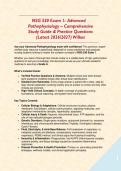
NSG 530 Exam 1: Advanced
Pathophysiology – Comprehensive
Study Guide & Practice Questions
(Latest 2026/2027) Wilkes
Ace your Advanced Pathophysiology exam with confidence! This premium, expert-
verified study resource is specifically designed for nurse practitioner and graduate
nursing students looking to master the complex concepts of NSG 530 Exam 1.
Whether you need a thorough last-minute review or a reliable bank of high-yield practice
questions to test your knowledge, this document serves as your ultimate academic
roadmap to securing a Grade A.
What’s Included Inside:
• Verified Practice Questions & Answers: Multiple-choice and short-answer
style questions modeled closely after actual exam distributions.
• Detailed Core Rationales: Every single answer is paired with a clear, step-by-
step clinical explanation outlining exactly why an answer is correct and why other
choices are incorrect.
• High-Yield Clinical Concepts: In-depth coverage of graduate nursing
foundations, clinical reasoning, and system-level mechanisms.
Key Topics Covered:
• Cellular Biology & Adaptations: Cellular structures (nucleus, plasma
membrane, fluid bilayer), cellular communication, signaling molecules, and
adaptation mechanisms (atrophy, hypertrophy, dysplasia).
• Cellular Injury & Death: Hypoxia, mitochondrial injury, ATP depletion, and the
role of free radicals/hydrogen peroxide.
• Genetic Disorders: Single-gene mutations, autosomal dominant vs. recessive
inheritance, and chromosomal abnormalities (Triploidy, Huntington's disease,
Cystic Fibrosis).
• Fluid, Electrolyte, & Acid-Base Balance: Full breakdown of respiratory vs.
metabolic acidosis and alkalosis, compensatory mechanisms (renal and
respiratory), ROME method, and clinical signs like Kussmaul breathing.
• Immunity & Inflammation: Phagocytosis, the NLRP3 inflammasome complex,
cytokine activity, and tissue damage caused by excessive inflammatory
responses.
• Disease Prevention & Health Promotion: Primary vs. secondary prevention
strategies, wellness models, and clinical application principles.
1
,Why Choose This Study Resource?
• Save Hours of Study Time: Skip the stress of sorting through massive
textbooks—all the critical information you need to know is condensed into clean,
punchy, and highly readable notes.
• Boost Test-Taking Confidence: Learn the diagnostic reasoning patterns
required to dismantle complex clinical scenarios and trick questions.
• Instant Digital Access: Download the clean, professionally formatted PDF
immediately upon purchase and begin studying right away on your phone, tablet,
or laptop!
1. Q: What occurs during the Interphase stage of the cell cycle?
A: During interphase, the cell feeds, metabolizes, and grows while replicating
its DNA in preparation for mitosis.
• Expert Rationale: Interphase is the daily living phase of the cell, divided
into G1 (growth), S (DNA synthesis), and G2 (final preparation) phases. It is
metabolically active and essential for ensuring that an exact duplicate of the
genome is created before nuclear division begins.
2. Q: What characterizes Prophase in cellular division?
A: Prophase is marked by the first appearance of chromosomes, which will
temporarily total 92 sister chromatids before division.
• Expert Rationale: During prophase, loosely packed chromatin condenses
into highly visible chromosomes. Since the DNA was duplicated during the
S phase of interphase, each of the 46 chromosomes consists of two identical
sister chromatids, creating a total of 92 chromatids ready for segregation.
3. Q: What takes place during Metaphase?
A: Centrioles pull chromosomes to the opposite sides of the cell, aligning 46
chromatids toward each side along the equatorial plate.
2
, • Expert Rationale: Chromosomes line up along the metaphase plate. Spindle
fibers attached to the kinetochores of the centromeres exert tension, ensuring
that when separation occurs, an equal and exact set of 46 chromosomes
moves toward each pole.
4. Q: What happens during Anaphase?
A: Centromeres split and sister chromatids are pulled apart toward opposite
poles of the cell.
• Expert Rationale: The enzyme separase cleaves the cohesin proteins
holding the sister chromatids together. Once separated, each chromatid is
considered a distinct individual chromosome, driven by the shortening of the
mitotic spindle fibers.
5. Q: What occurs during Telophase?
A: A new nuclear membrane forms around each group of 46 chromosomes.
When this process proceeds correctly, euploid cells are produced.
• Expert Rationale: Telophase reverses the events of prophase; chromosomes
de-condense, and nuclear envelopes reform around the two new identical
nuclei. "Euploid" signifies a cell containing the correct, normal complement
of chromosomes (46 in humans).
6. Q: What is Nondisjunction?
A: Nondisjunction is an error in meiosis or mitosis in which homologous
chromosomes or sister chromatids fail to separate properly.
• Expert Rationale: This failure results in daughter cells with abnormal
chromosome numbers (aneuploidy). If it happens during gametogenesis, it
leads to conditions such as monosomy (e.g., Turner syndrome) or trisomy
(e.g., Down syndrome) upon fertilization.
3
Pathophysiology – Comprehensive
Study Guide & Practice Questions
(Latest 2026/2027) Wilkes
Ace your Advanced Pathophysiology exam with confidence! This premium, expert-
verified study resource is specifically designed for nurse practitioner and graduate
nursing students looking to master the complex concepts of NSG 530 Exam 1.
Whether you need a thorough last-minute review or a reliable bank of high-yield practice
questions to test your knowledge, this document serves as your ultimate academic
roadmap to securing a Grade A.
What’s Included Inside:
• Verified Practice Questions & Answers: Multiple-choice and short-answer
style questions modeled closely after actual exam distributions.
• Detailed Core Rationales: Every single answer is paired with a clear, step-by-
step clinical explanation outlining exactly why an answer is correct and why other
choices are incorrect.
• High-Yield Clinical Concepts: In-depth coverage of graduate nursing
foundations, clinical reasoning, and system-level mechanisms.
Key Topics Covered:
• Cellular Biology & Adaptations: Cellular structures (nucleus, plasma
membrane, fluid bilayer), cellular communication, signaling molecules, and
adaptation mechanisms (atrophy, hypertrophy, dysplasia).
• Cellular Injury & Death: Hypoxia, mitochondrial injury, ATP depletion, and the
role of free radicals/hydrogen peroxide.
• Genetic Disorders: Single-gene mutations, autosomal dominant vs. recessive
inheritance, and chromosomal abnormalities (Triploidy, Huntington's disease,
Cystic Fibrosis).
• Fluid, Electrolyte, & Acid-Base Balance: Full breakdown of respiratory vs.
metabolic acidosis and alkalosis, compensatory mechanisms (renal and
respiratory), ROME method, and clinical signs like Kussmaul breathing.
• Immunity & Inflammation: Phagocytosis, the NLRP3 inflammasome complex,
cytokine activity, and tissue damage caused by excessive inflammatory
responses.
• Disease Prevention & Health Promotion: Primary vs. secondary prevention
strategies, wellness models, and clinical application principles.
1
,Why Choose This Study Resource?
• Save Hours of Study Time: Skip the stress of sorting through massive
textbooks—all the critical information you need to know is condensed into clean,
punchy, and highly readable notes.
• Boost Test-Taking Confidence: Learn the diagnostic reasoning patterns
required to dismantle complex clinical scenarios and trick questions.
• Instant Digital Access: Download the clean, professionally formatted PDF
immediately upon purchase and begin studying right away on your phone, tablet,
or laptop!
1. Q: What occurs during the Interphase stage of the cell cycle?
A: During interphase, the cell feeds, metabolizes, and grows while replicating
its DNA in preparation for mitosis.
• Expert Rationale: Interphase is the daily living phase of the cell, divided
into G1 (growth), S (DNA synthesis), and G2 (final preparation) phases. It is
metabolically active and essential for ensuring that an exact duplicate of the
genome is created before nuclear division begins.
2. Q: What characterizes Prophase in cellular division?
A: Prophase is marked by the first appearance of chromosomes, which will
temporarily total 92 sister chromatids before division.
• Expert Rationale: During prophase, loosely packed chromatin condenses
into highly visible chromosomes. Since the DNA was duplicated during the
S phase of interphase, each of the 46 chromosomes consists of two identical
sister chromatids, creating a total of 92 chromatids ready for segregation.
3. Q: What takes place during Metaphase?
A: Centrioles pull chromosomes to the opposite sides of the cell, aligning 46
chromatids toward each side along the equatorial plate.
2
, • Expert Rationale: Chromosomes line up along the metaphase plate. Spindle
fibers attached to the kinetochores of the centromeres exert tension, ensuring
that when separation occurs, an equal and exact set of 46 chromosomes
moves toward each pole.
4. Q: What happens during Anaphase?
A: Centromeres split and sister chromatids are pulled apart toward opposite
poles of the cell.
• Expert Rationale: The enzyme separase cleaves the cohesin proteins
holding the sister chromatids together. Once separated, each chromatid is
considered a distinct individual chromosome, driven by the shortening of the
mitotic spindle fibers.
5. Q: What occurs during Telophase?
A: A new nuclear membrane forms around each group of 46 chromosomes.
When this process proceeds correctly, euploid cells are produced.
• Expert Rationale: Telophase reverses the events of prophase; chromosomes
de-condense, and nuclear envelopes reform around the two new identical
nuclei. "Euploid" signifies a cell containing the correct, normal complement
of chromosomes (46 in humans).
6. Q: What is Nondisjunction?
A: Nondisjunction is an error in meiosis or mitosis in which homologous
chromosomes or sister chromatids fail to separate properly.
• Expert Rationale: This failure results in daughter cells with abnormal
chromosome numbers (aneuploidy). If it happens during gametogenesis, it
leads to conditions such as monosomy (e.g., Turner syndrome) or trisomy
(e.g., Down syndrome) upon fertilization.
3


