
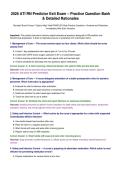
2026 ATI RN Predictor Exit Exam – Practice Question Bank
& Detailed Rationales
Standard Exam Format • Original High-Yield RN/NCLEX-Style Practice Questions • Answers and Rationales
Immediately After Each Question
Important: This practice document contains original educational questions designed for RN predictor and
NCLEX-style preparation. It does not reproduce secure or proprietary ATI examination items.
1. Management of Care — The nurse receives report on four clients. Which client should the nurse
assess first?
A. A client 1 day postoperative who reports pain of 7 on a 0-to-10 scale
B. A client with COPD whose oxygen saturation is 91% on prescribed oxygen
C. A client receiving a blood transfusion who reports chills and low back pain
D. A client scheduled for discharge who has questions about medications
Correct Answer: C. A client receiving a blood transfusion who reports chills and low back pain
Rationale: Chills and low back pain during a blood transfusion can indicate an acute hemolytic reaction. Stop the
transfusion and assess the client immediately.
2. Management of Care — A nurse delegates ambulation of a stable postoperative client to assistive
personnel. Which instruction is appropriate?
A. Evaluate the client's tolerance after ambulation
B. Ambulate the client and report dizziness or weakness immediately
C. Determine whether the client needs pain medication first
D. Teach the client how to use a walker
Correct Answer: B. Ambulate the client and report dizziness or weakness immediately
Rationale: Assistive personnel can perform routine ambulation for stable clients and report observations. Assessment,
evaluation, teaching, and clinical judgment remain the nurse's responsibility.
3. Safety and Infection Control — Which action by the nurse is appropriate for a client with suspected
Clostridioides difficile infection?
A. Use alcohol-based hand sanitizer after care
B. Place the client in a negative-pressure room
C. Wash hands with soap and water after removing gloves
D. Require staff to wear an N95 respirator
Correct Answer: C. Wash hands with soap and water after removing gloves
Rationale: Soap and water is preferred because C. difficile spores are not reliably removed by alcohol-based hand
sanitizer.
4. Safety and Infection Control — A nurse is preparing to administer medication. Which action is most
effective for preventing medication errors?
A. Prepare medications for several clients at one time
, B. Compare the medication label with the prescription three times
C. Ask another nurse to administer all high-alert medications
D. Document administration before giving the medication
Correct Answer: B. Compare the medication label with the prescription three times
Rationale: Using established medication checks and comparing the medication label with the prescription at key points
helps prevent administration errors.
5. Pharmacology — A client taking warfarin should report which finding to the provider immediately?
A. Increased appetite
B. Black, tarry stools
C. Mild fatigue after exercise
D. Dry mouth
Correct Answer: B. Black, tarry stools
Rationale: Black, tarry stools can indicate gastrointestinal bleeding, a serious adverse effect of anticoagulant therapy.
6. Pharmacology — The nurse should question a prescription for potassium chloride for a client who
has which finding?
A. Serum potassium 3.1 mEq/L
B. Urine output 15 mL/hr
C. Muscle weakness
D. Use of a loop diuretic
Correct Answer: B. Urine output 15 mL/hr
Rationale: Severely decreased urine output can impair potassium excretion and increase the risk of dangerous
hyperkalemia.
7. Adult Medical-Surgical — A client with chest pain receives nitroglycerin. Which finding requires
immediate follow-up?
A. Headache
B. Blood pressure 82/50 mm Hg
C. Facial flushing
D. Mild dizziness when standing
Correct Answer: B. Blood pressure 82/50 mm Hg
Rationale: Nitroglycerin can cause significant hypotension. A blood pressure of 82/50 mm Hg requires immediate
intervention.
8. Adult Medical-Surgical — Which finding is expected in a client experiencing left-sided heart failure?
A. Jugular vein distention
B. Peripheral edema only
C. Crackles in the lungs
D. Enlarged liver
Correct Answer: C. Crackles in the lungs
,Rationale: Left-sided heart failure causes pulmonary congestion, commonly producing crackles, dyspnea, and
orthopnea.
9. Maternal-Newborn — A postpartum client has a boggy uterus and heavy vaginal bleeding. Which
action should the nurse take first?
A. Notify the provider
B. Massage the fundus
C. Administer an analgesic
D. Prepare the client for discharge
Correct Answer: B. Massage the fundus
Rationale: A boggy uterus suggests uterine atony. Fundal massage is an immediate nursing intervention to promote
uterine contraction.
10. Maternal-Newborn — Which newborn finding should the nurse report immediately?
A. Acrocyanosis at 2 hours of age
B. Respiratory rate of 68/min with nasal flaring
C. Sleeping after feeding
D. Sneezing twice after birth
Correct Answer: B. Respiratory rate of 68/min with nasal flaring
Rationale: Tachypnea with nasal flaring indicates respiratory distress and requires prompt assessment.
11. Pediatrics — A nurse is caring for a child with suspected epiglottitis. Which action is appropriate?
A. Inspect the throat with a tongue blade
B. Obtain a throat culture immediately
C. Keep the child calm and avoid throat examination
D. Encourage the child to lie flat
Correct Answer: C. Keep the child calm and avoid throat examination
Rationale: Manipulating the throat can trigger complete airway obstruction. Keep the child calm and prepare for
emergency airway management.
12. Pediatrics — Which finding suggests dehydration in an infant?
A. Tears when crying
B. Bulging fontanel
C. Decreased number of wet diapers
D. Increased salivation
Correct Answer: C. Decreased number of wet diapers
Rationale: Decreased urine output is a common sign of dehydration in infants.
13. Mental Health — A client says, 'I have nothing left to live for.' Which response is the nurse's
priority?
A. 'You should think about your family.'
B. 'Are you thinking about killing yourself?'
, C. 'Everything will get better soon.'
D. 'Why do you feel that way?'
Correct Answer: B. 'Are you thinking about killing yourself?'
Rationale: The nurse should directly assess for suicidal ideation. Asking about suicide does not increase the risk and
helps determine immediate safety needs.
14. Mental Health — Which intervention is appropriate for a client experiencing a panic attack?
A. Leave the client alone to reduce stimulation
B. Give detailed explanations of the situation
C. Stay with the client and use short, simple statements
D. Encourage the client to make several decisions
Correct Answer: C. Stay with the client and use short, simple statements
Rationale: During a panic attack, the nurse should remain with the client, reduce stimulation, and communicate using
calm, simple directions.
15. Management of Care — The nurse receives report on four clients. Which client should the nurse
assess first?
A. A client 1 day postoperative who reports pain of 7 on a 0-to-10 scale
B. A client with COPD whose oxygen saturation is 91% on prescribed oxygen
C. A client receiving a blood transfusion who reports chills and low back pain
D. A client scheduled for discharge who has questions about medications
Correct Answer: C. A client receiving a blood transfusion who reports chills and low back pain
Rationale: Chills and low back pain during a blood transfusion can indicate an acute hemolytic reaction. Stop the
transfusion and assess the client immediately.
16. Management of Care — A nurse delegates ambulation of a stable postoperative client to assistive
personnel. Which instruction is appropriate?
A. Evaluate the client's tolerance after ambulation
B. Ambulate the client and report dizziness or weakness immediately
C. Determine whether the client needs pain medication first
D. Teach the client how to use a walker
Correct Answer: B. Ambulate the client and report dizziness or weakness immediately
Rationale: Assistive personnel can perform routine ambulation for stable clients and report observations. Assessment,
evaluation, teaching, and clinical judgment remain the nurse's responsibility.
17. Safety and Infection Control — Which action by the nurse is appropriate for a client with suspected
Clostridioides difficile infection?
A. Use alcohol-based hand sanitizer after care
B. Place the client in a negative-pressure room
C. Wash hands with soap and water after removing gloves
D. Require staff to wear an N95 respirator
Correct Answer: C. Wash hands with soap and water after removing gloves
& Detailed Rationales
Standard Exam Format • Original High-Yield RN/NCLEX-Style Practice Questions • Answers and Rationales
Immediately After Each Question
Important: This practice document contains original educational questions designed for RN predictor and
NCLEX-style preparation. It does not reproduce secure or proprietary ATI examination items.
1. Management of Care — The nurse receives report on four clients. Which client should the nurse
assess first?
A. A client 1 day postoperative who reports pain of 7 on a 0-to-10 scale
B. A client with COPD whose oxygen saturation is 91% on prescribed oxygen
C. A client receiving a blood transfusion who reports chills and low back pain
D. A client scheduled for discharge who has questions about medications
Correct Answer: C. A client receiving a blood transfusion who reports chills and low back pain
Rationale: Chills and low back pain during a blood transfusion can indicate an acute hemolytic reaction. Stop the
transfusion and assess the client immediately.
2. Management of Care — A nurse delegates ambulation of a stable postoperative client to assistive
personnel. Which instruction is appropriate?
A. Evaluate the client's tolerance after ambulation
B. Ambulate the client and report dizziness or weakness immediately
C. Determine whether the client needs pain medication first
D. Teach the client how to use a walker
Correct Answer: B. Ambulate the client and report dizziness or weakness immediately
Rationale: Assistive personnel can perform routine ambulation for stable clients and report observations. Assessment,
evaluation, teaching, and clinical judgment remain the nurse's responsibility.
3. Safety and Infection Control — Which action by the nurse is appropriate for a client with suspected
Clostridioides difficile infection?
A. Use alcohol-based hand sanitizer after care
B. Place the client in a negative-pressure room
C. Wash hands with soap and water after removing gloves
D. Require staff to wear an N95 respirator
Correct Answer: C. Wash hands with soap and water after removing gloves
Rationale: Soap and water is preferred because C. difficile spores are not reliably removed by alcohol-based hand
sanitizer.
4. Safety and Infection Control — A nurse is preparing to administer medication. Which action is most
effective for preventing medication errors?
A. Prepare medications for several clients at one time
, B. Compare the medication label with the prescription three times
C. Ask another nurse to administer all high-alert medications
D. Document administration before giving the medication
Correct Answer: B. Compare the medication label with the prescription three times
Rationale: Using established medication checks and comparing the medication label with the prescription at key points
helps prevent administration errors.
5. Pharmacology — A client taking warfarin should report which finding to the provider immediately?
A. Increased appetite
B. Black, tarry stools
C. Mild fatigue after exercise
D. Dry mouth
Correct Answer: B. Black, tarry stools
Rationale: Black, tarry stools can indicate gastrointestinal bleeding, a serious adverse effect of anticoagulant therapy.
6. Pharmacology — The nurse should question a prescription for potassium chloride for a client who
has which finding?
A. Serum potassium 3.1 mEq/L
B. Urine output 15 mL/hr
C. Muscle weakness
D. Use of a loop diuretic
Correct Answer: B. Urine output 15 mL/hr
Rationale: Severely decreased urine output can impair potassium excretion and increase the risk of dangerous
hyperkalemia.
7. Adult Medical-Surgical — A client with chest pain receives nitroglycerin. Which finding requires
immediate follow-up?
A. Headache
B. Blood pressure 82/50 mm Hg
C. Facial flushing
D. Mild dizziness when standing
Correct Answer: B. Blood pressure 82/50 mm Hg
Rationale: Nitroglycerin can cause significant hypotension. A blood pressure of 82/50 mm Hg requires immediate
intervention.
8. Adult Medical-Surgical — Which finding is expected in a client experiencing left-sided heart failure?
A. Jugular vein distention
B. Peripheral edema only
C. Crackles in the lungs
D. Enlarged liver
Correct Answer: C. Crackles in the lungs
,Rationale: Left-sided heart failure causes pulmonary congestion, commonly producing crackles, dyspnea, and
orthopnea.
9. Maternal-Newborn — A postpartum client has a boggy uterus and heavy vaginal bleeding. Which
action should the nurse take first?
A. Notify the provider
B. Massage the fundus
C. Administer an analgesic
D. Prepare the client for discharge
Correct Answer: B. Massage the fundus
Rationale: A boggy uterus suggests uterine atony. Fundal massage is an immediate nursing intervention to promote
uterine contraction.
10. Maternal-Newborn — Which newborn finding should the nurse report immediately?
A. Acrocyanosis at 2 hours of age
B. Respiratory rate of 68/min with nasal flaring
C. Sleeping after feeding
D. Sneezing twice after birth
Correct Answer: B. Respiratory rate of 68/min with nasal flaring
Rationale: Tachypnea with nasal flaring indicates respiratory distress and requires prompt assessment.
11. Pediatrics — A nurse is caring for a child with suspected epiglottitis. Which action is appropriate?
A. Inspect the throat with a tongue blade
B. Obtain a throat culture immediately
C. Keep the child calm and avoid throat examination
D. Encourage the child to lie flat
Correct Answer: C. Keep the child calm and avoid throat examination
Rationale: Manipulating the throat can trigger complete airway obstruction. Keep the child calm and prepare for
emergency airway management.
12. Pediatrics — Which finding suggests dehydration in an infant?
A. Tears when crying
B. Bulging fontanel
C. Decreased number of wet diapers
D. Increased salivation
Correct Answer: C. Decreased number of wet diapers
Rationale: Decreased urine output is a common sign of dehydration in infants.
13. Mental Health — A client says, 'I have nothing left to live for.' Which response is the nurse's
priority?
A. 'You should think about your family.'
B. 'Are you thinking about killing yourself?'
, C. 'Everything will get better soon.'
D. 'Why do you feel that way?'
Correct Answer: B. 'Are you thinking about killing yourself?'
Rationale: The nurse should directly assess for suicidal ideation. Asking about suicide does not increase the risk and
helps determine immediate safety needs.
14. Mental Health — Which intervention is appropriate for a client experiencing a panic attack?
A. Leave the client alone to reduce stimulation
B. Give detailed explanations of the situation
C. Stay with the client and use short, simple statements
D. Encourage the client to make several decisions
Correct Answer: C. Stay with the client and use short, simple statements
Rationale: During a panic attack, the nurse should remain with the client, reduce stimulation, and communicate using
calm, simple directions.
15. Management of Care — The nurse receives report on four clients. Which client should the nurse
assess first?
A. A client 1 day postoperative who reports pain of 7 on a 0-to-10 scale
B. A client with COPD whose oxygen saturation is 91% on prescribed oxygen
C. A client receiving a blood transfusion who reports chills and low back pain
D. A client scheduled for discharge who has questions about medications
Correct Answer: C. A client receiving a blood transfusion who reports chills and low back pain
Rationale: Chills and low back pain during a blood transfusion can indicate an acute hemolytic reaction. Stop the
transfusion and assess the client immediately.
16. Management of Care — A nurse delegates ambulation of a stable postoperative client to assistive
personnel. Which instruction is appropriate?
A. Evaluate the client's tolerance after ambulation
B. Ambulate the client and report dizziness or weakness immediately
C. Determine whether the client needs pain medication first
D. Teach the client how to use a walker
Correct Answer: B. Ambulate the client and report dizziness or weakness immediately
Rationale: Assistive personnel can perform routine ambulation for stable clients and report observations. Assessment,
evaluation, teaching, and clinical judgment remain the nurse's responsibility.
17. Safety and Infection Control — Which action by the nurse is appropriate for a client with suspected
Clostridioides difficile infection?
A. Use alcohol-based hand sanitizer after care
B. Place the client in a negative-pressure room
C. Wash hands with soap and water after removing gloves
D. Require staff to wear an N95 respirator
Correct Answer: C. Wash hands with soap and water after removing gloves


