
TEST BANK FOR PROFESSIONAL NURSING CONCEPTS &
CHALLENGES 9TH EDITION BETH BLACK ALL CHAPTERS
INCLUDED
ORIGINAL EXAM STYLE PRACTICE QUESTIONS
This study bank contains original practice questions aligned to the published chapter themes of the 9th edition. It is not a reproduction of
Elsevier's proprietary test bank or actual examination items.
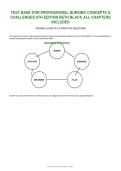
NURSING PROCESS
ASSESS
EVALUATE DIAGNOSE
IMPLEMENT PLAN
Answer key is built into each item: incorrect choices use a large dot; the correct choice uses a large checked box.
Professional Nursing Mastery • Page 1
,NURSING IN TODAYS EVOLVING HEALTH CARE ENVIRONMENT
EVIDENCE HIERARCHY FOR PRACTICE
SYSTEMATIC REVIEWS / META-ANALYSES
RANDOMIZED TRIALS
COHORT / CASE-CONTROL STUDIES
QUALITATIVE / DESCRIPTIVE STUDIES
EXPERT OPINION / TRADITION
1. A nurse explains that quality improvement primarily focuses on:
■ Identifying trends and improving care processes
• Replacing the nursing process
• Eliminating all clinical uncertainty
• Assigning blame after errors
2. Which action best demonstrates patient-centered care?
• Choosing the plan without patient input
■ Including the patient in decisions about goals and preferences
• Using the same teaching plan for every patient
• Delegating all communication to unlicensed staff
3. A nurse using an electronic health record should first prioritize:
■ Accurate, timely documentation
• Copying yesterday's assessment unchanged
• Sharing passwords with coworkers
• Documenting before assessing
4. Which activity best reflects care coordination?
• Repeating the same assessment independently
■ Organizing services across settings to promote continuity
• Avoiding communication with other disciplines
• Limiting the patient to one provider
5. A nurse recognizes a health disparity when a population:
Professional Nursing Mastery • Page 2
, ■ Has unequal access or outcomes linked to social conditions
• Receives individualized education
• Uses preventive services
• Has access to primary care
6. Which statement best describes population health?
• It focuses only on hospitalized patients
■ It considers health outcomes of groups and factors affecting them
• It excludes prevention
• It is limited to infectious disease
7. A nurse advocates for health literacy by:
• Using complex medical terminology
■ Asking the patient to explain instructions in their own words
• Providing only written information
• Speaking louder to every patient
8. Which technology-related behavior protects patient privacy?
• Leaving the EHR open
■ Using an individual secure login
• Posting de-identified stories publicly without policy review
• Sharing passwords during busy shifts
9. A nurse notices a recurring medication-delay problem. The best first quality-improvement action is to:
■ Define and measure the problem
• Blame the pharmacy
• Change the policy immediately
• Ignore isolated reports
10. Which example represents evidence-informed practice?
• Using habit alone
■ Combining best evidence with clinical expertise and patient preferences
• Following social media advice
• Avoiding research findings
11. A patient with multiple chronic conditions is most likely to benefit from:
• Fragmented care
■ Coordinated interdisciplinary care
• Duplicate prescriptions
Professional Nursing Mastery • Page 3
, • No follow-up
12. Which nursing action most directly promotes safety culture?
• Hiding near misses
■ Reporting hazards and learning from system failures
• Punishing every reporter
• Avoiding incident review
13. Telehealth is most useful when it:
• Always replaces physical assessment
■ Provides appropriate remote access while recognizing its limitations
• Eliminates privacy concerns
• Requires no patient education
14. A nurse supports social justice by:
■ Advocating for fair access to needed care
• Treating social factors as irrelevant
• Using stereotypes to guide care
• Providing fewer resources to vulnerable groups
15. Which trend has increased the need for nurses skilled in care transitions?
• Patients routinely staying in one setting for months
■ Shorter hospital stays and more movement among care settings
• Elimination of chronic illness
• Fewer outpatient services
16. A nurse using quality-improvement data should look for:
■ Patterns and trends over time
• One isolated opinion only
• Personal blame
• Unverified rumors
17. Patient safety improves when nurses:
■ Use standardized processes while responding to individual patient needs
• Avoid checklists
• Skip verification
• Rely only on memory
18. A nurse should escalate a safety concern when:
■ The concern remains unresolved and could harm the patient
Professional Nursing Mastery • Page 4
CHALLENGES 9TH EDITION BETH BLACK ALL CHAPTERS
INCLUDED
ORIGINAL EXAM STYLE PRACTICE QUESTIONS
This study bank contains original practice questions aligned to the published chapter themes of the 9th edition. It is not a reproduction of
Elsevier's proprietary test bank or actual examination items.
NURSING PROCESS
ASSESS
EVALUATE DIAGNOSE
IMPLEMENT PLAN
Answer key is built into each item: incorrect choices use a large dot; the correct choice uses a large checked box.
Professional Nursing Mastery • Page 1
,NURSING IN TODAYS EVOLVING HEALTH CARE ENVIRONMENT
EVIDENCE HIERARCHY FOR PRACTICE
SYSTEMATIC REVIEWS / META-ANALYSES
RANDOMIZED TRIALS
COHORT / CASE-CONTROL STUDIES
QUALITATIVE / DESCRIPTIVE STUDIES
EXPERT OPINION / TRADITION
1. A nurse explains that quality improvement primarily focuses on:
■ Identifying trends and improving care processes
• Replacing the nursing process
• Eliminating all clinical uncertainty
• Assigning blame after errors
2. Which action best demonstrates patient-centered care?
• Choosing the plan without patient input
■ Including the patient in decisions about goals and preferences
• Using the same teaching plan for every patient
• Delegating all communication to unlicensed staff
3. A nurse using an electronic health record should first prioritize:
■ Accurate, timely documentation
• Copying yesterday's assessment unchanged
• Sharing passwords with coworkers
• Documenting before assessing
4. Which activity best reflects care coordination?
• Repeating the same assessment independently
■ Organizing services across settings to promote continuity
• Avoiding communication with other disciplines
• Limiting the patient to one provider
5. A nurse recognizes a health disparity when a population:
Professional Nursing Mastery • Page 2
, ■ Has unequal access or outcomes linked to social conditions
• Receives individualized education
• Uses preventive services
• Has access to primary care
6. Which statement best describes population health?
• It focuses only on hospitalized patients
■ It considers health outcomes of groups and factors affecting them
• It excludes prevention
• It is limited to infectious disease
7. A nurse advocates for health literacy by:
• Using complex medical terminology
■ Asking the patient to explain instructions in their own words
• Providing only written information
• Speaking louder to every patient
8. Which technology-related behavior protects patient privacy?
• Leaving the EHR open
■ Using an individual secure login
• Posting de-identified stories publicly without policy review
• Sharing passwords during busy shifts
9. A nurse notices a recurring medication-delay problem. The best first quality-improvement action is to:
■ Define and measure the problem
• Blame the pharmacy
• Change the policy immediately
• Ignore isolated reports
10. Which example represents evidence-informed practice?
• Using habit alone
■ Combining best evidence with clinical expertise and patient preferences
• Following social media advice
• Avoiding research findings
11. A patient with multiple chronic conditions is most likely to benefit from:
• Fragmented care
■ Coordinated interdisciplinary care
• Duplicate prescriptions
Professional Nursing Mastery • Page 3
, • No follow-up
12. Which nursing action most directly promotes safety culture?
• Hiding near misses
■ Reporting hazards and learning from system failures
• Punishing every reporter
• Avoiding incident review
13. Telehealth is most useful when it:
• Always replaces physical assessment
■ Provides appropriate remote access while recognizing its limitations
• Eliminates privacy concerns
• Requires no patient education
14. A nurse supports social justice by:
■ Advocating for fair access to needed care
• Treating social factors as irrelevant
• Using stereotypes to guide care
• Providing fewer resources to vulnerable groups
15. Which trend has increased the need for nurses skilled in care transitions?
• Patients routinely staying in one setting for months
■ Shorter hospital stays and more movement among care settings
• Elimination of chronic illness
• Fewer outpatient services
16. A nurse using quality-improvement data should look for:
■ Patterns and trends over time
• One isolated opinion only
• Personal blame
• Unverified rumors
17. Patient safety improves when nurses:
■ Use standardized processes while responding to individual patient needs
• Avoid checklists
• Skip verification
• Rely only on memory
18. A nurse should escalate a safety concern when:
■ The concern remains unresolved and could harm the patient
Professional Nursing Mastery • Page 4


