
NZ NURSING STATE EXAM & PRACTICE EXAM 2026
NEW ZEALAND REGISTERED NURSE STATE FINAL EXAM PREP — 250 ORIGINAL
PRACTICE QUESTIONS WITH CORRECT ANSWERS & RATIONALES
Important: These are original practice questions aligned to publicly available Nursing Council of New Zealand exam structure, sample-question style, and
current competency themes. They are not leaked or claimed to be actual 2026 exam questions. The Nursing Council states that its published sample
questions are examples and are not used in the actual examination.
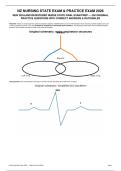
Visual practice: Use the respiratory schematic to reinforce airway, breathing and assessment concepts.
NZ Nursing State Exam 2026 — Original Practice Bank Page 1
,1. [Professional responsibility] A registered nurse discovers that a medication error reached a patient. What is the
nurse's priority?
Wait to see whether symptoms develop
Ask a colleague to decide what to do
Document only after the end of the shift
Assess the patient and respond to any harm
Correct answer: Assess the patient and respond to any harm
Rationale: Immediate patient safety comes first. The nurse assesses the patient, initiates appropriate care, and escalates
according to policy.
2. [Professional responsibility] Under the Health Practitioners Competence Assurance framework, the primary purpose
of nurse regulation is to:
Protect the health and safety of the public
Set hospital staffing ratios
Guarantee employment for registered nurses
Protect nurses from all complaints
Correct answer: Protect the health and safety of the public
Rationale: The Nursing Council's statutory role centres on competence and protection of the public.
3. [Professional responsibility] A competent adult refuses a recommended procedure after receiving understandable
information. The nurse should first:
Respect the refusal and document the discussion
Proceed because the treatment is beneficial
Ask a family member to consent instead
Threaten discharge if the patient refuses
Correct answer: Respect the refusal and document the discussion
Rationale: A competent person may refuse care. The nurse should ensure the decision is informed, respect it, and document it.
4. [Professional responsibility] Which action best demonstrates professional accountability?
Avoiding documentation of uncertainty
Delegating without checking competence
Recognising limits and seeking assistance when required
Accepting every task to appear confident
Correct answer: Recognising limits and seeking assistance when required
Rationale: Accountability includes practising within competence and seeking help when necessary.
NZ Nursing State Exam 2026 — Original Practice Bank Page 2
,5. [Professional responsibility] A nurse is asked to perform a procedure outside their competence. What is the safest
response?
Ask the patient to decide
Proceed if the ward is busy
Perform it once while supervised by another unqualified person
Explain the limitation and seek an appropriately competent practitioner
Correct answer: Explain the limitation and seek an appropriately competent practitioner
Rationale: The nurse must practise within competence and arrange safe care.
6. [Cultural safety] A patient explains that a health practice has cultural significance. The nurse should:
Tell the patient hospital routines are more important
Assume the practice is harmless and ignore it
Ask the patient what the practice means to them and incorporate it where safe
Ask another patient from the same culture to explain it
Correct answer: Ask the patient what the practice means to them and incorporate it where safe
Rationale: Culturally safe care starts with the person's own perspective and avoids stereotyping.
7. [Cultural safety] Which approach is most consistent with cultural safety?
Avoiding discussion of culture
Learning a fixed list of traits for every culture
Reflecting on how the nurse's own assumptions affect care
Treating everyone identically regardless of context
Correct answer: Reflecting on how the nurse's own assumptions affect care
Rationale: Cultural safety requires self-reflection and attention to power, assumptions and the person's experience.
8. [Te Tiriti] In nursing practice, partnership under Te Tiriti o Waitangi is best reflected by:
Working collaboratively with M■ori patients and wh■nau in decisions about care
Delegating cultural issues to administration
Making decisions without involving wh■nau
Using the same plan for every patient
Correct answer: Working collaboratively with M■ori patients and wh■nau in decisions about care
Rationale: Partnership supports shared decision-making and respectful relationships.
9. [Privacy] A visitor asks for information about a patient's diagnosis. The patient has not given permission. The nurse
should:
Provide a brief summary because the visitor is family
Decline to disclose confidential information
Ask another visitor to answer
Give information if the visitor knows the patient's name
Correct answer: Decline to disclose confidential information
Rationale: Confidential health information should not be disclosed without appropriate authority or consent.
10. [Documentation] Which documentation entry is most appropriate?
Normal today.
Patient was difficult and finally settled.
14:10: Patient reports pain 7/10; observations stable; analgesia given as prescribed; reassessed at 14:40 with pain 3/10.
Pain medication given, seems better.
Correct answer: 14:10: Patient reports pain 7/10; observations stable; analgesia given as prescribed; reassessed at 14:40 with
pain 3/10.
Rationale: Documentation should be objective, specific, timed and clinically relevant.
11. [Consent] Before a procedure, the patient says, 'I do not understand what you are going to do.' The nurse should:
Proceed and explain afterward
Pause and ensure the patient receives an appropriate explanation before proceeding
Continue because the consent form is signed
Ask the family to explain it
Correct answer: Pause and ensure the patient receives an appropriate explanation before proceeding
Rationale: Consent must be informed and voluntary; lack of understanding requires clarification before proceeding.
NZ Nursing State Exam 2026 — Original Practice Bank Page 3
, 12. [Delegation] When delegating a task, the registered nurse remains responsible for:
Transferring all accountability to the delegate
Doing the task personally every time
Ensuring the task is appropriate, the person is competent, and follow-up occurs
Only checking the task if something goes wrong
Correct answer: Ensuring the task is appropriate, the person is competent, and follow-up occurs
Rationale: Safe delegation requires appropriate assignment, competence and supervision/evaluation.
13. [Incident reporting] The main purpose of an incident report is to:
Support safety learning and risk management
Hide the event from the patient
Replace clinical documentation
Punish the nurse automatically
Correct answer: Support safety learning and risk management
Rationale: Incident reporting supports organisational learning and risk reduction; it does not replace the clinical record.
14. [Professional boundaries] A patient offers the nurse an expensive gift. The best response is to:
Exchange gifts with the patient
Accept it because refusal may offend
Accept it secretly
Decline or manage it according to professional and organisational boundary guidance
Correct answer: Decline or manage it according to professional and organisational boundary guidance
Rationale: Expensive gifts can create conflicts of interest or boundary concerns.
15. [Social media] A nurse posts a photo from a clinical area with the patient's face blurred but identifiable details visible.
This is:
Required for professional education
Acceptable if posted outside work hours
Always acceptable if the face is hidden
A potential confidentiality and privacy breach
Correct answer: A potential confidentiality and privacy breach
Rationale: Identifying details can remain even when a face is blurred; professional confidentiality still applies.
16. [Duty of care] A nurse notices a colleague repeatedly skipping required safety checks. The most appropriate action is
to:
Address/escalate the concern through appropriate safety and professional channels
Ignore it because the colleague is senior
Post about it online
Wait until a patient is harmed
Correct answer: Address/escalate the concern through appropriate safety and professional channels
Rationale: Unsafe practice should be addressed promptly through appropriate escalation pathways.
17. [Open disclosure] After an adverse event, open disclosure generally requires the nurse to:
Communicate honestly and appropriately, acknowledge what is known, and escalate according to policy
Hide the event to prevent distress
Change the record
Blame another staff member
Correct answer: Communicate honestly and appropriately, acknowledge what is known, and escalate according to policy
Rationale: Transparent communication and appropriate escalation are core components of safe practice after harm.
18. [Interpreter] A patient has limited English and a complex consent discussion is required. The best option is:
Use a young child as interpreter
Ask another patient to translate
Speak louder in English
Use an appropriate professional interpreter service
Correct answer: Use an appropriate professional interpreter service
Rationale: Professional interpreters improve accuracy, confidentiality and informed decision-making.
NZ Nursing State Exam 2026 — Original Practice Bank Page 4
NEW ZEALAND REGISTERED NURSE STATE FINAL EXAM PREP — 250 ORIGINAL
PRACTICE QUESTIONS WITH CORRECT ANSWERS & RATIONALES
Important: These are original practice questions aligned to publicly available Nursing Council of New Zealand exam structure, sample-question style, and
current competency themes. They are not leaked or claimed to be actual 2026 exam questions. The Nursing Council states that its published sample
questions are examples and are not used in the actual examination.
Visual practice: Use the respiratory schematic to reinforce airway, breathing and assessment concepts.
NZ Nursing State Exam 2026 — Original Practice Bank Page 1
,1. [Professional responsibility] A registered nurse discovers that a medication error reached a patient. What is the
nurse's priority?
Wait to see whether symptoms develop
Ask a colleague to decide what to do
Document only after the end of the shift
Assess the patient and respond to any harm
Correct answer: Assess the patient and respond to any harm
Rationale: Immediate patient safety comes first. The nurse assesses the patient, initiates appropriate care, and escalates
according to policy.
2. [Professional responsibility] Under the Health Practitioners Competence Assurance framework, the primary purpose
of nurse regulation is to:
Protect the health and safety of the public
Set hospital staffing ratios
Guarantee employment for registered nurses
Protect nurses from all complaints
Correct answer: Protect the health and safety of the public
Rationale: The Nursing Council's statutory role centres on competence and protection of the public.
3. [Professional responsibility] A competent adult refuses a recommended procedure after receiving understandable
information. The nurse should first:
Respect the refusal and document the discussion
Proceed because the treatment is beneficial
Ask a family member to consent instead
Threaten discharge if the patient refuses
Correct answer: Respect the refusal and document the discussion
Rationale: A competent person may refuse care. The nurse should ensure the decision is informed, respect it, and document it.
4. [Professional responsibility] Which action best demonstrates professional accountability?
Avoiding documentation of uncertainty
Delegating without checking competence
Recognising limits and seeking assistance when required
Accepting every task to appear confident
Correct answer: Recognising limits and seeking assistance when required
Rationale: Accountability includes practising within competence and seeking help when necessary.
NZ Nursing State Exam 2026 — Original Practice Bank Page 2
,5. [Professional responsibility] A nurse is asked to perform a procedure outside their competence. What is the safest
response?
Ask the patient to decide
Proceed if the ward is busy
Perform it once while supervised by another unqualified person
Explain the limitation and seek an appropriately competent practitioner
Correct answer: Explain the limitation and seek an appropriately competent practitioner
Rationale: The nurse must practise within competence and arrange safe care.
6. [Cultural safety] A patient explains that a health practice has cultural significance. The nurse should:
Tell the patient hospital routines are more important
Assume the practice is harmless and ignore it
Ask the patient what the practice means to them and incorporate it where safe
Ask another patient from the same culture to explain it
Correct answer: Ask the patient what the practice means to them and incorporate it where safe
Rationale: Culturally safe care starts with the person's own perspective and avoids stereotyping.
7. [Cultural safety] Which approach is most consistent with cultural safety?
Avoiding discussion of culture
Learning a fixed list of traits for every culture
Reflecting on how the nurse's own assumptions affect care
Treating everyone identically regardless of context
Correct answer: Reflecting on how the nurse's own assumptions affect care
Rationale: Cultural safety requires self-reflection and attention to power, assumptions and the person's experience.
8. [Te Tiriti] In nursing practice, partnership under Te Tiriti o Waitangi is best reflected by:
Working collaboratively with M■ori patients and wh■nau in decisions about care
Delegating cultural issues to administration
Making decisions without involving wh■nau
Using the same plan for every patient
Correct answer: Working collaboratively with M■ori patients and wh■nau in decisions about care
Rationale: Partnership supports shared decision-making and respectful relationships.
9. [Privacy] A visitor asks for information about a patient's diagnosis. The patient has not given permission. The nurse
should:
Provide a brief summary because the visitor is family
Decline to disclose confidential information
Ask another visitor to answer
Give information if the visitor knows the patient's name
Correct answer: Decline to disclose confidential information
Rationale: Confidential health information should not be disclosed without appropriate authority or consent.
10. [Documentation] Which documentation entry is most appropriate?
Normal today.
Patient was difficult and finally settled.
14:10: Patient reports pain 7/10; observations stable; analgesia given as prescribed; reassessed at 14:40 with pain 3/10.
Pain medication given, seems better.
Correct answer: 14:10: Patient reports pain 7/10; observations stable; analgesia given as prescribed; reassessed at 14:40 with
pain 3/10.
Rationale: Documentation should be objective, specific, timed and clinically relevant.
11. [Consent] Before a procedure, the patient says, 'I do not understand what you are going to do.' The nurse should:
Proceed and explain afterward
Pause and ensure the patient receives an appropriate explanation before proceeding
Continue because the consent form is signed
Ask the family to explain it
Correct answer: Pause and ensure the patient receives an appropriate explanation before proceeding
Rationale: Consent must be informed and voluntary; lack of understanding requires clarification before proceeding.
NZ Nursing State Exam 2026 — Original Practice Bank Page 3
, 12. [Delegation] When delegating a task, the registered nurse remains responsible for:
Transferring all accountability to the delegate
Doing the task personally every time
Ensuring the task is appropriate, the person is competent, and follow-up occurs
Only checking the task if something goes wrong
Correct answer: Ensuring the task is appropriate, the person is competent, and follow-up occurs
Rationale: Safe delegation requires appropriate assignment, competence and supervision/evaluation.
13. [Incident reporting] The main purpose of an incident report is to:
Support safety learning and risk management
Hide the event from the patient
Replace clinical documentation
Punish the nurse automatically
Correct answer: Support safety learning and risk management
Rationale: Incident reporting supports organisational learning and risk reduction; it does not replace the clinical record.
14. [Professional boundaries] A patient offers the nurse an expensive gift. The best response is to:
Exchange gifts with the patient
Accept it because refusal may offend
Accept it secretly
Decline or manage it according to professional and organisational boundary guidance
Correct answer: Decline or manage it according to professional and organisational boundary guidance
Rationale: Expensive gifts can create conflicts of interest or boundary concerns.
15. [Social media] A nurse posts a photo from a clinical area with the patient's face blurred but identifiable details visible.
This is:
Required for professional education
Acceptable if posted outside work hours
Always acceptable if the face is hidden
A potential confidentiality and privacy breach
Correct answer: A potential confidentiality and privacy breach
Rationale: Identifying details can remain even when a face is blurred; professional confidentiality still applies.
16. [Duty of care] A nurse notices a colleague repeatedly skipping required safety checks. The most appropriate action is
to:
Address/escalate the concern through appropriate safety and professional channels
Ignore it because the colleague is senior
Post about it online
Wait until a patient is harmed
Correct answer: Address/escalate the concern through appropriate safety and professional channels
Rationale: Unsafe practice should be addressed promptly through appropriate escalation pathways.
17. [Open disclosure] After an adverse event, open disclosure generally requires the nurse to:
Communicate honestly and appropriately, acknowledge what is known, and escalate according to policy
Hide the event to prevent distress
Change the record
Blame another staff member
Correct answer: Communicate honestly and appropriately, acknowledge what is known, and escalate according to policy
Rationale: Transparent communication and appropriate escalation are core components of safe practice after harm.
18. [Interpreter] A patient has limited English and a complex consent discussion is required. The best option is:
Use a young child as interpreter
Ask another patient to translate
Speak louder in English
Use an appropriate professional interpreter service
Correct answer: Use an appropriate professional interpreter service
Rationale: Professional interpreters improve accuracy, confidentiality and informed decision-making.
NZ Nursing State Exam 2026 — Original Practice Bank Page 4


