
WGU D551 FRAUD AND FORENSIC ACCOUNTING —
250-QUESTION OBJECTIVE ASSESSMENT PRACTICE EXAM
2026/2027
Original study questions — not official WGU questions, not leaked/released exam content, and not a guarantee of a passing score.
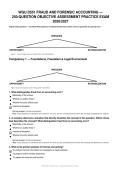
PRESSURE
OPPORTUNITY RATIONALIZATION
Figure 1. Fraud triangle: pressure, opportunity, and rationalization.
Competency 1 — Foundations, Fraudsters & Legal Environment
PRESSURE
OPPORTUNITY RATIONALIZATION
Figure: fraud-risk concepts used in the questions that follow.
1. What distinguishes fraud from an accounting error?
Materiality of the amount
Whether an auditor finds it
Whether the entry affects cash
Intentional deception
Correct answer: Intentional deception
Why: Fraud requires an intentional act to deceive. An error can be unintentional even when the resulting misstatement is material.
2. A company discovers a situation that directly illustrates the concept in this question. Which choice
best describes the concept? What distinguishes fraud from an accounting error?
Materiality of the amount
Whether an auditor finds it
Intentional deception
Whether the entry affects cash
Correct answer: Intentional deception
Why: Fraud requires an intentional act to deceive. An error can be unintentional even when the resulting misstatement is material.
3. What is the primary purpose of forensic accounting?
To analyze financial information for investigative or legal purposes
To prepare routine monthly statements
To replace the external audit function
WGU D551 Practice Exam • Original Study Material • Page 1
, To set an entity’s tax rate
Correct answer: To analyze financial information for investigative or legal purposes
Why: Forensic accounting combines accounting and investigative skills and often produces work that can support disputes,
investigations, or litigation.
4. An investigator encounters a fact pattern involving this concept. Which choice is the best
interpretation? What is the primary purpose of forensic accounting?
To prepare routine monthly statements
To replace the external audit function
To analyze financial information for investigative or legal purposes
To set an entity’s tax rate
Correct answer: To analyze financial information for investigative or legal purposes
Why: Forensic accounting combines accounting and investigative skills and often produces work that can support disputes,
investigations, or litigation.
5. Which three elements form the traditional fraud triangle?
Pressure, opportunity, and rationalization
Intent, materiality, and evidence
Capability, concealment, and collusion
Incentive, access, and detection
Correct answer: Pressure, opportunity, and rationalization
Why: The fraud triangle explains fraud risk through perceived pressure, perceived opportunity, and rationalization.
6. A company discovers a situation that directly illustrates the concept in this question. Which choice
best describes the concept? Which three elements form the traditional fraud triangle?
Capability, concealment, and collusion
Incentive, access, and detection
Pressure, opportunity, and rationalization
Intent, materiality, and evidence
Correct answer: Pressure, opportunity, and rationalization
Why: The fraud triangle explains fraud risk through perceived pressure, perceived opportunity, and rationalization.
7. In the fraud triangle, what does opportunity refer to?
A personal financial need
The amount of the expected loss
A belief that the act is morally acceptable
A perceived chance to commit and conceal fraud
Correct answer: A perceived chance to commit and conceal fraud
Why: Opportunity is created by weaknesses such as poor segregation of duties, weak oversight, or excessive access.
8. An investigator encounters a fact pattern involving this concept. Which choice is the best
interpretation? In the fraud triangle, what does opportunity refer to?
A belief that the act is morally acceptable
A perceived chance to commit and conceal fraud
A personal financial need
The amount of the expected loss
WGU D551 Practice Exam • Original Study Material • Page 2
, Correct answer: A perceived chance to commit and conceal fraud
Why: Opportunity is created by weaknesses such as poor segregation of duties, weak oversight, or excessive access.
9. Which concept was added by the fraud diamond?
Independence
Litigation support
Capability
Materiality
Correct answer: Capability
Why: The fraud diamond adds capability—the skills, position, confidence, and ability needed to exploit an opportunity and sustain the
scheme.
10. A company discovers a situation that directly illustrates the concept in this question. Which choice
best describes the concept? Which concept was added by the fraud diamond?
Litigation support
Capability
Independence
Materiality
Correct answer: Capability
Why: The fraud diamond adds capability—the skills, position, confidence, and ability needed to exploit an opportunity and sustain the
scheme.
11. Which behavior is most directly an example of rationalization?
“The employee can approve and record payments.”
“The company owes me because I work harder than everyone else.”
“The accounting system has excessive access.”
“My medical bills are unexpectedly high.”
Correct answer: “The company owes me because I work harder than everyone else.”
Why: Rationalization is the perpetrator’s justification for wrongdoing, often framing the act as deserved, temporary, or harmless.
12. An investigator encounters a fact pattern involving this concept. Which choice is the best
interpretation? Which behavior is most directly an example of rationalization?
“The accounting system has excessive access.”
“The employee can approve and record payments.”
“The company owes me because I work harder than everyone else.”
“My medical bills are unexpectedly high.”
Correct answer: “The company owes me because I work harder than everyone else.”
Why: Rationalization is the perpetrator’s justification for wrongdoing, often framing the act as deserved, temporary, or harmless.
13. Which type of fraud is generally classified as an asset misappropriation?
Hiding a liability
Stealing cash collections
Falsifying revenue recognition
Manipulating a valuation estimate
Correct answer: Stealing cash collections
Why: Asset misappropriation involves theft or misuse of an organization’s assets, including cash, inventory, or other property.
WGU D551 Practice Exam • Original Study Material • Page 3
, 14. A company discovers a situation that directly illustrates the concept in this question. Which choice
best describes the concept? Which type of fraud is generally classified as an asset misappropriation?
Hiding a liability
Falsifying revenue recognition
Manipulating a valuation estimate
Stealing cash collections
Correct answer: Stealing cash collections
Why: Asset misappropriation involves theft or misuse of an organization’s assets, including cash, inventory, or other property.
15. Which is an example of corruption?
Deleting an accounting entry by mistake
Overstating inventory
Stealing office supplies
Accepting a kickback from a vendor
Correct answer: Accepting a kickback from a vendor
Why: Corruption includes schemes involving conflicts of interest, bribery, illegal gratuities, or similar abuse of influence.
Cash-Scheme Review Flow
Customer payment Receipt record Bank deposit Ledger Reconciliation
Figure: trace a cash transaction across independent records.
16. An investigator encounters a fact pattern involving this concept. Which choice is the best
interpretation? Which is an example of corruption?
Accepting a kickback from a vendor
Stealing office supplies
Deleting an accounting entry by mistake
Overstating inventory
Correct answer: Accepting a kickback from a vendor
Why: Corruption includes schemes involving conflicts of interest, bribery, illegal gratuities, or similar abuse of influence.
17. What is financial statement fraud?
Intentional misstatement or omission in financial reporting
Any bookkeeping mistake
Any employee theft
A disagreement over an accounting estimate
Correct answer: Intentional misstatement or omission in financial reporting
Why: Financial statement fraud intentionally distorts reported financial condition or performance through misstatement or omission.
18. A company discovers a situation that directly illustrates the concept in this question. Which choice
best describes the concept? What is financial statement fraud?
Intentional misstatement or omission in financial reporting
WGU D551 Practice Exam • Original Study Material • Page 4
250-QUESTION OBJECTIVE ASSESSMENT PRACTICE EXAM
2026/2027
Original study questions — not official WGU questions, not leaked/released exam content, and not a guarantee of a passing score.
PRESSURE
OPPORTUNITY RATIONALIZATION
Figure 1. Fraud triangle: pressure, opportunity, and rationalization.
Competency 1 — Foundations, Fraudsters & Legal Environment
PRESSURE
OPPORTUNITY RATIONALIZATION
Figure: fraud-risk concepts used in the questions that follow.
1. What distinguishes fraud from an accounting error?
Materiality of the amount
Whether an auditor finds it
Whether the entry affects cash
Intentional deception
Correct answer: Intentional deception
Why: Fraud requires an intentional act to deceive. An error can be unintentional even when the resulting misstatement is material.
2. A company discovers a situation that directly illustrates the concept in this question. Which choice
best describes the concept? What distinguishes fraud from an accounting error?
Materiality of the amount
Whether an auditor finds it
Intentional deception
Whether the entry affects cash
Correct answer: Intentional deception
Why: Fraud requires an intentional act to deceive. An error can be unintentional even when the resulting misstatement is material.
3. What is the primary purpose of forensic accounting?
To analyze financial information for investigative or legal purposes
To prepare routine monthly statements
To replace the external audit function
WGU D551 Practice Exam • Original Study Material • Page 1
, To set an entity’s tax rate
Correct answer: To analyze financial information for investigative or legal purposes
Why: Forensic accounting combines accounting and investigative skills and often produces work that can support disputes,
investigations, or litigation.
4. An investigator encounters a fact pattern involving this concept. Which choice is the best
interpretation? What is the primary purpose of forensic accounting?
To prepare routine monthly statements
To replace the external audit function
To analyze financial information for investigative or legal purposes
To set an entity’s tax rate
Correct answer: To analyze financial information for investigative or legal purposes
Why: Forensic accounting combines accounting and investigative skills and often produces work that can support disputes,
investigations, or litigation.
5. Which three elements form the traditional fraud triangle?
Pressure, opportunity, and rationalization
Intent, materiality, and evidence
Capability, concealment, and collusion
Incentive, access, and detection
Correct answer: Pressure, opportunity, and rationalization
Why: The fraud triangle explains fraud risk through perceived pressure, perceived opportunity, and rationalization.
6. A company discovers a situation that directly illustrates the concept in this question. Which choice
best describes the concept? Which three elements form the traditional fraud triangle?
Capability, concealment, and collusion
Incentive, access, and detection
Pressure, opportunity, and rationalization
Intent, materiality, and evidence
Correct answer: Pressure, opportunity, and rationalization
Why: The fraud triangle explains fraud risk through perceived pressure, perceived opportunity, and rationalization.
7. In the fraud triangle, what does opportunity refer to?
A personal financial need
The amount of the expected loss
A belief that the act is morally acceptable
A perceived chance to commit and conceal fraud
Correct answer: A perceived chance to commit and conceal fraud
Why: Opportunity is created by weaknesses such as poor segregation of duties, weak oversight, or excessive access.
8. An investigator encounters a fact pattern involving this concept. Which choice is the best
interpretation? In the fraud triangle, what does opportunity refer to?
A belief that the act is morally acceptable
A perceived chance to commit and conceal fraud
A personal financial need
The amount of the expected loss
WGU D551 Practice Exam • Original Study Material • Page 2
, Correct answer: A perceived chance to commit and conceal fraud
Why: Opportunity is created by weaknesses such as poor segregation of duties, weak oversight, or excessive access.
9. Which concept was added by the fraud diamond?
Independence
Litigation support
Capability
Materiality
Correct answer: Capability
Why: The fraud diamond adds capability—the skills, position, confidence, and ability needed to exploit an opportunity and sustain the
scheme.
10. A company discovers a situation that directly illustrates the concept in this question. Which choice
best describes the concept? Which concept was added by the fraud diamond?
Litigation support
Capability
Independence
Materiality
Correct answer: Capability
Why: The fraud diamond adds capability—the skills, position, confidence, and ability needed to exploit an opportunity and sustain the
scheme.
11. Which behavior is most directly an example of rationalization?
“The employee can approve and record payments.”
“The company owes me because I work harder than everyone else.”
“The accounting system has excessive access.”
“My medical bills are unexpectedly high.”
Correct answer: “The company owes me because I work harder than everyone else.”
Why: Rationalization is the perpetrator’s justification for wrongdoing, often framing the act as deserved, temporary, or harmless.
12. An investigator encounters a fact pattern involving this concept. Which choice is the best
interpretation? Which behavior is most directly an example of rationalization?
“The accounting system has excessive access.”
“The employee can approve and record payments.”
“The company owes me because I work harder than everyone else.”
“My medical bills are unexpectedly high.”
Correct answer: “The company owes me because I work harder than everyone else.”
Why: Rationalization is the perpetrator’s justification for wrongdoing, often framing the act as deserved, temporary, or harmless.
13. Which type of fraud is generally classified as an asset misappropriation?
Hiding a liability
Stealing cash collections
Falsifying revenue recognition
Manipulating a valuation estimate
Correct answer: Stealing cash collections
Why: Asset misappropriation involves theft or misuse of an organization’s assets, including cash, inventory, or other property.
WGU D551 Practice Exam • Original Study Material • Page 3
, 14. A company discovers a situation that directly illustrates the concept in this question. Which choice
best describes the concept? Which type of fraud is generally classified as an asset misappropriation?
Hiding a liability
Falsifying revenue recognition
Manipulating a valuation estimate
Stealing cash collections
Correct answer: Stealing cash collections
Why: Asset misappropriation involves theft or misuse of an organization’s assets, including cash, inventory, or other property.
15. Which is an example of corruption?
Deleting an accounting entry by mistake
Overstating inventory
Stealing office supplies
Accepting a kickback from a vendor
Correct answer: Accepting a kickback from a vendor
Why: Corruption includes schemes involving conflicts of interest, bribery, illegal gratuities, or similar abuse of influence.
Cash-Scheme Review Flow
Customer payment Receipt record Bank deposit Ledger Reconciliation
Figure: trace a cash transaction across independent records.
16. An investigator encounters a fact pattern involving this concept. Which choice is the best
interpretation? Which is an example of corruption?
Accepting a kickback from a vendor
Stealing office supplies
Deleting an accounting entry by mistake
Overstating inventory
Correct answer: Accepting a kickback from a vendor
Why: Corruption includes schemes involving conflicts of interest, bribery, illegal gratuities, or similar abuse of influence.
17. What is financial statement fraud?
Intentional misstatement or omission in financial reporting
Any bookkeeping mistake
Any employee theft
A disagreement over an accounting estimate
Correct answer: Intentional misstatement or omission in financial reporting
Why: Financial statement fraud intentionally distorts reported financial condition or performance through misstatement or omission.
18. A company discovers a situation that directly illustrates the concept in this question. Which choice
best describes the concept? What is financial statement fraud?
Intentional misstatement or omission in financial reporting
WGU D551 Practice Exam • Original Study Material • Page 4


