
CLINICAL PHARMACOLOGY MASTERY COMPLETE EXAM
PREP FOR INTRODUCTION TO CLINICAL PHARMACOLOGY
TENTH EDITION BY CONSTANCE VISOVSKY CHERYL
ZAMBROSKI AND SHIRLEY HOSLER ALL CHAPTERS 1–20
CHAPTER 1 Pharmacology and the Nursing Process in LPN Practice
1. A patient-care question asks: What is the primary purpose of pharmacology? Choose the best
answer.
● They provide a comparison point for detecting therapeutic or adverse effects.
● Whether the patient's outcomes and response to therapy meet the goals.
☑ To study drugs and their effects on living organisms.
● Assessment.
Rationale: The best answer is: To study drugs and their effects on living organisms.
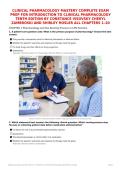
Clinical visual for medication-safety context. Image generated for this study document.
2. Which statement best answers the following clinical question: Which nursing-process step
focuses on collecting patient data before medication administration?
● To reduce the risk of a preventable hypersensitivity reaction.
☑ Assessment.
● The desired physiologic or clinical effect of a medication.
● Whether the patient's outcomes and response to therapy meet the goals.
Rationale: The best answer is: Assessment.
Original exam-style practice material • Introduction to Clinical Pharmacology 10th Edition coverage Page 1
, ABSORPTION DISTRIBUTION METABOLISM EXCRETION
Core pharmacokinetic pathway
3. The nurse is reviewing pharmacology concepts. Which finding is subjective data? Which
answer is most accurate?
● The desired physiologic or clinical effect of a medication.
● Carrying out planned nursing interventions safely.
● They provide a comparison point for detecting therapeutic or adverse effects.
☑ The patient reports feeling dizzy after taking the medication.
Rationale: The best answer is: The patient reports feeling dizzy after taking the medication.
4. A patient-care question asks: Which finding is objective data? Choose the best answer.
☑ The patient's blood pressure is 88/54 mm Hg.
● Assessment.
● They provide a comparison point for detecting therapeutic or adverse effects.
● The desired physiologic or clinical effect of a medication.
Rationale: The best answer is: The patient's blood pressure is 88/54 mm Hg.
Clinical visual for medication-safety context. Image generated for this study document.
5. Which statement best answers the following clinical question: What is the main goal of the
planning phase?
● To study drugs and their effects on living organisms.
☑ To establish measurable goals and interventions for the patient.
Original exam-style practice material • Introduction to Clinical Pharmacology 10th Edition coverage Page 2
, ● To reduce the risk of a preventable hypersensitivity reaction.
● It helps identify current therapies, duplication, interactions, and adherence issues.
Rationale: The best answer is: To establish measurable goals and interventions for the patient.
6. The nurse is reviewing pharmacology concepts. What is the focus of implementation? Which
answer is most accurate?
● They provide a comparison point for detecting therapeutic or adverse effects.
☑ Carrying out planned nursing interventions safely.
● To study drugs and their effects on living organisms.
● To reduce the risk of a preventable hypersensitivity reaction.
Rationale: The best answer is: Carrying out planned nursing interventions safely.
7. A patient-care question asks: What does evaluation determine? Choose the best answer.
● The patient's blood pressure is 88/54 mm Hg.
● The patient reports feeling dizzy after taking the medication.
☑ Whether the patient's outcomes and response to therapy meet the goals.
● The desired physiologic or clinical effect of a medication.
Rationale: The best answer is: Whether the patient's outcomes and response to therapy meet the goals.
8. Which statement best answers the following clinical question: Why should allergies be
assessed before a drug is given?
● The desired physiologic or clinical effect of a medication.
● Assessment.
☑ To reduce the risk of a preventable hypersensitivity reaction.
● The patient's blood pressure is 88/54 mm Hg.
Rationale: The best answer is: To reduce the risk of a preventable hypersensitivity reaction.
9. The nurse is reviewing pharmacology concepts. What is an important reason to obtain a
medication history? Which answer is most accurate?
☑ It helps identify current therapies, duplication, interactions, and adherence issues.
● Safe, informed participation in medication use.
● Assessment.
● The patient reports feeling dizzy after taking the medication.
Rationale: The best answer is: It helps identify current therapies, duplication, interactions, and adherence issues.
10. A patient-care question asks: What is a therapeutic response? Choose the best answer.
● To reduce the risk of a preventable hypersensitivity reaction.
☑ The desired physiologic or clinical effect of a medication.
● The patient's blood pressure is 88/54 mm Hg.
● The patient reports feeling dizzy after taking the medication.
Rationale: The best answer is: The desired physiologic or clinical effect of a medication.
11. Which statement best answers the following clinical question: Why are baseline data
important?
● Carrying out planned nursing interventions safely.
● It helps identify current therapies, duplication, interactions, and adherence issues.
● To reduce the risk of a preventable hypersensitivity reaction.
☑ They provide a comparison point for detecting therapeutic or adverse effects.
Rationale: The best answer is: They provide a comparison point for detecting therapeutic or adverse effects.
Original exam-style practice material • Introduction to Clinical Pharmacology 10th Edition coverage Page 3
, 12. The nurse is reviewing pharmacology concepts. What is patient-centered medication
teaching intended to promote? Which answer is most accurate?
● The patient's blood pressure is 88/54 mm Hg.
☑ Safe, informed participation in medication use.
● It helps identify current therapies, duplication, interactions, and adherence issues.
● Carrying out planned nursing interventions safely.
Rationale: The best answer is: Safe, informed participation in medication use.
CHAPTER 2 Legal Regulatory and Ethical Aspects of Drug Administration
13. A patient-care question asks: What is the nurse's responsibility when a medication order
appears unsafe? Choose the best answer.
☑ Hold the medication and clarify the order before administration.
● Acting to promote the patient's well-being.
● To reduce diversion, misuse, and unauthorized access.
● Protecting private patient information from unauthorized disclosure.
Rationale: The best answer is: Hold the medication and clarify the order before administration.
14. Which statement best answers the following clinical question: Why are medication records
important?
● Avoiding preventable harm.
☑ They provide a legal and clinical record of what was administered.
● An informed voluntary decision by the patient.
● Hold the medication and clarify the order before administration.
Rationale: The best answer is: They provide a legal and clinical record of what was administered.
15. The nurse is reviewing pharmacology concepts. What principle supports a patient's right to
accept or refuse treatment? Which answer is most accurate?
● Ambiguous orders increase the risk of medication errors.
☑ Respect for patient autonomy.
● Protecting private patient information from unauthorized disclosure.
● Failure to provide the standard of care expected in a similar situation.
Rationale: The best answer is: Respect for patient autonomy.
16. A patient-care question asks: What is informed consent intended to support? Choose the
best answer.
● Professional negligence that causes patient harm.
☑ An informed voluntary decision by the patient.
● Hold the medication and clarify the order before administration.
● Failure to provide the standard of care expected in a similar situation.
Rationale: The best answer is: An informed voluntary decision by the patient.
17. Which statement best answers the following clinical question: What is negligence?
● They provide a legal and clinical record of what was administered.
☑ Failure to provide the standard of care expected in a similar situation.
● Ambiguous orders increase the risk of medication errors.
● Professional negligence that causes patient harm.
Rationale: The best answer is: Failure to provide the standard of care expected in a similar situation.
Original exam-style practice material • Introduction to Clinical Pharmacology 10th Edition coverage Page 4
PREP FOR INTRODUCTION TO CLINICAL PHARMACOLOGY
TENTH EDITION BY CONSTANCE VISOVSKY CHERYL
ZAMBROSKI AND SHIRLEY HOSLER ALL CHAPTERS 1–20
CHAPTER 1 Pharmacology and the Nursing Process in LPN Practice
1. A patient-care question asks: What is the primary purpose of pharmacology? Choose the best
answer.
● They provide a comparison point for detecting therapeutic or adverse effects.
● Whether the patient's outcomes and response to therapy meet the goals.
☑ To study drugs and their effects on living organisms.
● Assessment.
Rationale: The best answer is: To study drugs and their effects on living organisms.
Clinical visual for medication-safety context. Image generated for this study document.
2. Which statement best answers the following clinical question: Which nursing-process step
focuses on collecting patient data before medication administration?
● To reduce the risk of a preventable hypersensitivity reaction.
☑ Assessment.
● The desired physiologic or clinical effect of a medication.
● Whether the patient's outcomes and response to therapy meet the goals.
Rationale: The best answer is: Assessment.
Original exam-style practice material • Introduction to Clinical Pharmacology 10th Edition coverage Page 1
, ABSORPTION DISTRIBUTION METABOLISM EXCRETION
Core pharmacokinetic pathway
3. The nurse is reviewing pharmacology concepts. Which finding is subjective data? Which
answer is most accurate?
● The desired physiologic or clinical effect of a medication.
● Carrying out planned nursing interventions safely.
● They provide a comparison point for detecting therapeutic or adverse effects.
☑ The patient reports feeling dizzy after taking the medication.
Rationale: The best answer is: The patient reports feeling dizzy after taking the medication.
4. A patient-care question asks: Which finding is objective data? Choose the best answer.
☑ The patient's blood pressure is 88/54 mm Hg.
● Assessment.
● They provide a comparison point for detecting therapeutic or adverse effects.
● The desired physiologic or clinical effect of a medication.
Rationale: The best answer is: The patient's blood pressure is 88/54 mm Hg.
Clinical visual for medication-safety context. Image generated for this study document.
5. Which statement best answers the following clinical question: What is the main goal of the
planning phase?
● To study drugs and their effects on living organisms.
☑ To establish measurable goals and interventions for the patient.
Original exam-style practice material • Introduction to Clinical Pharmacology 10th Edition coverage Page 2
, ● To reduce the risk of a preventable hypersensitivity reaction.
● It helps identify current therapies, duplication, interactions, and adherence issues.
Rationale: The best answer is: To establish measurable goals and interventions for the patient.
6. The nurse is reviewing pharmacology concepts. What is the focus of implementation? Which
answer is most accurate?
● They provide a comparison point for detecting therapeutic or adverse effects.
☑ Carrying out planned nursing interventions safely.
● To study drugs and their effects on living organisms.
● To reduce the risk of a preventable hypersensitivity reaction.
Rationale: The best answer is: Carrying out planned nursing interventions safely.
7. A patient-care question asks: What does evaluation determine? Choose the best answer.
● The patient's blood pressure is 88/54 mm Hg.
● The patient reports feeling dizzy after taking the medication.
☑ Whether the patient's outcomes and response to therapy meet the goals.
● The desired physiologic or clinical effect of a medication.
Rationale: The best answer is: Whether the patient's outcomes and response to therapy meet the goals.
8. Which statement best answers the following clinical question: Why should allergies be
assessed before a drug is given?
● The desired physiologic or clinical effect of a medication.
● Assessment.
☑ To reduce the risk of a preventable hypersensitivity reaction.
● The patient's blood pressure is 88/54 mm Hg.
Rationale: The best answer is: To reduce the risk of a preventable hypersensitivity reaction.
9. The nurse is reviewing pharmacology concepts. What is an important reason to obtain a
medication history? Which answer is most accurate?
☑ It helps identify current therapies, duplication, interactions, and adherence issues.
● Safe, informed participation in medication use.
● Assessment.
● The patient reports feeling dizzy after taking the medication.
Rationale: The best answer is: It helps identify current therapies, duplication, interactions, and adherence issues.
10. A patient-care question asks: What is a therapeutic response? Choose the best answer.
● To reduce the risk of a preventable hypersensitivity reaction.
☑ The desired physiologic or clinical effect of a medication.
● The patient's blood pressure is 88/54 mm Hg.
● The patient reports feeling dizzy after taking the medication.
Rationale: The best answer is: The desired physiologic or clinical effect of a medication.
11. Which statement best answers the following clinical question: Why are baseline data
important?
● Carrying out planned nursing interventions safely.
● It helps identify current therapies, duplication, interactions, and adherence issues.
● To reduce the risk of a preventable hypersensitivity reaction.
☑ They provide a comparison point for detecting therapeutic or adverse effects.
Rationale: The best answer is: They provide a comparison point for detecting therapeutic or adverse effects.
Original exam-style practice material • Introduction to Clinical Pharmacology 10th Edition coverage Page 3
, 12. The nurse is reviewing pharmacology concepts. What is patient-centered medication
teaching intended to promote? Which answer is most accurate?
● The patient's blood pressure is 88/54 mm Hg.
☑ Safe, informed participation in medication use.
● It helps identify current therapies, duplication, interactions, and adherence issues.
● Carrying out planned nursing interventions safely.
Rationale: The best answer is: Safe, informed participation in medication use.
CHAPTER 2 Legal Regulatory and Ethical Aspects of Drug Administration
13. A patient-care question asks: What is the nurse's responsibility when a medication order
appears unsafe? Choose the best answer.
☑ Hold the medication and clarify the order before administration.
● Acting to promote the patient's well-being.
● To reduce diversion, misuse, and unauthorized access.
● Protecting private patient information from unauthorized disclosure.
Rationale: The best answer is: Hold the medication and clarify the order before administration.
14. Which statement best answers the following clinical question: Why are medication records
important?
● Avoiding preventable harm.
☑ They provide a legal and clinical record of what was administered.
● An informed voluntary decision by the patient.
● Hold the medication and clarify the order before administration.
Rationale: The best answer is: They provide a legal and clinical record of what was administered.
15. The nurse is reviewing pharmacology concepts. What principle supports a patient's right to
accept or refuse treatment? Which answer is most accurate?
● Ambiguous orders increase the risk of medication errors.
☑ Respect for patient autonomy.
● Protecting private patient information from unauthorized disclosure.
● Failure to provide the standard of care expected in a similar situation.
Rationale: The best answer is: Respect for patient autonomy.
16. A patient-care question asks: What is informed consent intended to support? Choose the
best answer.
● Professional negligence that causes patient harm.
☑ An informed voluntary decision by the patient.
● Hold the medication and clarify the order before administration.
● Failure to provide the standard of care expected in a similar situation.
Rationale: The best answer is: An informed voluntary decision by the patient.
17. Which statement best answers the following clinical question: What is negligence?
● They provide a legal and clinical record of what was administered.
☑ Failure to provide the standard of care expected in a similar situation.
● Ambiguous orders increase the risk of medication errors.
● Professional negligence that causes patient harm.
Rationale: The best answer is: Failure to provide the standard of care expected in a similar situation.
Original exam-style practice material • Introduction to Clinical Pharmacology 10th Edition coverage Page 4


