
Child Life Specialist Certification prep Verified Exam Questions and Answer
2026/2027
Study online at https://quizlet.com/_jwta33
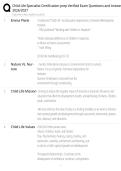
1. Emma Plank -Established "Child Life" and Education department at Cleveland Metropolitan
hospital.
- 1962 published "Working with Children in Hospitals."
*Notes individual differences of children's responses
to illness and stress (assessment)
* Truth Telling
(Child Life Handbook pg 10-13)
2. Nature Vs. Nur- - Genetic Inheritance (nature) vs. Environmental factors (nurture)
ture Nature: Focus on genetic, hormonal explanations for
behavior
Nurture: All behavior is learned from the
environment through conditioning.
3. Child Life Mission -Striving to reduce the negative impact of stressful or traumatic life events and
situations that affect the development, health, and well being of infants, children,
youth, and families.
-We also embrace the value of play as a healing modality as we work to enhance
their optimal growth and development through assessment, intervention, preven-
tion, advocacy, and education.
4. Child Life Values Child Life Professionals value:
Infants, Children, Youth, and families
Play- Play facilitates healing, coping, mastery, self-
expression, creativity, achievement and learning, and
is vital to a child's optimal growth and development.
Therapeutic Relationships- Contribute to the
development of confidence, resilience, and problem-
, Child Life Specialist Certification prep Verified Exam Questions and Answer
2026/2027
Study online at https://quizlet.com/_jwta33
solving skills that enable individuals and families to
deal effectively with challenges to development,
health, and well-being.
Communication
Theoretical foundation of practice- Knowledge and
application of our foundations in theories of
development, play, stress, and coping, and family
systems are the basis of our professional practices.
Professional collaboration
Professional standards of practice- The commitment
to excellence and integrity through learning,
adherence to our code of ethics, and the development
and support of educational training programs based
upon defined clinical competencies.
Research
5. Bolig's types of Rosemary Bolig listed five basic approaches to Child Life programming includ-
Child Life Pro- ing...
grams: (The Child A) Diversion
Life Handbook B) Activity/Recreation
pg 70) C) Child Development
D) Therapeutic
E) Comprehensive
6. Stuart & Sun- 1) Initiation/orientation phase- Establish trust, purpose & decide on plans/goals.
deen- Stages of 2) Working phase- works towards achieving goals.
Therapeutic Re- 3) Termination phase- End of relationship or closure.
, Child Life Specialist Certification prep Verified Exam Questions and Answer
2026/2027
Study online at https://quizlet.com/_jwta33
lationship: (Child
Life Handbook,
pg 64)
7. Dana Prugh: Created the 1st experimental designer research study to prove adverse psy-
chological upset resulting from hospitalization could be changed by unlimited
parental visitation, preparation, & play.
8. Considerations - Establishing relationships and maintaining continuity of
of Child Life care.
Programming: - Assessing children & families' potential vulnerability and
(Guidelines for prioritizing care accordingly.
Development of - Supporting and enhancing normal development through
Child Life play.
Programming - Maintaining welcoming, safe play areas
pg 17) - Assessing likely stress points and providing psychological
preparation
- Communicating with other members of the healthcare
team
9. Characteristics of Interactions and activities that:
play, Play is: (Psy- - Are pleasurable/enjoyable
chosocial care of - Involve extrinsic & intrinsic motivation
children, pg 67) - Are spontaneous and/voluntary
- Involve active engagement either direct or
- vicarious on the part of the player
- Is a form of universal communication
10. Functions of Play: Play provides a context for children to practice newly acquired skills and also
(Meeting Chil- function on the edge of their developing capacities to take on new social roles,
dren's Psycho-so- attempt novel or challenging tasks, and to solve complex problems that they would
cial Needs, pg 83) not, could not otherwise do.
, Child Life Specialist Certification prep Verified Exam Questions and Answer
2026/2027
Study online at https://quizlet.com/_jwta33
11. Variables affect- A) The play environment
ing hospital- B) Parental contact
ized children C) Age
and their play: D) Length of hospitalization
(Meeting chil- E) Types of Illness
dren's Psycho-so- F) Gender
cial Needs)
12. Normalization: Is Important for child's optimal development and encourage family stability
(Meeting A Child Life Specialist would use normalization by:
Children's A) Applying the same rules for special needs child as for other children in family
Psycho-social B) Encourage self-care
needs, pg C) Intra-family communication
181-182) D) Empathize with child's abilities
E) Allow child to make decisions
13. Stress and Potential stressors for families and children:
Coping theory A) Aspects of illness
(Lazarus & Folk- B) Role strain
man): (Meeting C) Role confusion
Children's Psy- D) Financial stressors
chosocial Needs, E) Time constraints
Pg 184-185) F) Energy demands
G) Psycho-social stressors
H) Sustained uncertainty.
Families should focus on resilience and coping
Three theoretical models are considered when researching impact on a child's
behavior & emotions:
A) Discrete disease
2026/2027
Study online at https://quizlet.com/_jwta33
1. Emma Plank -Established "Child Life" and Education department at Cleveland Metropolitan
hospital.
- 1962 published "Working with Children in Hospitals."
*Notes individual differences of children's responses
to illness and stress (assessment)
* Truth Telling
(Child Life Handbook pg 10-13)
2. Nature Vs. Nur- - Genetic Inheritance (nature) vs. Environmental factors (nurture)
ture Nature: Focus on genetic, hormonal explanations for
behavior
Nurture: All behavior is learned from the
environment through conditioning.
3. Child Life Mission -Striving to reduce the negative impact of stressful or traumatic life events and
situations that affect the development, health, and well being of infants, children,
youth, and families.
-We also embrace the value of play as a healing modality as we work to enhance
their optimal growth and development through assessment, intervention, preven-
tion, advocacy, and education.
4. Child Life Values Child Life Professionals value:
Infants, Children, Youth, and families
Play- Play facilitates healing, coping, mastery, self-
expression, creativity, achievement and learning, and
is vital to a child's optimal growth and development.
Therapeutic Relationships- Contribute to the
development of confidence, resilience, and problem-
, Child Life Specialist Certification prep Verified Exam Questions and Answer
2026/2027
Study online at https://quizlet.com/_jwta33
solving skills that enable individuals and families to
deal effectively with challenges to development,
health, and well-being.
Communication
Theoretical foundation of practice- Knowledge and
application of our foundations in theories of
development, play, stress, and coping, and family
systems are the basis of our professional practices.
Professional collaboration
Professional standards of practice- The commitment
to excellence and integrity through learning,
adherence to our code of ethics, and the development
and support of educational training programs based
upon defined clinical competencies.
Research
5. Bolig's types of Rosemary Bolig listed five basic approaches to Child Life programming includ-
Child Life Pro- ing...
grams: (The Child A) Diversion
Life Handbook B) Activity/Recreation
pg 70) C) Child Development
D) Therapeutic
E) Comprehensive
6. Stuart & Sun- 1) Initiation/orientation phase- Establish trust, purpose & decide on plans/goals.
deen- Stages of 2) Working phase- works towards achieving goals.
Therapeutic Re- 3) Termination phase- End of relationship or closure.
, Child Life Specialist Certification prep Verified Exam Questions and Answer
2026/2027
Study online at https://quizlet.com/_jwta33
lationship: (Child
Life Handbook,
pg 64)
7. Dana Prugh: Created the 1st experimental designer research study to prove adverse psy-
chological upset resulting from hospitalization could be changed by unlimited
parental visitation, preparation, & play.
8. Considerations - Establishing relationships and maintaining continuity of
of Child Life care.
Programming: - Assessing children & families' potential vulnerability and
(Guidelines for prioritizing care accordingly.
Development of - Supporting and enhancing normal development through
Child Life play.
Programming - Maintaining welcoming, safe play areas
pg 17) - Assessing likely stress points and providing psychological
preparation
- Communicating with other members of the healthcare
team
9. Characteristics of Interactions and activities that:
play, Play is: (Psy- - Are pleasurable/enjoyable
chosocial care of - Involve extrinsic & intrinsic motivation
children, pg 67) - Are spontaneous and/voluntary
- Involve active engagement either direct or
- vicarious on the part of the player
- Is a form of universal communication
10. Functions of Play: Play provides a context for children to practice newly acquired skills and also
(Meeting Chil- function on the edge of their developing capacities to take on new social roles,
dren's Psycho-so- attempt novel or challenging tasks, and to solve complex problems that they would
cial Needs, pg 83) not, could not otherwise do.
, Child Life Specialist Certification prep Verified Exam Questions and Answer
2026/2027
Study online at https://quizlet.com/_jwta33
11. Variables affect- A) The play environment
ing hospital- B) Parental contact
ized children C) Age
and their play: D) Length of hospitalization
(Meeting chil- E) Types of Illness
dren's Psycho-so- F) Gender
cial Needs)
12. Normalization: Is Important for child's optimal development and encourage family stability
(Meeting A Child Life Specialist would use normalization by:
Children's A) Applying the same rules for special needs child as for other children in family
Psycho-social B) Encourage self-care
needs, pg C) Intra-family communication
181-182) D) Empathize with child's abilities
E) Allow child to make decisions
13. Stress and Potential stressors for families and children:
Coping theory A) Aspects of illness
(Lazarus & Folk- B) Role strain
man): (Meeting C) Role confusion
Children's Psy- D) Financial stressors
chosocial Needs, E) Time constraints
Pg 184-185) F) Energy demands
G) Psycho-social stressors
H) Sustained uncertainty.
Families should focus on resilience and coping
Three theoretical models are considered when researching impact on a child's
behavior & emotions:
A) Discrete disease


