
Mental Health Nursing-History and Law
History of Psychiatry
o Hildegarde Peplau (1909 -1999)
Developed the model for psychiatric nursing practice
Over 40 years ago introduced nurse patient relationship
AKA “mother of psychiatric nursing
Graduated in 1931 w/ diploma, got BSN in 1943, got MA in psychiatric nursing in
1947
Very rare for women accomplish degrees in Master’s Level
Influential in movement in advancement of nursing education
Focus: Therapeutic Communication
o Sigmund Freud
Father of psychoanalysis/defense mechanisms and the ego
o Erickson
Stages of growth and development
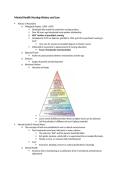
o Abraham Maslow
Hierarchy of Needs
Lower needs fulfillment before those at higher levels can be achieved
Self Actualization: fulfillment of one’s highest potential
Mental Health & Mental Illness
o The concepts of both are established in one’s cultural society/norms
Past treatments have been inhumane in some cultures.
The soul was “bad” and the person should be killed
Evil spirits, demons, witchcraft or a supernatural force invaded the body.
Maybe a curse, or someone did something bad
Cure
Exorcisms, beatings, torture or cultural purifications (cleaning).
o Mental Health
Someone who is functioning at a satisfactory level of emotional and behavioral
adjustment
, ”The successful adaptation to stressors from the internal or external
environment, evidenced by thoughts, feelings and behaviors that are age
appropriate and congruent with local and cultural norms” (Townsend,
2015).
What does it look like?
Successful adaptation
o Death, loss of limb, loss of job
o May be grieving, anxiety and depression but over time you get
better
o Maslow: motivation towards self-actualization
Theory of Mental Health
o Characteristics:
Problem solve, appropriate perception of reality,
independence, autonomy
o Mental Illness
Disruption in person’s thinking AEB thoughts, feelings, and behaviors incongruent
w/ local and cultural norms
“Maladaptive responses to stressors from the internal or external
environment, evidenced by thoughts, feelings, and behaviors that are
incongruent with the local and cultural norms and interfere with the
individuals social, occupational and or physical functioning” (Townsend,
2015).
What does it look like?
A person is maladaptive, but for long periods of time
Behavior becomes noncongruent w/ societal norms
o Person isolating, stop taking care of selves, eating out of a trash can,
talking to selves, inability to comprehend what is going on,
inappropriate behavior/language
Characteristics
o Isolation, heavy drinking, heavy drug abuse, using defense
mechanisms and not dealing w/ reality, person unable to return to
previous functioning, shutdown/withdraw, sometimes chemical
imbalance
Difficult to define, but 2 elements associated w/ mental illness across any cultural
norms:
Incomprehensibility
o The inability of the general population/society to understand the
motivation behind the behavior
When observers unable to find meaning in behavior
Will often label it as mental illness
Cultural Relativity
o Behavior is categorized as “normal” or “abnormal” according to
one’s cultural or societal norms
Behavior that may be categorized as mental illness in one
society may not be a mental illness in another
What is Mental Illness and Why do we Study it?
Is Anxiety a Mental Illness?
, Is everyone a “little” mentally ill?
Who should be hospitalized?
Can you recover from Mental Illness?
How Does it happen?
Issues and Trends in Mental Illness
o Noncompliance
o Chronic illnesses
Often have the following:
Poor health condition
Organ system failures
Heart, respiratory, circulation poor
Obesity, malnutrition, HTN, diabetes
Hard to manage b/c of mental illness
o Caregiver stress
Caregiver Role Strain: when have mental illness often not able to follow instructions,
so caregiver (whether family member or conservator) is often worried about that
person
o Homelessness
2019: 152,000 homeless in CA
o Neglect
Self-care, hygiene, nutrition, dental
Have inability to follow up w/ legal matters/make decision
o Stigma
Family members and society doesn’t embrace mental illness (eg. Embarrassing)
o Dumping
Moving homeless from high desirable place to less desirable
So Homeless not congregating in nice areas
o Research but no money for treatment
When try to put them in home, have a lot of paranoia, b/c where they live (like
homeless encampments) is still home to them and feel comfortable there
o 1% tax on rich in CA
Anybody who makes 263,000/year, paid into public service
o Tobacco settle money:
Give institutions that service
Ppl who have mental health get finances for emergency help and tobacco
Ethical & Legal Issues in Mental Illness
o Nurses are held to the highest degree of ethical and legal responsibility regarding patient
care.
o American Nurses Association (ANA) has guidelines that nurses use as a code of ethics
o Relationships with patients should be conducted with respect and civility
Pt.’s should be treated w/ dignity and respect.
o Medical care for the mentally ill patient should include teamwork and collaboration
o Nurses knowledge of patients’ legal rights protects the nurse from legal backlash.
BE AWARE OF LAWS B/C YOUR PATIENTS ARE
o Ethical Considerations
Ethical Theory
Definition: A set of principle that address right or wrong conduct
History of Psychiatry
o Hildegarde Peplau (1909 -1999)
Developed the model for psychiatric nursing practice
Over 40 years ago introduced nurse patient relationship
AKA “mother of psychiatric nursing
Graduated in 1931 w/ diploma, got BSN in 1943, got MA in psychiatric nursing in
1947
Very rare for women accomplish degrees in Master’s Level
Influential in movement in advancement of nursing education
Focus: Therapeutic Communication
o Sigmund Freud
Father of psychoanalysis/defense mechanisms and the ego
o Erickson
Stages of growth and development
o Abraham Maslow
Hierarchy of Needs
Lower needs fulfillment before those at higher levels can be achieved
Self Actualization: fulfillment of one’s highest potential
Mental Health & Mental Illness
o The concepts of both are established in one’s cultural society/norms
Past treatments have been inhumane in some cultures.
The soul was “bad” and the person should be killed
Evil spirits, demons, witchcraft or a supernatural force invaded the body.
Maybe a curse, or someone did something bad
Cure
Exorcisms, beatings, torture or cultural purifications (cleaning).
o Mental Health
Someone who is functioning at a satisfactory level of emotional and behavioral
adjustment
, ”The successful adaptation to stressors from the internal or external
environment, evidenced by thoughts, feelings and behaviors that are age
appropriate and congruent with local and cultural norms” (Townsend,
2015).
What does it look like?
Successful adaptation
o Death, loss of limb, loss of job
o May be grieving, anxiety and depression but over time you get
better
o Maslow: motivation towards self-actualization
Theory of Mental Health
o Characteristics:
Problem solve, appropriate perception of reality,
independence, autonomy
o Mental Illness
Disruption in person’s thinking AEB thoughts, feelings, and behaviors incongruent
w/ local and cultural norms
“Maladaptive responses to stressors from the internal or external
environment, evidenced by thoughts, feelings, and behaviors that are
incongruent with the local and cultural norms and interfere with the
individuals social, occupational and or physical functioning” (Townsend,
2015).
What does it look like?
A person is maladaptive, but for long periods of time
Behavior becomes noncongruent w/ societal norms
o Person isolating, stop taking care of selves, eating out of a trash can,
talking to selves, inability to comprehend what is going on,
inappropriate behavior/language
Characteristics
o Isolation, heavy drinking, heavy drug abuse, using defense
mechanisms and not dealing w/ reality, person unable to return to
previous functioning, shutdown/withdraw, sometimes chemical
imbalance
Difficult to define, but 2 elements associated w/ mental illness across any cultural
norms:
Incomprehensibility
o The inability of the general population/society to understand the
motivation behind the behavior
When observers unable to find meaning in behavior
Will often label it as mental illness
Cultural Relativity
o Behavior is categorized as “normal” or “abnormal” according to
one’s cultural or societal norms
Behavior that may be categorized as mental illness in one
society may not be a mental illness in another
What is Mental Illness and Why do we Study it?
Is Anxiety a Mental Illness?
, Is everyone a “little” mentally ill?
Who should be hospitalized?
Can you recover from Mental Illness?
How Does it happen?
Issues and Trends in Mental Illness
o Noncompliance
o Chronic illnesses
Often have the following:
Poor health condition
Organ system failures
Heart, respiratory, circulation poor
Obesity, malnutrition, HTN, diabetes
Hard to manage b/c of mental illness
o Caregiver stress
Caregiver Role Strain: when have mental illness often not able to follow instructions,
so caregiver (whether family member or conservator) is often worried about that
person
o Homelessness
2019: 152,000 homeless in CA
o Neglect
Self-care, hygiene, nutrition, dental
Have inability to follow up w/ legal matters/make decision
o Stigma
Family members and society doesn’t embrace mental illness (eg. Embarrassing)
o Dumping
Moving homeless from high desirable place to less desirable
So Homeless not congregating in nice areas
o Research but no money for treatment
When try to put them in home, have a lot of paranoia, b/c where they live (like
homeless encampments) is still home to them and feel comfortable there
o 1% tax on rich in CA
Anybody who makes 263,000/year, paid into public service
o Tobacco settle money:
Give institutions that service
Ppl who have mental health get finances for emergency help and tobacco
Ethical & Legal Issues in Mental Illness
o Nurses are held to the highest degree of ethical and legal responsibility regarding patient
care.
o American Nurses Association (ANA) has guidelines that nurses use as a code of ethics
o Relationships with patients should be conducted with respect and civility
Pt.’s should be treated w/ dignity and respect.
o Medical care for the mentally ill patient should include teamwork and collaboration
o Nurses knowledge of patients’ legal rights protects the nurse from legal backlash.
BE AWARE OF LAWS B/C YOUR PATIENTS ARE
o Ethical Considerations
Ethical Theory
Definition: A set of principle that address right or wrong conduct


