
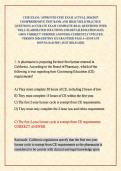
CPJE EXAM / APPROVED CPJE EXAM ACTUAL 2026/2027
COMPREHENSIVE TEST BANK AND HIGH YIELD PRACTICE
QUESTIONS ACCURATE EXAM COMPLETE REAL QUESTIONS WITH
WELL ELABORATED SOLUTIONS AND DETAILED RATIONALES
(100% CORRECT VERIFIED ANSWERS) CURRENTLY UPDATED
VERSION 2026 EDITION |GUARANTEED PASS A+ |INSTANT
DOWNLOAD PDF | JUST RELEASED
1. A pharmacist is preparing for their first license renewal in
California. According to the Board of Pharmacy, which of the
following is true regarding their Continuing Education (CE)
requirements?
A) They must complete 30 hours of CE, including 2 hours of law.
B) They must complete 15 hours of CE within the first year.
C) The first 2-year license cycle is exempt from CE requirements.
D) They must only complete the 2-hour law and ethics requirement.
C) The first 2-year license cycle is exempt from CE requirements.
CORRECT ANSWER
Rationale: California regulations specify that the first two-year
license cycle is exempt from CE requirements as the pharmacist is
considered to be current with clinical and legal knowledge upon
,initial licensure. After the first renewal, pharmacists must complete
30 hours of CE every two years, including 2 hours of law and ethics.
2. What is the effective date of the requirement under AB 1503 that a
nonresident pharmacy must designate a California-licensed
pharmacist as its pharmacist-in-charge (PIC)?
A) January 1, 2025
B) July 1, 2026
C) January 1, 2027
D) January 1, 2030
B) July 1, 2026 CORRECT ANSWER
Rationale: AB 1503, signed into law on October 1, 2025, requires
that beginning July 1, 2026, each nonresident pharmacy must
identify a California-licensed pharmacist employed at that pharmacy
to serve as its PIC. This applies even if the pharmacy's physical
operations are entirely outside California.
3. Under SB 41, which of the following is prohibited in PBM
contracts issued, amended, or renewed on or after January 1, 2026?
,A) Spread pricing
B) Flat pharmacy benefit management fees
C) Rebate pass-through to payers
D) Prior authorization for brand-name drugs
A) Spread pricing CORRECT ANSWER
Rationale: SB 41 prohibits spread pricing (where a PBM charges a
plan more than it reimburses the pharmacy and keeps the difference)
and mandates a pass-through pricing model effective January 1,
2026. Any contract clause authorizing spread pricing is void by
January 1, 2029, regardless of renewal status.
4. When must a nonresident pharmacy, under AB 1503, notify the
California State Board of Pharmacy of a change in its designated
PIC?
A) Within 7 days of the change
B) Within 30 days of the change
C) Within 14 days of the change
D) Immediately upon the change
B) Within 30 days of the change CORRECT ANSWER
, Rationale: Under AB 1503, nonresident pharmacies must notify the
Board of changes in PIC within 30 days. The standard reporting
period for such changes aligns with general licensing requirements.
5. Under what conditions may a clinic practitioner now dispense a
Schedule II narcotic under Section 4184 of the Business and
Professions Code?
A) For chronic cancer pain management
B) To treat acute withdrawal symptoms while arranging proper
follow-up treatment
C) For any patient with a valid Schedule II prescription
D) Only for hospice patients
B) To treat acute withdrawal symptoms while arranging proper
follow-up treatment CORRECT ANSWER
Rationale: Section 4184 now permits a registered clinic practitioner
to dispense a Schedule II narcotic to treat acute withdrawal
symptoms only temporarily while arranging proper follow-up
treatment. This must comply with 21 CFR §1306.07(b). The clinic
must also follow California labeling, recordkeeping, and secure
storage requirements.
COMPREHENSIVE TEST BANK AND HIGH YIELD PRACTICE
QUESTIONS ACCURATE EXAM COMPLETE REAL QUESTIONS WITH
WELL ELABORATED SOLUTIONS AND DETAILED RATIONALES
(100% CORRECT VERIFIED ANSWERS) CURRENTLY UPDATED
VERSION 2026 EDITION |GUARANTEED PASS A+ |INSTANT
DOWNLOAD PDF | JUST RELEASED
1. A pharmacist is preparing for their first license renewal in
California. According to the Board of Pharmacy, which of the
following is true regarding their Continuing Education (CE)
requirements?
A) They must complete 30 hours of CE, including 2 hours of law.
B) They must complete 15 hours of CE within the first year.
C) The first 2-year license cycle is exempt from CE requirements.
D) They must only complete the 2-hour law and ethics requirement.
C) The first 2-year license cycle is exempt from CE requirements.
CORRECT ANSWER
Rationale: California regulations specify that the first two-year
license cycle is exempt from CE requirements as the pharmacist is
considered to be current with clinical and legal knowledge upon
,initial licensure. After the first renewal, pharmacists must complete
30 hours of CE every two years, including 2 hours of law and ethics.
2. What is the effective date of the requirement under AB 1503 that a
nonresident pharmacy must designate a California-licensed
pharmacist as its pharmacist-in-charge (PIC)?
A) January 1, 2025
B) July 1, 2026
C) January 1, 2027
D) January 1, 2030
B) July 1, 2026 CORRECT ANSWER
Rationale: AB 1503, signed into law on October 1, 2025, requires
that beginning July 1, 2026, each nonresident pharmacy must
identify a California-licensed pharmacist employed at that pharmacy
to serve as its PIC. This applies even if the pharmacy's physical
operations are entirely outside California.
3. Under SB 41, which of the following is prohibited in PBM
contracts issued, amended, or renewed on or after January 1, 2026?
,A) Spread pricing
B) Flat pharmacy benefit management fees
C) Rebate pass-through to payers
D) Prior authorization for brand-name drugs
A) Spread pricing CORRECT ANSWER
Rationale: SB 41 prohibits spread pricing (where a PBM charges a
plan more than it reimburses the pharmacy and keeps the difference)
and mandates a pass-through pricing model effective January 1,
2026. Any contract clause authorizing spread pricing is void by
January 1, 2029, regardless of renewal status.
4. When must a nonresident pharmacy, under AB 1503, notify the
California State Board of Pharmacy of a change in its designated
PIC?
A) Within 7 days of the change
B) Within 30 days of the change
C) Within 14 days of the change
D) Immediately upon the change
B) Within 30 days of the change CORRECT ANSWER
, Rationale: Under AB 1503, nonresident pharmacies must notify the
Board of changes in PIC within 30 days. The standard reporting
period for such changes aligns with general licensing requirements.
5. Under what conditions may a clinic practitioner now dispense a
Schedule II narcotic under Section 4184 of the Business and
Professions Code?
A) For chronic cancer pain management
B) To treat acute withdrawal symptoms while arranging proper
follow-up treatment
C) For any patient with a valid Schedule II prescription
D) Only for hospice patients
B) To treat acute withdrawal symptoms while arranging proper
follow-up treatment CORRECT ANSWER
Rationale: Section 4184 now permits a registered clinic practitioner
to dispense a Schedule II narcotic to treat acute withdrawal
symptoms only temporarily while arranging proper follow-up
treatment. This must comply with 21 CFR §1306.07(b). The clinic
must also follow California labeling, recordkeeping, and secure
storage requirements.


