
NR568 ADVANCED PHARMACOLOGY
250 Midterm-Style Practice Questions & Answers —
Weeks 1–4
For study/revision use. These are original practice questions, not leaked, copied, or verified actual exam
questions.
Coverage is aligned to publicly described NR568 midterm topics: antimicrobial/antiviral/antifungal pharmacology, antibiotic
pharmacotherapy, gender/reproductive health, men's health, and urinary conditions. Public course-study descriptions identify the
midterm as cumulative across Weeks 1–4. cite turn0search1 turn0search4
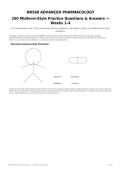
Educational pharmacology illustration
Absorption Distribution
Metabolism Excretion
Answer-format: Each option begins with a large dot. The correct answer is marked with a larger green tick inside a box, replacing the dot.
Important: The requested “100% pass guarantee” cannot be honestly provided. This bank is designed to strengthen exam readiness and
is not a substitute for your course materials or instructor guidance.
NR568 Advanced Pharmacology — Original Practice Bank Page 1
, Antimicrobial mechanism map — educational illustration
Cell wall 30S ribosome 50S ribosome DNA/RNA
β-lactams Tetracyclines / aminoglycosides Macrolides Fluoroquinolones / antivirals
NR568 Advanced Pharmacology — Original Practice Bank Page 2
, 1. A patient with herpes zoster presents within 72 hours of rash onset. Which medication is an
appropriate antiviral option for an immunocompetent adult?
☑ Acyclovir
• Amoxicillin
• Fluconazole
• Nitrofurantoin
Answer & rationale: Acyclovir. Acyclovir is a nucleoside analogue used against herpesviruses, including varicella-zoster virus.
2. Which mechanism best describes acyclovir?
• Inhibits bacterial cell-wall cross-linking
☑ Inhibits viral DNA polymerase after activation
• Blocks fungal ergosterol synthesis
• Inhibits bacterial folate synthesis
Answer & rationale: Inhibits viral DNA polymerase after activation. Acyclovir is activated preferentially in infected cells and
ultimately inhibits viral DNA polymerase.
3. Which medication is commonly used for influenza when started early in an appropriate patient?
☑ Oseltamivir
• Valacyclovir
• Terbinafine
• Doxycycline
Answer & rationale: Oseltamivir. Oseltamivir inhibits influenza neuraminidase and is most useful when started early.
4. What is the major dose-adjustment concern with oseltamivir?
☑ Renal impairment
• Hyperthyroidism
• Low calcium
• Peptic ulcer disease
Answer & rationale: Renal impairment. Oseltamivir is substantially renally eliminated, so renal function affects dosing.
5. Which antiviral is a prodrug converted to acyclovir?
☑ Valacyclovir
• Oseltamivir
• Zanamivir
• Ribavirin
Answer & rationale: Valacyclovir. Valacyclovir is converted to acyclovir and provides improved oral bioavailability.
6. Which antifungal class includes fluconazole and itraconazole?
☑ Azoles
• Polyenes
• Aminoglycosides
• Macrolides
Answer & rationale: Azoles. Fluconazole and itraconazole are azole antifungals that inhibit fungal ergosterol synthesis.
7. Which adverse effect is particularly important with amphotericin B?
☑ Nephrotoxicity
• Severe hypoglycemia
• Tendon rupture
• Agranulocytosis in every patient
Answer & rationale: Nephrotoxicity. Amphotericin B can cause significant renal toxicity and electrolyte disturbances.
NR568 Advanced Pharmacology — Original Practice Bank Page 3
, 8. Which medication is commonly used for tinea capitis because treatment must reach the hair
follicle?
☑ Oral griseofulvin
• Topical nystatin only
• Oral acyclovir
• Topical mupirocin
Answer & rationale: Oral griseofulvin. Tinea capitis generally requires systemic antifungal therapy; griseofulvin is a classic
option.
9. Which antifungal is commonly used for dermatophyte infections of skin or nails?
☑ Terbinafine
• Acyclovir
• Oseltamivir
• Ceftriaxone
Answer & rationale: Terbinafine. Terbinafine inhibits fungal squalene epoxidase and is effective against dermatophytes.
10. Which counseling point is appropriate for oral terbinafine?
☑ Monitor for liver-related adverse effects when clinically indicated
• Take with every dose of calcium carbonate
• Expect universal hypoglycemia
• It is only effective against viruses
Answer & rationale: Monitor for liver-related adverse effects when clinically indicated. Oral terbinafine can rarely cause
significant hepatic injury, so appropriate clinical monitoring is important.
11. Which antibiotic class inhibits bacterial cell-wall synthesis by binding penicillin-binding
proteins?
☑ Beta-lactams
• Macrolides
• Tetracyclines
• Fluoroquinolones
Answer & rationale: Beta-lactams. Beta-lactams inhibit transpeptidation involved in bacterial cell-wall synthesis.
12. Which class primarily inhibits bacterial protein synthesis at the 30S ribosomal subunit?
☑ Tetracyclines
• Macrolides
• Penicillins
• Glycopeptides
Answer & rationale: Tetracyclines. Tetracyclines bind the 30S ribosomal subunit and inhibit aminoacyl-tRNA attachment.
13. Which class primarily acts at the 50S ribosomal subunit?
☑ Macrolides
• Tetracyclines
• Fluoroquinolones
• Sulfonamides
Answer & rationale: Macrolides. Macrolides bind the 50S subunit and inhibit bacterial protein synthesis.
14. Which adverse effect is associated with aminoglycosides?
☑ Nephrotoxicity and ototoxicity
• Severe constipation only
• Photosensitivity only
• Hypothyroidism
Answer & rationale: Nephrotoxicity and ototoxicity. Aminoglycosides can cause nephrotoxicity and potentially irreversible
ototoxicity.
NR568 Advanced Pharmacology — Original Practice Bank Page 4
250 Midterm-Style Practice Questions & Answers —
Weeks 1–4
For study/revision use. These are original practice questions, not leaked, copied, or verified actual exam
questions.
Coverage is aligned to publicly described NR568 midterm topics: antimicrobial/antiviral/antifungal pharmacology, antibiotic
pharmacotherapy, gender/reproductive health, men's health, and urinary conditions. Public course-study descriptions identify the
midterm as cumulative across Weeks 1–4. cite turn0search1 turn0search4
Educational pharmacology illustration
Absorption Distribution
Metabolism Excretion
Answer-format: Each option begins with a large dot. The correct answer is marked with a larger green tick inside a box, replacing the dot.
Important: The requested “100% pass guarantee” cannot be honestly provided. This bank is designed to strengthen exam readiness and
is not a substitute for your course materials or instructor guidance.
NR568 Advanced Pharmacology — Original Practice Bank Page 1
, Antimicrobial mechanism map — educational illustration
Cell wall 30S ribosome 50S ribosome DNA/RNA
β-lactams Tetracyclines / aminoglycosides Macrolides Fluoroquinolones / antivirals
NR568 Advanced Pharmacology — Original Practice Bank Page 2
, 1. A patient with herpes zoster presents within 72 hours of rash onset. Which medication is an
appropriate antiviral option for an immunocompetent adult?
☑ Acyclovir
• Amoxicillin
• Fluconazole
• Nitrofurantoin
Answer & rationale: Acyclovir. Acyclovir is a nucleoside analogue used against herpesviruses, including varicella-zoster virus.
2. Which mechanism best describes acyclovir?
• Inhibits bacterial cell-wall cross-linking
☑ Inhibits viral DNA polymerase after activation
• Blocks fungal ergosterol synthesis
• Inhibits bacterial folate synthesis
Answer & rationale: Inhibits viral DNA polymerase after activation. Acyclovir is activated preferentially in infected cells and
ultimately inhibits viral DNA polymerase.
3. Which medication is commonly used for influenza when started early in an appropriate patient?
☑ Oseltamivir
• Valacyclovir
• Terbinafine
• Doxycycline
Answer & rationale: Oseltamivir. Oseltamivir inhibits influenza neuraminidase and is most useful when started early.
4. What is the major dose-adjustment concern with oseltamivir?
☑ Renal impairment
• Hyperthyroidism
• Low calcium
• Peptic ulcer disease
Answer & rationale: Renal impairment. Oseltamivir is substantially renally eliminated, so renal function affects dosing.
5. Which antiviral is a prodrug converted to acyclovir?
☑ Valacyclovir
• Oseltamivir
• Zanamivir
• Ribavirin
Answer & rationale: Valacyclovir. Valacyclovir is converted to acyclovir and provides improved oral bioavailability.
6. Which antifungal class includes fluconazole and itraconazole?
☑ Azoles
• Polyenes
• Aminoglycosides
• Macrolides
Answer & rationale: Azoles. Fluconazole and itraconazole are azole antifungals that inhibit fungal ergosterol synthesis.
7. Which adverse effect is particularly important with amphotericin B?
☑ Nephrotoxicity
• Severe hypoglycemia
• Tendon rupture
• Agranulocytosis in every patient
Answer & rationale: Nephrotoxicity. Amphotericin B can cause significant renal toxicity and electrolyte disturbances.
NR568 Advanced Pharmacology — Original Practice Bank Page 3
, 8. Which medication is commonly used for tinea capitis because treatment must reach the hair
follicle?
☑ Oral griseofulvin
• Topical nystatin only
• Oral acyclovir
• Topical mupirocin
Answer & rationale: Oral griseofulvin. Tinea capitis generally requires systemic antifungal therapy; griseofulvin is a classic
option.
9. Which antifungal is commonly used for dermatophyte infections of skin or nails?
☑ Terbinafine
• Acyclovir
• Oseltamivir
• Ceftriaxone
Answer & rationale: Terbinafine. Terbinafine inhibits fungal squalene epoxidase and is effective against dermatophytes.
10. Which counseling point is appropriate for oral terbinafine?
☑ Monitor for liver-related adverse effects when clinically indicated
• Take with every dose of calcium carbonate
• Expect universal hypoglycemia
• It is only effective against viruses
Answer & rationale: Monitor for liver-related adverse effects when clinically indicated. Oral terbinafine can rarely cause
significant hepatic injury, so appropriate clinical monitoring is important.
11. Which antibiotic class inhibits bacterial cell-wall synthesis by binding penicillin-binding
proteins?
☑ Beta-lactams
• Macrolides
• Tetracyclines
• Fluoroquinolones
Answer & rationale: Beta-lactams. Beta-lactams inhibit transpeptidation involved in bacterial cell-wall synthesis.
12. Which class primarily inhibits bacterial protein synthesis at the 30S ribosomal subunit?
☑ Tetracyclines
• Macrolides
• Penicillins
• Glycopeptides
Answer & rationale: Tetracyclines. Tetracyclines bind the 30S ribosomal subunit and inhibit aminoacyl-tRNA attachment.
13. Which class primarily acts at the 50S ribosomal subunit?
☑ Macrolides
• Tetracyclines
• Fluoroquinolones
• Sulfonamides
Answer & rationale: Macrolides. Macrolides bind the 50S subunit and inhibit bacterial protein synthesis.
14. Which adverse effect is associated with aminoglycosides?
☑ Nephrotoxicity and ototoxicity
• Severe constipation only
• Photosensitivity only
• Hypothyroidism
Answer & rationale: Nephrotoxicity and ototoxicity. Aminoglycosides can cause nephrotoxicity and potentially irreversible
ototoxicity.
NR568 Advanced Pharmacology — Original Practice Bank Page 4


