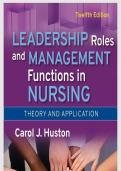
,Test Bank: Leadership Roles and Management Functions in Nursing,
12th Edition (Huston)
Complete Test Bank — All 25 Chapters Covered (900 Questions)
Table of Contents
UNIT I: The Critical Triad: Decision Making, Management, and Leadership
• Chapter 1: Decision Making, Problem Solving, Critical Thinking, and Clinical Reasoning (Questions 1–
40)
• Chapter 2: Classical Views of Leadership and Management (Questions 41–75)
• Chapter 3: Twenty-First Century Thinking About Leadership and Management (Questions 76–110)
UNIT II: Foundation for Effective Leadership and Management: Ethics, Law, and Advocacy
• Chapter 4: Ethical Issues (Questions 111–145)
• Chapter 5: Legal and Legislative Issues (Questions 146–180)
• Chapter 6: Patient, Subordinate, Workplace, and Professional Advocacy (Questions 181–215)
UNIT III: Roles and Functions in Planning
• Chapter 7: Organizational Planning (Questions 216–250)
• Chapter 8: Planned Change (Questions 251–285)
• Chapter 9: Time Management (Questions 286–315)
• Chapter 10: Fiscal Planning and Healthcare Reimbursement (Questions 316–350)
• Chapter 11: Career Planning and Development in Nursing (Questions 351–380)
UNIT IV: Roles and Functions in Organizing
• Chapter 12: Organizational Structure (Questions 381–415)
• Chapter 13: Organizational, Political, and Personal Power (Questions 416–450)
• Chapter 14: Organizing Patient Care (Questions 451–485)
UNIT V: Roles and Functions in Staffing
• Chapter 15: Employee Recruitment, Selection, Placement, and Onboarding (Questions 486–520)
• Chapter 16: Educating and Socializing Staff in a Learning Organization (Questions 521–555)
• Chapter 17: Staffing Needs and Scheduling Policies (Questions 556–590)
,UNIT VI: Roles and Functions in Directing
• Chapter 18: Creating a Motivating Climate (Questions 591–625)
• Chapter 19: Organizational, Interpersonal, and Group Communication in Team Building (Questions
626–660)
• Chapter 20: Delegation (Questions 661–695)
• Chapter 21: Conflict, Incivility, Workplace Violence, and Negotiation (Questions 696–730)
• Chapter 22: Collective Bargaining, Unionization, and Employment Laws (Questions 731–765)
UNIT VII: Roles and Functions in Controlling
• Chapter 23: Quality Control in Creating a Culture of Patient Safety (Questions 766–800)
• Chapter 24: Performance Appraisal (Questions 801–835)
• Chapter 25: Rule Breaking, Marginal Performance, and Substance Use Disorder (Questions 836–
900)
UNIT I: The Critical Triad: Decision Making, Management, and Leadership
Chapter 1: Decision Making, Problem Solving, Critical Thinking, and Clinical Reasoning (Questions 1–40)
1. A nurse manager is reviewing the decision-making process with a group of new charge nurses. Which
statements accurately describe the relationship between decision making and problem solving? (Select
all that apply.)
A. Decision making is a complex, cognitive process often defined as choosing a particular course of action.
B. Problem solving is a systematic process that focuses on analyzing a difficult situation.
C. Decision making always occurs after the problem-solving process is complete.
D. Problem solving includes decision making as one of its steps.
E. Decision making and problem solving are interchangeable terms with identical meanings.
Answer: A, B, D
Rationale: Decision making is indeed a complex, cognitive process of choosing a course of action, and
problem solving is a systematic process focused on analyzing difficult situations. Problem solving
encompasses decision making as one of its steps because once a problem is analyzed, a decision must be
made about how to resolve it. Option C is incorrect because decision making can occur at multiple points
during problem solving, not only at the end. Option E is incorrect because the terms are related but not
identical; problem solving is broader and includes decision making as a component.
, 2. A nurse manager is using a decision-making model to address a staffing shortage. Which factors
should the manager consider when identifying the criteria for evaluating possible solutions? (Select all
that apply.)
A. The cost of implementing each solution
B. The timeline for implementation
C. The personal preferences of the manager
D. The impact on patient outcomes
E. The feasibility of the solution within organizational constraints
Answer: A, B, D, E
Rationale: When establishing criteria for evaluating solutions, the nurse manager should consider objective
factors such as cost, timeline, impact on patient outcomes, and feasibility within organizational constraints.
Option C is incorrect because personal preferences should not drive decision criteria; decisions should be
based on objective, evidence-based factors that align with organizational goals and patient safety.
3. A nurse is faced with a clinical decision that requires critical thinking. Which behaviors demonstrate
the use of critical thinking in clinical reasoning? (Select all that apply.)
A. Relying solely on intuition and past experience
B. Questioning assumptions and examining evidence
C. Considering multiple perspectives before drawing conclusions
D. Accepting the first solution that comes to mind
E. Evaluating the potential consequences of each option
Answer: B, C, E
Rationale: Critical thinking involves questioning assumptions, examining evidence, considering multiple
perspectives, and evaluating consequences. Option A is incorrect because while intuition and experience
can inform thinking, critical thinking requires more than relying solely on them. Option D is incorrect
because accepting the first solution without evaluating alternatives is antithetical to critical thinking and
clinical reasoning.
4. A nurse manager is facilitating a group decision-making session about implementing a new electronic
health record system. Which strategies promote effective group decision making? (Select all that apply.)
A. Encouraging diverse viewpoints and constructive debate
B. Allowing the most vocal member to dominate the discussion
12th Edition (Huston)
Complete Test Bank — All 25 Chapters Covered (900 Questions)
Table of Contents
UNIT I: The Critical Triad: Decision Making, Management, and Leadership
• Chapter 1: Decision Making, Problem Solving, Critical Thinking, and Clinical Reasoning (Questions 1–
40)
• Chapter 2: Classical Views of Leadership and Management (Questions 41–75)
• Chapter 3: Twenty-First Century Thinking About Leadership and Management (Questions 76–110)
UNIT II: Foundation for Effective Leadership and Management: Ethics, Law, and Advocacy
• Chapter 4: Ethical Issues (Questions 111–145)
• Chapter 5: Legal and Legislative Issues (Questions 146–180)
• Chapter 6: Patient, Subordinate, Workplace, and Professional Advocacy (Questions 181–215)
UNIT III: Roles and Functions in Planning
• Chapter 7: Organizational Planning (Questions 216–250)
• Chapter 8: Planned Change (Questions 251–285)
• Chapter 9: Time Management (Questions 286–315)
• Chapter 10: Fiscal Planning and Healthcare Reimbursement (Questions 316–350)
• Chapter 11: Career Planning and Development in Nursing (Questions 351–380)
UNIT IV: Roles and Functions in Organizing
• Chapter 12: Organizational Structure (Questions 381–415)
• Chapter 13: Organizational, Political, and Personal Power (Questions 416–450)
• Chapter 14: Organizing Patient Care (Questions 451–485)
UNIT V: Roles and Functions in Staffing
• Chapter 15: Employee Recruitment, Selection, Placement, and Onboarding (Questions 486–520)
• Chapter 16: Educating and Socializing Staff in a Learning Organization (Questions 521–555)
• Chapter 17: Staffing Needs and Scheduling Policies (Questions 556–590)
,UNIT VI: Roles and Functions in Directing
• Chapter 18: Creating a Motivating Climate (Questions 591–625)
• Chapter 19: Organizational, Interpersonal, and Group Communication in Team Building (Questions
626–660)
• Chapter 20: Delegation (Questions 661–695)
• Chapter 21: Conflict, Incivility, Workplace Violence, and Negotiation (Questions 696–730)
• Chapter 22: Collective Bargaining, Unionization, and Employment Laws (Questions 731–765)
UNIT VII: Roles and Functions in Controlling
• Chapter 23: Quality Control in Creating a Culture of Patient Safety (Questions 766–800)
• Chapter 24: Performance Appraisal (Questions 801–835)
• Chapter 25: Rule Breaking, Marginal Performance, and Substance Use Disorder (Questions 836–
900)
UNIT I: The Critical Triad: Decision Making, Management, and Leadership
Chapter 1: Decision Making, Problem Solving, Critical Thinking, and Clinical Reasoning (Questions 1–40)
1. A nurse manager is reviewing the decision-making process with a group of new charge nurses. Which
statements accurately describe the relationship between decision making and problem solving? (Select
all that apply.)
A. Decision making is a complex, cognitive process often defined as choosing a particular course of action.
B. Problem solving is a systematic process that focuses on analyzing a difficult situation.
C. Decision making always occurs after the problem-solving process is complete.
D. Problem solving includes decision making as one of its steps.
E. Decision making and problem solving are interchangeable terms with identical meanings.
Answer: A, B, D
Rationale: Decision making is indeed a complex, cognitive process of choosing a course of action, and
problem solving is a systematic process focused on analyzing difficult situations. Problem solving
encompasses decision making as one of its steps because once a problem is analyzed, a decision must be
made about how to resolve it. Option C is incorrect because decision making can occur at multiple points
during problem solving, not only at the end. Option E is incorrect because the terms are related but not
identical; problem solving is broader and includes decision making as a component.
, 2. A nurse manager is using a decision-making model to address a staffing shortage. Which factors
should the manager consider when identifying the criteria for evaluating possible solutions? (Select all
that apply.)
A. The cost of implementing each solution
B. The timeline for implementation
C. The personal preferences of the manager
D. The impact on patient outcomes
E. The feasibility of the solution within organizational constraints
Answer: A, B, D, E
Rationale: When establishing criteria for evaluating solutions, the nurse manager should consider objective
factors such as cost, timeline, impact on patient outcomes, and feasibility within organizational constraints.
Option C is incorrect because personal preferences should not drive decision criteria; decisions should be
based on objective, evidence-based factors that align with organizational goals and patient safety.
3. A nurse is faced with a clinical decision that requires critical thinking. Which behaviors demonstrate
the use of critical thinking in clinical reasoning? (Select all that apply.)
A. Relying solely on intuition and past experience
B. Questioning assumptions and examining evidence
C. Considering multiple perspectives before drawing conclusions
D. Accepting the first solution that comes to mind
E. Evaluating the potential consequences of each option
Answer: B, C, E
Rationale: Critical thinking involves questioning assumptions, examining evidence, considering multiple
perspectives, and evaluating consequences. Option A is incorrect because while intuition and experience
can inform thinking, critical thinking requires more than relying solely on them. Option D is incorrect
because accepting the first solution without evaluating alternatives is antithetical to critical thinking and
clinical reasoning.
4. A nurse manager is facilitating a group decision-making session about implementing a new electronic
health record system. Which strategies promote effective group decision making? (Select all that apply.)
A. Encouraging diverse viewpoints and constructive debate
B. Allowing the most vocal member to dominate the discussion