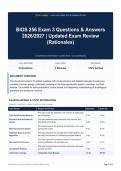
[STUDY GUIDE] • HIGH-YIELD PRACTICE & REVIEW EDITION
BIOS 256 Exam 3 Questions & Answers
2026/2027 | Updated Exam Review
(Rationales)
Comprehensive Examination Question Bank • Concept Mapping
TOTAL QUESTIONS EXAM TOPICS RATIONALES
33 Questions 6 Modules 100% Verified
DOCUMENT OVERVIEW
This document contains 33 verified questions with correct answers and detailed rationales covering key
concepts in human biology, particularly focusing on the male reproductive system, hormones, and fluid
balance. It is suitable for exam preparation, course review, and deepening understanding of physiological
processes and endocrine functions.
EXAM BLUEPRINT & TOPIC DISTRIBUTION
Systematic breakdown of subject domains and exam coverage.
Topic Module Scope & Core Focus Questions Share (%)
This topic covers the distribution and functions of bodily fluids
Fluid and Electrolyte Balance and electrolytes. 8 Qs 24.2%
Hormones and the Endocrine This topic examines various hormones, their sources, and
System their effects on the body. 6 Qs 18.2%
This topic focuses on the anatomy and physiology of the male
Male Reproductive System reproductive system. 6 Qs 18.2%
Acid-Base Balance and pH This topic addresses the concepts of pH, buffer systems, and
Regulation the body's mechanisms for maintaining acid-base balance. 5 Qs 15.2%
This topic explores the processes involved in reproduction,
Reproductive Processes including fertilization and gametogenesis. 4 Qs 12.1%
This topic compares male and female reproductive structures
Comparative Anatomy and their functions. 4 Qs 12.1%
Total Exam Coverage 6 Integrated Topic Modules 33 Qs 100.0%
Confidential • Student Study Edition • Practice & Review Guide Page 1 of 12
, STUDENT STUDY & MASTERY EDITION PRACTICE & REVIEW GUIDE
TOPIC 1: FLUID AND ELECTROLYTE BALANCE
8 Questions • 24.2% of Exam • This topic covers the distribution and functions of bodily fluids and electrolytes.
QUESTION 1
What are buffer systems
Answer: Minimize shifts in pH, controls body's acid-base level at suitable levels, acids and bases work
together to counter shifts in pH.
Rationale: Buffer systems are crucial for maintaining homeostasis by minimizing fluctuations in pH. They achieve this by
consisting of a weak acid and its conjugate base, or a weak base and its conjugate acid, which work together to neutralize
added acids or bases.
QUESTION 2
What are various fluid compartments in the body and where is the most fluid located
Answer: Intravascular, interstitial, and intracellular. Most is located in intracellular.
Rationale: The body's fluid is distributed across three main compartments: intravascular (within blood
vessels), interstitial (surrounding cells), and intracellular (inside cells). The intracellular compartment contains the largest
proportion of the body's total fluid volume.
QUESTION 3
Natriuresis
Answer: Sodium in urine.
Rationale: Natriuresis refers to the process of sodium excretion by the kidneys. This process is measured by the amount of
sodium present in the urine.
Confidential • Student Study Edition • Practice & Review Guide Page 2 of 12