[STUDY GUIDE] • HIGH-YIELD PRACTICE & REVIEW EDITION
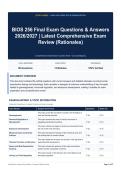
BIOS 256 Final Exam Questions & Answers
2026/2027 | Latest Comprehensive Exam
Review (Rationales)
Comprehensive Examination Question Bank • Concept Mapping
TOTAL QUESTIONS EXAM TOPICS RATIONALES
86 Questions 13 Modules 100% Verified
DOCUMENT OVERVIEW
This document contains 86 verified questions with correct answers and detailed rationales covering human
reproductive biology and physiology. Each question is designed to enhance understanding of key concepts
related to gametogenesis, hormonal regulation, and embryonic development, making it suitable for exam
preparation and comprehensive review.
EXAM BLUEPRINT & TOPIC DISTRIBUTION
Systematic breakdown of subject domains and exam coverage.
Topic Module Scope & Core Focus Questions Share (%)
This topic covers the processes involved in the formation of
Gametogenesis male and female gametes. 7 Qs 8.1%
Hormonal Regulation in This topic examines the roles of various hormones in
Reproduction regulating reproductive functions. 7 Qs 8.1%
This topic outlines the stages of embryonic development and
Embryonic Development the role of the inner cell mass. 7 Qs 8.1%
Menstrual Cycle and Ovarian This topic discusses the phases of the menstrual cycle and
Follicles the development of ovarian follicles. 7 Qs 8.1%
This topic details the structure and function of the placenta in
Placental Function and Structure supporting fetal development. 7 Qs 8.1%
Semen and Male Reproductive This topic includes the anatomy of the male reproductive
Anatomy system and the composition of semen. 7 Qs 8.1%
This topic focuses on the kidneys' role in fluid balance and
Urinary and Fluid Regulation electrolyte regulation. 7 Qs 8.1%
Confidential • Student Study Edition • Practice & Review Guide Page 1 of 27
,STUDENT STUDY & MASTERY EDITION PRACTICE & REVIEW GUIDE
This topic covers physiological mechanisms involved in
Acid-Base Balance maintaining acid-base homeostasis. 7 Qs 8.1%
This topic discusses the respiratory system's role in gas
Respiratory System Functions exchange and regulation of blood pH. 6 Qs 7.0%
Genetics and Inheritance This topic examines genetic concepts including alleles,
Patterns autosomes, and inheritance patterns. 6 Qs 7.0%
Developmental Stages of This topic highlights the key developmental milestones during
Pregnancy pregnancy. 6 Qs 7.0%
Functions of Accessory This topic outlines the contributions of various glands to
Reproductive Glands reproductive functions. 6 Qs 7.0%
Physiology of Labor and This topic describes the physiological changes and hormonal
Delivery involvement during labor. 6 Qs 7.0%
Total Exam Coverage 13 Integrated Topic Modules 86 Qs 100.0%
Confidential • Student Study Edition • Practice & Review Guide Page 2 of 27
, STUDENT STUDY & MASTERY EDITION PRACTICE & REVIEW GUIDE
TOPIC 1: GAMETOGENESIS
7 Questions • 8.1% of Exam • This topic covers the processes involved in the formation of male and female gametes.
QUESTION 1
What are male gametes?
Answer: Sperm.
Rationale: Sperm are the male gametes, which are reproductive cells produced by males. These haploid cells contain half
the genetic material of a diploid organism and are responsible for fertilizing the female gamete, the ovum.
QUESTION 2
What are female gametes?
Answer: Secondary oocytes.
Rationale: Female gametes are mature female reproductive cells. In humans and many other animals, the female gamete
is the secondary oocyte, which is released from the ovary during ovulation.
QUESTION 3
Process of spermatogenesis
Answer: Spermatogonia (germ cells)-- Primary spermatocyte (2n)-- Meiosis I occurs-- Secondary
spermatocytes 2 of (n), Meiosis II occurs-- Spermatids 4 of (n)-- Spermiogenesis (production of sperm)
Rationale: Spermatogenesis is the process by which male gametes, sperm, are produced from germ cells called
spermatogonia. This process begins with diploid spermatogonia (2n) differentiating into primary spermatocytes, which then
undergo meiosis I to produce two haploid secondary spermatocytes (n).
Confidential • Student Study Edition • Practice & Review Guide Page 3 of 27