
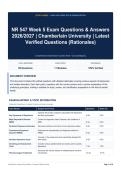
[STUDY GUIDE] • HIGH-YIELD PRACTICE & REVIEW EDITION
NR 547 Week 5 Exam Questions & Answers
2026/2027 | Chamberlain University | Latest
Verified Questions (Rationales)
Comprehensive Examination Question Bank • Concept Mapping
TOTAL QUESTIONS EXAM TOPICS RATIONALES
89 Questions 11 Modules 100% Verified
DOCUMENT OVERVIEW
This document contains 89 verified questions with detailed rationales covering various aspects of depression
and related disorders. Each item pairs a question with the correct answer and a concise explanation of the
underlying principles, making it suitable for study, review, and certification preparation in the field of mental
health.
EXAM BLUEPRINT & TOPIC DISTRIBUTION
Systematic breakdown of subject domains and exam coverage.
Topic Module Scope & Core Focus Questions Share (%)
Explores the primary symptoms associated with depression
Key Symptoms of Depression and their presentation. 8 Qs 9.0%
Major Depressive Disorder Covers the diagnostic criteria, features, and variations of
(MDD) MDD. 8 Qs 9.0%
Persistent Depressive Disorders Discusses dysthymia and other chronic depressive states. 8 Qs 9.0%
Premenstrual Dysphoric Examines the characteristics and diagnostic criteria for
Disorder (PMDD) PMDD. 8 Qs 9.0%
Focuses on the assessment tools specifically designed for
Geriatric Depression Scale older adults. 8 Qs 9.0%
Screening and Assessment Includes various questionnaires and scales used to assess
Tools depression. 7 Qs 7.9%
Discusses the various classes of antidepressants and their
Pharmacological Treatments mechanisms. 14 Qs 15.7%
Confidential • Student Study Edition • Practice & Review Guide Page 1 of 34
,STUDENT STUDY & MASTERY EDITION PRACTICE & REVIEW GUIDE
Non-pharmacological Covers therapeutic approaches such as psychotherapy for
Treatments managing depression. 7 Qs 7.9%
Examines the relationship between bipolar disorder and
Bipolar Disorder and Depression depressive symptoms. 7 Qs 7.9%
Medical Conditions Mimicking Identifies various medical issues that can present with
Depression depressive-like symptoms. 7 Qs 7.9%
Explores the role of inflammation and cytokines in the
Cytokines and Inflammation pathophysiology of depression. 7 Qs 7.9%
Total Exam Coverage 11 Integrated Topic Modules 89 Qs 100.0%
Confidential • Student Study Edition • Practice & Review Guide Page 2 of 34
,STUDENT STUDY & MASTERY EDITION PRACTICE & REVIEW GUIDE
TOPIC 1: KEY SYMPTOMS OF DEPRESSION
8 Questions • 9.0% of Exam • Explores the primary symptoms associated with depression and their presentation.
QUESTION 1
Depression: Key symptoms
Answer: Depressed mood lack of interest or pleasure.
Rationale: Depression is characterized by a persistent low mood and a diminished capacity to experience
pleasure. The presence of a depressed mood, often described as sadness or emptiness, and anhedonia, the inability to feel
enjoyment in previously pleasurable activities, are considered core diagnostic criteria for major depressive disorder.
QUESTION 2
Depression: Physical Symptoms
Answer: Fatigue, inattention, poor appetite, decreased libido, psychomotor retardation, or agitation.
Rationale: Depression is a mood disorder that can manifest with a variety of physical symptoms beyond emotional distress.
These somatic presentations include a pervasive lack of energy (fatigue), difficulty concentrating (inattention), changes in
eating habits (poor appetite), reduced sexual desire (decreased libido), and alterations in movement and activity levels, such
as slowed physical functioning (psychomotor retardation) or restlessness (agitation).
QUESTION 3
Depression: Severe Cases
Answer: May report hallucinations or delusions; catatonia.
Rationale: Severe depression can manifest with psychotic features, which include hallucinations or delusions.
Catatonia, a state of immobility or excessive motor activity, can also be a symptom of severe depression.
Confidential • Student Study Edition • Practice & Review Guide Page 3 of 34
, STUDENT STUDY & MASTERY EDITION PRACTICE & REVIEW GUIDE
QUESTION 4
MDD: Primary Feature
Answer: At least one episode of major depression lasting at least 2 weeks.
Rationale: Major Depressive Disorder (MDD) is characterized by the presence of at least one major depressive
episode. A major depressive episode is defined by a period of at least two consecutive weeks during which an individual
experiences a depressed mood or a loss of interest or pleasure in all or nearly all activities.
QUESTION 5
MDD: Required symptoms
Answer: Must experience at least 5 of the following:
- feeling low most of the days for most days
- decreased interest in activities
- substantial weight loss, significant change in appetite
- fidgeting, random movement (pacing)
- Decreased Energy
- guilt or worthlessness
-lack of focus or ability to make decisions
- repeated thoughts of death or suicide.
QUESTION 6
MDD: Mild
Answer: Intensity of symptoms is manageable w/ minimal impairment in functions
*few sx beyond those required for dx.
Rationale: Mild Major Depressive Disorder (MDD) is characterized by symptoms that are manageable and cause minimal
impairment in daily functioning. This includes experiencing only a few symptoms beyond those strictly required for the
diagnosis.
Confidential • Student Study Edition • Practice & Review Guide Page 4 of 34
NR 547 Week 5 Exam Questions & Answers
2026/2027 | Chamberlain University | Latest
Verified Questions (Rationales)
Comprehensive Examination Question Bank • Concept Mapping
TOTAL QUESTIONS EXAM TOPICS RATIONALES
89 Questions 11 Modules 100% Verified
DOCUMENT OVERVIEW
This document contains 89 verified questions with detailed rationales covering various aspects of depression
and related disorders. Each item pairs a question with the correct answer and a concise explanation of the
underlying principles, making it suitable for study, review, and certification preparation in the field of mental
health.
EXAM BLUEPRINT & TOPIC DISTRIBUTION
Systematic breakdown of subject domains and exam coverage.
Topic Module Scope & Core Focus Questions Share (%)
Explores the primary symptoms associated with depression
Key Symptoms of Depression and their presentation. 8 Qs 9.0%
Major Depressive Disorder Covers the diagnostic criteria, features, and variations of
(MDD) MDD. 8 Qs 9.0%
Persistent Depressive Disorders Discusses dysthymia and other chronic depressive states. 8 Qs 9.0%
Premenstrual Dysphoric Examines the characteristics and diagnostic criteria for
Disorder (PMDD) PMDD. 8 Qs 9.0%
Focuses on the assessment tools specifically designed for
Geriatric Depression Scale older adults. 8 Qs 9.0%
Screening and Assessment Includes various questionnaires and scales used to assess
Tools depression. 7 Qs 7.9%
Discusses the various classes of antidepressants and their
Pharmacological Treatments mechanisms. 14 Qs 15.7%
Confidential • Student Study Edition • Practice & Review Guide Page 1 of 34
,STUDENT STUDY & MASTERY EDITION PRACTICE & REVIEW GUIDE
Non-pharmacological Covers therapeutic approaches such as psychotherapy for
Treatments managing depression. 7 Qs 7.9%
Examines the relationship between bipolar disorder and
Bipolar Disorder and Depression depressive symptoms. 7 Qs 7.9%
Medical Conditions Mimicking Identifies various medical issues that can present with
Depression depressive-like symptoms. 7 Qs 7.9%
Explores the role of inflammation and cytokines in the
Cytokines and Inflammation pathophysiology of depression. 7 Qs 7.9%
Total Exam Coverage 11 Integrated Topic Modules 89 Qs 100.0%
Confidential • Student Study Edition • Practice & Review Guide Page 2 of 34
,STUDENT STUDY & MASTERY EDITION PRACTICE & REVIEW GUIDE
TOPIC 1: KEY SYMPTOMS OF DEPRESSION
8 Questions • 9.0% of Exam • Explores the primary symptoms associated with depression and their presentation.
QUESTION 1
Depression: Key symptoms
Answer: Depressed mood lack of interest or pleasure.
Rationale: Depression is characterized by a persistent low mood and a diminished capacity to experience
pleasure. The presence of a depressed mood, often described as sadness or emptiness, and anhedonia, the inability to feel
enjoyment in previously pleasurable activities, are considered core diagnostic criteria for major depressive disorder.
QUESTION 2
Depression: Physical Symptoms
Answer: Fatigue, inattention, poor appetite, decreased libido, psychomotor retardation, or agitation.
Rationale: Depression is a mood disorder that can manifest with a variety of physical symptoms beyond emotional distress.
These somatic presentations include a pervasive lack of energy (fatigue), difficulty concentrating (inattention), changes in
eating habits (poor appetite), reduced sexual desire (decreased libido), and alterations in movement and activity levels, such
as slowed physical functioning (psychomotor retardation) or restlessness (agitation).
QUESTION 3
Depression: Severe Cases
Answer: May report hallucinations or delusions; catatonia.
Rationale: Severe depression can manifest with psychotic features, which include hallucinations or delusions.
Catatonia, a state of immobility or excessive motor activity, can also be a symptom of severe depression.
Confidential • Student Study Edition • Practice & Review Guide Page 3 of 34
, STUDENT STUDY & MASTERY EDITION PRACTICE & REVIEW GUIDE
QUESTION 4
MDD: Primary Feature
Answer: At least one episode of major depression lasting at least 2 weeks.
Rationale: Major Depressive Disorder (MDD) is characterized by the presence of at least one major depressive
episode. A major depressive episode is defined by a period of at least two consecutive weeks during which an individual
experiences a depressed mood or a loss of interest or pleasure in all or nearly all activities.
QUESTION 5
MDD: Required symptoms
Answer: Must experience at least 5 of the following:
- feeling low most of the days for most days
- decreased interest in activities
- substantial weight loss, significant change in appetite
- fidgeting, random movement (pacing)
- Decreased Energy
- guilt or worthlessness
-lack of focus or ability to make decisions
- repeated thoughts of death or suicide.
QUESTION 6
MDD: Mild
Answer: Intensity of symptoms is manageable w/ minimal impairment in functions
*few sx beyond those required for dx.
Rationale: Mild Major Depressive Disorder (MDD) is characterized by symptoms that are manageable and cause minimal
impairment in daily functioning. This includes experiencing only a few symptoms beyond those strictly required for the
diagnosis.
Confidential • Student Study Edition • Practice & Review Guide Page 4 of 34


