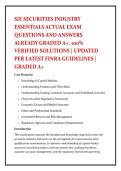
SIE SECURITIES INDUSTRY
ESSENTIALS ACTUAL EXAM
QUESTIONS AND ANSWERS
ALREADY GRADED A+. 100%
VERIFIED SOLUTIONS | UPDATED
PER LATEST FINRA GUIDELINES |
GRADED A+
Core Domains
• Knowledge of Capital Markets
• Understanding Products and Their Risks
• Understanding Trading, Customer Accounts, and Prohibited Activities
• Overview of the Regulatory Framework
• Economic Factors and Market Structure
• Ethics and Professional Standards
• Investment Returns and Risk Management
• Regulatory Agencies and Compliance Requirements
Introduction
This examination assesses the foundational knowledge required to enter the
securities industry and serves as the prerequisite for representative-level
qualification examinations. It evaluates understanding of capital market
structure, securities products and associated risks, trading procedures,
customer account management, and the regulatory framework governing
,broker-dealers and associated persons. Questions are structured in multiple-
choice and scenario-based formats to emphasize practical application,
regulatory compliance, and ethical decision-making. Candidates must
demonstrate the ability to identify suitable investments, recognize prohibited
practices, and apply FINRA and SEC rules to real-world situations.
SECTION ONE: QUESTIONS 1–100
1. Which market involves the direct trading of securities between
institutions without a broker-dealer intermediary?
A. First market
B. Second market
C. Third market
D. Fourth market
D
RATIONALE: The fourth market consists of direct institution-to-
institution transactions, typically executed through electronic
communication networks (ECNs) without broker-dealer intermediation.
2. A company issues 5 million shares to the public for the first time
through an investment bank that underwrites on a firm-commitment
basis. This is best described as:
A. A secondary offering
B. An initial public offering (IPO)
C. A private placement
D. A shelf offering
B
RATIONALE: An initial public offering (IPO) is the first sale of a
company's stock to the public. In a firm-commitment underwriting, the
investment bank purchases the shares from the issuer and assumes the risk of
selling them.
,3. Under FINRA rules, which of the following loans is a registered
representative permitted to accept if allowed by the firm?
A. A loan from a long-time customer
B. A loan from a high-net-worth customer
C. A loan from a customer that is an industrial corporation
D. A loan from a customer who was a long-time friend prior to becoming
associated with the firm
D
RATIONALE: FINRA permits loans between registered representatives
and customers who were friends or immediate family prior to the
representative's association with the firm, provided the firm allows it.
4. Which of the following securities is backed by the full faith and
credit of the U.S. government?
A. Treasury notes
B. Municipal bonds
C. Corporate debentures
D. Agency securities
A
RATIONALE: U.S. Treasury securities, including Treasury notes and
bonds, are backed by the full faith and credit of the U.S. government, making
them among the safest investments.
5. A registered representative engages in trading ahead of a known
customer block order. This prohibited practice is called:
A. Wash trading
B. Churning
C. Front running
D. Painting the tape
C
, RATIONALE: Front running is the prohibited practice of trading ahead of
a customer's large order to profit from the anticipated price movement. It
violates fiduciary duty and FINRA rules.
6. Which of the following is characteristic of a Coverdell Education
Savings Account (ESA)?
A. There are no annual contribution limits
B. Contributions are tax deductible
C. Unused funds may be transferred to an eligible relative of any age
D. The designated beneficiary must be under 18 or a special needs beneficiary
when established
D
RATIONALE: A Coverdell ESA requires the beneficiary to be under 18 or a
special needs beneficiary at the time the account is established. Contributions
are not tax deductible, and annual limits apply.
7. The frequency of interest payments for a fixed-coupon municipal
bond is typically:
A. Monthly
B. Quarterly
C. Semiannually
D. Annually
C
RATIONALE: Municipal bonds typically pay interest semiannually,
consistent with the standard convention for most fixed-income securities.
8. Under FINRA Rule 3110, a member firm must hold an annual
compliance meeting with each registered person. The format of this
meeting:
A. Must be in person only
B. May be in person, by video conference, or through on-demand webcast
ESSENTIALS ACTUAL EXAM
QUESTIONS AND ANSWERS
ALREADY GRADED A+. 100%
VERIFIED SOLUTIONS | UPDATED
PER LATEST FINRA GUIDELINES |
GRADED A+
Core Domains
• Knowledge of Capital Markets
• Understanding Products and Their Risks
• Understanding Trading, Customer Accounts, and Prohibited Activities
• Overview of the Regulatory Framework
• Economic Factors and Market Structure
• Ethics and Professional Standards
• Investment Returns and Risk Management
• Regulatory Agencies and Compliance Requirements
Introduction
This examination assesses the foundational knowledge required to enter the
securities industry and serves as the prerequisite for representative-level
qualification examinations. It evaluates understanding of capital market
structure, securities products and associated risks, trading procedures,
customer account management, and the regulatory framework governing
,broker-dealers and associated persons. Questions are structured in multiple-
choice and scenario-based formats to emphasize practical application,
regulatory compliance, and ethical decision-making. Candidates must
demonstrate the ability to identify suitable investments, recognize prohibited
practices, and apply FINRA and SEC rules to real-world situations.
SECTION ONE: QUESTIONS 1–100
1. Which market involves the direct trading of securities between
institutions without a broker-dealer intermediary?
A. First market
B. Second market
C. Third market
D. Fourth market
D
RATIONALE: The fourth market consists of direct institution-to-
institution transactions, typically executed through electronic
communication networks (ECNs) without broker-dealer intermediation.
2. A company issues 5 million shares to the public for the first time
through an investment bank that underwrites on a firm-commitment
basis. This is best described as:
A. A secondary offering
B. An initial public offering (IPO)
C. A private placement
D. A shelf offering
B
RATIONALE: An initial public offering (IPO) is the first sale of a
company's stock to the public. In a firm-commitment underwriting, the
investment bank purchases the shares from the issuer and assumes the risk of
selling them.
,3. Under FINRA rules, which of the following loans is a registered
representative permitted to accept if allowed by the firm?
A. A loan from a long-time customer
B. A loan from a high-net-worth customer
C. A loan from a customer that is an industrial corporation
D. A loan from a customer who was a long-time friend prior to becoming
associated with the firm
D
RATIONALE: FINRA permits loans between registered representatives
and customers who were friends or immediate family prior to the
representative's association with the firm, provided the firm allows it.
4. Which of the following securities is backed by the full faith and
credit of the U.S. government?
A. Treasury notes
B. Municipal bonds
C. Corporate debentures
D. Agency securities
A
RATIONALE: U.S. Treasury securities, including Treasury notes and
bonds, are backed by the full faith and credit of the U.S. government, making
them among the safest investments.
5. A registered representative engages in trading ahead of a known
customer block order. This prohibited practice is called:
A. Wash trading
B. Churning
C. Front running
D. Painting the tape
C
, RATIONALE: Front running is the prohibited practice of trading ahead of
a customer's large order to profit from the anticipated price movement. It
violates fiduciary duty and FINRA rules.
6. Which of the following is characteristic of a Coverdell Education
Savings Account (ESA)?
A. There are no annual contribution limits
B. Contributions are tax deductible
C. Unused funds may be transferred to an eligible relative of any age
D. The designated beneficiary must be under 18 or a special needs beneficiary
when established
D
RATIONALE: A Coverdell ESA requires the beneficiary to be under 18 or a
special needs beneficiary at the time the account is established. Contributions
are not tax deductible, and annual limits apply.
7. The frequency of interest payments for a fixed-coupon municipal
bond is typically:
A. Monthly
B. Quarterly
C. Semiannually
D. Annually
C
RATIONALE: Municipal bonds typically pay interest semiannually,
consistent with the standard convention for most fixed-income securities.
8. Under FINRA Rule 3110, a member firm must hold an annual
compliance meeting with each registered person. The format of this
meeting:
A. Must be in person only
B. May be in person, by video conference, or through on-demand webcast