NUR 265 EXAM 1 – MEDICAL-SURGICAL NURSING | 2
VERSIONS | NEWEST QUESTIONS & ANSWERS COMPLETE
STUDY GUIDE – GALEN COLLEGE OF NURSING | LATEST
2026-2028 | 100% VERIFIEDIntroduction
This comprehensive examination assesses the foundational and advanced medical-surgical
nursing knowledge required for safe, evidence-based practice in adult health settings. It
evaluates understanding of the nursing process, fluid and electrolyte balance, acid-base
interpretation, perioperative care, shock management, and system-specific disorders.
Questions are structured in multiple-choice and scenario-based formats to emphasize
clinical judgment, prioritization, and real-world application. A strong emphasis is placed on
patient safety, interprofessional collaboration, and the synthesis of assessment data to
formulate appropriate nursing interventions and evaluate care outcomes. Candidates must
demonstrate the ability to apply pathophysiological principles to clinical decision-making
across diverse patient populations.
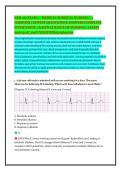
1. A 58-year-old male is admitted with severe vomiting for 3 days. The nurse
observes the following ECG finding. Which acid-base imbalance is most likely?
[Diagram: ECG showing flattened T waves and U waves]
A. Metabolic acidosis
B. Metabolic alkalosis
C. Respiratory acidosis
D. Respiratory alkalosis
B
RATIONALE: Severe vomiting causes loss of gastric hydrochloric acid, leading to
metabolic alkalosis. The ECG changes shown (flattened T waves and U waves) are
consistent with hypokalemia, which commonly accompanies metabolic alkalosis due to
renal potassium wasting.
,2. A 45-year-old female presents with diabetic ketoacidosis (DKA). The nurse
observes the following respiratory pattern. What is this breathing pattern called?
[Diagram: Respiratory pattern showing deep, rapid, labored breaths]
A. Cheyne-Stokes respirations
B. Kussmaul respirations
C. Biot respirations
D. Bradypnea
B
RATIONALE: Kussmaul respirations are deep, rapid breaths that occur as a
compensatory mechanism to blow off CO2 and reduce acidosis in DKA. This respiratory
pattern is a hallmark of metabolic acidosis.
3. A 62-year-old male with heart failure is receiving furosemide. The nurse observes
the following ECG finding. Which laboratory value requires immediate notification
of the provider?
[Diagram: ECG showing flattened T waves and prominent U waves]
A. Sodium 142 mEq/L
B. Potassium 3.1 mEq/L
C. Calcium 9.0 mg/dL
D. Magnesium 2.0 mEq/L
B
, RATIONALE: Furosemide is a potassium-wasting diuretic. A potassium level of 3.1
mEq/L indicates hypokalemia, which increases the risk of dysrhythmias, especially in heart
failure. The ECG changes shown are consistent with hypokalemia.
4. A 55-year-old female is admitted with syndrome of inappropriate antidiuretic
hormone (SIADH). The nurse observes the following laboratory findings. What is
the priority nursing intervention?
[Diagram: Laboratory results showing serum sodium 118 mEq/L, serum osmolality 260
mOsm/kg, urine osmolality 600 mOsm/kg]
A. Administer hypertonic saline as ordered
B. Restrict fluid intake
C. Administer furosemide
D. Encourage increased oral fluid intake
B
RATIONALE: SIADH is characterized by hyponatremia, low serum osmolality, and
concentrated urine. Fluid restriction is the first-line treatment to correct dilutional
hyponatremia. Hypertonic saline is reserved for severe symptomatic hyponatremia.
5. A 68-year-old male is admitted with acute kidney injury (AKI). The nurse
observes the following laboratory findings. Which intervention is the priority?
[Diagram: Laboratory results showing potassium 6.8 mEq/L, BUN 45 mg/dL, creatinine 3.2
mg/dL]
, A. Administer oral potassium supplements
B. Prepare the patient for hemodialysis
C. Obtain a 12-lead ECG
D. Encourage increased oral fluid intake
C
RATIONALE: Hyperkalemia (potassium >6.0 mEq/L) can cause life-threatening
cardiac dysrhythmias. An ECG is the priority assessment to evaluate for cardiac effects.
Oral potassium is contraindicated. Dialysis may be needed later, but ECG is the immediate
priority.
6. A 72-year-old female is scheduled for a total hip replacement. Which
preoperative assessment finding requires immediate notification of the surgeon?
A. Blood pressure 138/82 mmHg
B. Hemoglobin 10.2 g/dL
C. Temperature 101.8°F
D. Heart rate 88 beats/min
C
RATIONALE: An elevated temperature may indicate an active infection, which
increases the risk of surgical site infection and postoperative complications. Surgery may
need to be postponed until the infection is resolved.
7. A 45-year-old male is admitted with severe sepsis. Which finding indicates the
patient is in the early (warm) phase of septic shock?
A. Cool, clammy extremities
B. Bradycardia and hypotension
C. Warm, flushed skin and tachycardia
D. Decreased cardiac output and increased SVR
C
RATIONALE: The early (warm) phase of septic shock is characterized by peripheral
vasodilation, resulting in warm, flushed skin and compensatory tachycardia. Cool, clammy
extremities indicate the late (cold) phase.
8. A 60-year-old male with a history of COPD presents with increased sputum
production and worsening dyspnea. Which finding on chest X-ray is most
consistent with pneumonia?
VERSIONS | NEWEST QUESTIONS & ANSWERS COMPLETE
STUDY GUIDE – GALEN COLLEGE OF NURSING | LATEST
2026-2028 | 100% VERIFIEDIntroduction
This comprehensive examination assesses the foundational and advanced medical-surgical
nursing knowledge required for safe, evidence-based practice in adult health settings. It
evaluates understanding of the nursing process, fluid and electrolyte balance, acid-base
interpretation, perioperative care, shock management, and system-specific disorders.
Questions are structured in multiple-choice and scenario-based formats to emphasize
clinical judgment, prioritization, and real-world application. A strong emphasis is placed on
patient safety, interprofessional collaboration, and the synthesis of assessment data to
formulate appropriate nursing interventions and evaluate care outcomes. Candidates must
demonstrate the ability to apply pathophysiological principles to clinical decision-making
across diverse patient populations.
1. A 58-year-old male is admitted with severe vomiting for 3 days. The nurse
observes the following ECG finding. Which acid-base imbalance is most likely?
[Diagram: ECG showing flattened T waves and U waves]
A. Metabolic acidosis
B. Metabolic alkalosis
C. Respiratory acidosis
D. Respiratory alkalosis
B
RATIONALE: Severe vomiting causes loss of gastric hydrochloric acid, leading to
metabolic alkalosis. The ECG changes shown (flattened T waves and U waves) are
consistent with hypokalemia, which commonly accompanies metabolic alkalosis due to
renal potassium wasting.
,2. A 45-year-old female presents with diabetic ketoacidosis (DKA). The nurse
observes the following respiratory pattern. What is this breathing pattern called?
[Diagram: Respiratory pattern showing deep, rapid, labored breaths]
A. Cheyne-Stokes respirations
B. Kussmaul respirations
C. Biot respirations
D. Bradypnea
B
RATIONALE: Kussmaul respirations are deep, rapid breaths that occur as a
compensatory mechanism to blow off CO2 and reduce acidosis in DKA. This respiratory
pattern is a hallmark of metabolic acidosis.
3. A 62-year-old male with heart failure is receiving furosemide. The nurse observes
the following ECG finding. Which laboratory value requires immediate notification
of the provider?
[Diagram: ECG showing flattened T waves and prominent U waves]
A. Sodium 142 mEq/L
B. Potassium 3.1 mEq/L
C. Calcium 9.0 mg/dL
D. Magnesium 2.0 mEq/L
B
, RATIONALE: Furosemide is a potassium-wasting diuretic. A potassium level of 3.1
mEq/L indicates hypokalemia, which increases the risk of dysrhythmias, especially in heart
failure. The ECG changes shown are consistent with hypokalemia.
4. A 55-year-old female is admitted with syndrome of inappropriate antidiuretic
hormone (SIADH). The nurse observes the following laboratory findings. What is
the priority nursing intervention?
[Diagram: Laboratory results showing serum sodium 118 mEq/L, serum osmolality 260
mOsm/kg, urine osmolality 600 mOsm/kg]
A. Administer hypertonic saline as ordered
B. Restrict fluid intake
C. Administer furosemide
D. Encourage increased oral fluid intake
B
RATIONALE: SIADH is characterized by hyponatremia, low serum osmolality, and
concentrated urine. Fluid restriction is the first-line treatment to correct dilutional
hyponatremia. Hypertonic saline is reserved for severe symptomatic hyponatremia.
5. A 68-year-old male is admitted with acute kidney injury (AKI). The nurse
observes the following laboratory findings. Which intervention is the priority?
[Diagram: Laboratory results showing potassium 6.8 mEq/L, BUN 45 mg/dL, creatinine 3.2
mg/dL]
, A. Administer oral potassium supplements
B. Prepare the patient for hemodialysis
C. Obtain a 12-lead ECG
D. Encourage increased oral fluid intake
C
RATIONALE: Hyperkalemia (potassium >6.0 mEq/L) can cause life-threatening
cardiac dysrhythmias. An ECG is the priority assessment to evaluate for cardiac effects.
Oral potassium is contraindicated. Dialysis may be needed later, but ECG is the immediate
priority.
6. A 72-year-old female is scheduled for a total hip replacement. Which
preoperative assessment finding requires immediate notification of the surgeon?
A. Blood pressure 138/82 mmHg
B. Hemoglobin 10.2 g/dL
C. Temperature 101.8°F
D. Heart rate 88 beats/min
C
RATIONALE: An elevated temperature may indicate an active infection, which
increases the risk of surgical site infection and postoperative complications. Surgery may
need to be postponed until the infection is resolved.
7. A 45-year-old male is admitted with severe sepsis. Which finding indicates the
patient is in the early (warm) phase of septic shock?
A. Cool, clammy extremities
B. Bradycardia and hypotension
C. Warm, flushed skin and tachycardia
D. Decreased cardiac output and increased SVR
C
RATIONALE: The early (warm) phase of septic shock is characterized by peripheral
vasodilation, resulting in warm, flushed skin and compensatory tachycardia. Cool, clammy
extremities indicate the late (cold) phase.
8. A 60-year-old male with a history of COPD presents with increased sputum
production and worsening dyspnea. Which finding on chest X-ray is most
consistent with pneumonia?