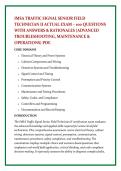
IMSA TRAFFIC SIGNAL SENIOR FIELD
TECHNICIAN II ACTUAL EXAM – 100 QUESTIONS
WITH ANSWERS & RATIONALES (ADVANCED
TROUBLESHOOTING, MAINTENANCE &
OPERATIONS) PDF.
CORE DOMAINS
• Electrical Theory and Power Systems
• Cabinet Components and Wiring
• Detection Systems and Troubleshooting
• Signal Control and Timing
• Preemption and Priority Control
• Communication Systems
• Maintenance and Testing Procedures
• Safety, Codes, and Compliance
• Controllers and Programming
• Documentation and Record Keeping
INTRODUCTION
The IMSA Traffic Signal Senior Field Technician II certification exam evaluates
the advanced knowledge and applied skills required for senior-level field
technicians. This comprehensive assessment covers electrical theory, cabinet
wiring, detection systems, signal control, preemption, communication,
maintenance procedures, safety compliance, and troubleshooting. The
examination employs multiple-choice and scenario-based questions that
emphasize real-world field application, critical thinking, and code-compliant
decision-making. It rigorously assesses the ability to diagnose complex faults,
,perform advanced maintenance, and ensure safe and efficient traffic signal
operations, validating readiness for senior technician responsibilities.
SECTION ONE: QUESTIONS 1–100
1. A traffic signal intersection goes dark during peak traffic hours. What
is the FIRST action a senior technician should take?
A. Replace signal heads immediately
B. Verify power supply and service disconnect status
C. Reprogram controller instantly
D. Shut down cabinet ventilation
B. Verify power supply and service disconnect status
RATIONALE: Power verification is the first step in troubleshooting a dark
intersection. Before investigating other potential causes like controller failure
or signal head malfunction, confirming the presence and stability of utility
power is the most fundamental diagnostic step.
2. A technician measures 95 VAC at a load switch output intended to
supply 120 VAC. What is the MOST likely issue?
A. Proper operation
B. Failing load switch or voltage drop issue
C. Cabinet grounding success
D. Conflict monitor failure only
B. Failing load switch or voltage drop issue
RATIONALE: A significantly reduced voltage at the load switch output
indicates either a failing load switch or an excessive voltage drop caused by
resistance in the circuit. This is not normal operation and must be
investigated.
,3. During maintenance, a technician bypasses lockout/tagout
procedures. What is the PRIMARY risk?
A. Timing drift
B. Electrical shock or accidental energization
C. Cabinet condensation
D. Detector sensitivity loss
B. Electrical shock or accidental energization
RATIONALE: Lockout/tagout (LOTO) procedures are critical safety
protocols designed to protect workers from hazardous energy. Bypassing
them creates a severe risk of electrical shock or accidental equipment
energization.
4. A conflict monitor enters flash mode repeatedly after rainstorms.
What is the MOST likely cause?
A. Timing optimization
B. Moisture intrusion causing short circuits
C. Excessive cabinet cooling
D. Proper detector operation
B. Moisture intrusion causing short circuits
RATIONALE: Moisture intrusion from rainstorms commonly causes
intermittent electrical faults, such as short circuits, which can trigger a
conflict monitor to place the intersection into flash mode as a safety
precaution.
5. A signal phase remains green continuously despite controller
commands. What should be checked FIRST?
, A. Street signs
B. Load switch stuck in energized state
C. Pavement markings
D. Cabinet paint condition
B. Load switch stuck in energized state
RATIONALE: A continuous green indication despite controller commands
strongly suggests a load switch has failed in the "stuck on" state. This prevents
the controller from terminating the phase.
6. A technician detects fluctuating cabinet voltage. What is the BEST
first diagnostic step?
A. Replace controller immediately
B. Verify incoming utility power stability
C. Remove detector cards
D. Disable flash mode
B. Verify incoming utility power stability
RATIONALE: Fluctuating cabinet voltage can originate from unstable
utility power. Verifying the stability of the incoming utility supply is the
correct first step before investigating internal cabinet components.
7. A vehicle detector fails to register cars in one lane. What is the most
likely cause?
A. Conflict monitor calibration
B. Open loop detector circuit
C. Signal head alignment
D. Battery backup activation
B. Open loop detector circuit
TECHNICIAN II ACTUAL EXAM – 100 QUESTIONS
WITH ANSWERS & RATIONALES (ADVANCED
TROUBLESHOOTING, MAINTENANCE &
OPERATIONS) PDF.
CORE DOMAINS
• Electrical Theory and Power Systems
• Cabinet Components and Wiring
• Detection Systems and Troubleshooting
• Signal Control and Timing
• Preemption and Priority Control
• Communication Systems
• Maintenance and Testing Procedures
• Safety, Codes, and Compliance
• Controllers and Programming
• Documentation and Record Keeping
INTRODUCTION
The IMSA Traffic Signal Senior Field Technician II certification exam evaluates
the advanced knowledge and applied skills required for senior-level field
technicians. This comprehensive assessment covers electrical theory, cabinet
wiring, detection systems, signal control, preemption, communication,
maintenance procedures, safety compliance, and troubleshooting. The
examination employs multiple-choice and scenario-based questions that
emphasize real-world field application, critical thinking, and code-compliant
decision-making. It rigorously assesses the ability to diagnose complex faults,
,perform advanced maintenance, and ensure safe and efficient traffic signal
operations, validating readiness for senior technician responsibilities.
SECTION ONE: QUESTIONS 1–100
1. A traffic signal intersection goes dark during peak traffic hours. What
is the FIRST action a senior technician should take?
A. Replace signal heads immediately
B. Verify power supply and service disconnect status
C. Reprogram controller instantly
D. Shut down cabinet ventilation
B. Verify power supply and service disconnect status
RATIONALE: Power verification is the first step in troubleshooting a dark
intersection. Before investigating other potential causes like controller failure
or signal head malfunction, confirming the presence and stability of utility
power is the most fundamental diagnostic step.
2. A technician measures 95 VAC at a load switch output intended to
supply 120 VAC. What is the MOST likely issue?
A. Proper operation
B. Failing load switch or voltage drop issue
C. Cabinet grounding success
D. Conflict monitor failure only
B. Failing load switch or voltage drop issue
RATIONALE: A significantly reduced voltage at the load switch output
indicates either a failing load switch or an excessive voltage drop caused by
resistance in the circuit. This is not normal operation and must be
investigated.
,3. During maintenance, a technician bypasses lockout/tagout
procedures. What is the PRIMARY risk?
A. Timing drift
B. Electrical shock or accidental energization
C. Cabinet condensation
D. Detector sensitivity loss
B. Electrical shock or accidental energization
RATIONALE: Lockout/tagout (LOTO) procedures are critical safety
protocols designed to protect workers from hazardous energy. Bypassing
them creates a severe risk of electrical shock or accidental equipment
energization.
4. A conflict monitor enters flash mode repeatedly after rainstorms.
What is the MOST likely cause?
A. Timing optimization
B. Moisture intrusion causing short circuits
C. Excessive cabinet cooling
D. Proper detector operation
B. Moisture intrusion causing short circuits
RATIONALE: Moisture intrusion from rainstorms commonly causes
intermittent electrical faults, such as short circuits, which can trigger a
conflict monitor to place the intersection into flash mode as a safety
precaution.
5. A signal phase remains green continuously despite controller
commands. What should be checked FIRST?
, A. Street signs
B. Load switch stuck in energized state
C. Pavement markings
D. Cabinet paint condition
B. Load switch stuck in energized state
RATIONALE: A continuous green indication despite controller commands
strongly suggests a load switch has failed in the "stuck on" state. This prevents
the controller from terminating the phase.
6. A technician detects fluctuating cabinet voltage. What is the BEST
first diagnostic step?
A. Replace controller immediately
B. Verify incoming utility power stability
C. Remove detector cards
D. Disable flash mode
B. Verify incoming utility power stability
RATIONALE: Fluctuating cabinet voltage can originate from unstable
utility power. Verifying the stability of the incoming utility supply is the
correct first step before investigating internal cabinet components.
7. A vehicle detector fails to register cars in one lane. What is the most
likely cause?
A. Conflict monitor calibration
B. Open loop detector circuit
C. Signal head alignment
D. Battery backup activation
B. Open loop detector circuit