
NIH Stroke Scale (Exam #2)
NIH Stroke Scale (Exam #2)
Study online at https://quizlet.com/_fulfxp
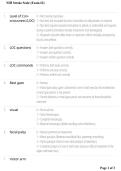
1. Level of Con- 0 = Alert; keenly responsive.
sciousness (LOC) 1 = Not alert; but arousable by minor stimulation to obey,answer, or respond.
2 = Not alert; requires repeated stimulation to attend, or isobtunded and requires
strong or painful stimulation tomake movements (not stereotyped).
3 = Responds only with reflex motor or autonomic effects ortotally unresponsive,
flaccid, and areflexic.
2. LOC questions 0 = Answers both questions correctly.
1 = Answers one question correctly.
2 = Answers neither question correctly
3. LOC commands 0 = Performs both tasks correctly.
1 = Performs one task correctly.
2 = Performs neither task correctly
4. Best gaze 0 = Normal.
1 = Partial gaze palsy; gaze is abnormal in one or both eyes,but forced deviation
or total gaze paresis is not present.
2 = Forced deviation, or total gaze paresis not overcome by theoculocephalic
maneuver.
5. visual 0 = No visual loss.
1 = Partial hemianopia.
2 = Complete hemianopia.
3 = Bilateral hemianopia (blind including cortical blindness)
6. facial palsy 0 = Normal symmetrical movements.
1 = Minor paralysis (flattened nasolabial fold, asymmetry onsmiling).
2 = Partial paralysis (total or near-total paralysis of lowerface).
3 = Complete paralysis of one or both sides (absence offacial movement in the
upper and lower face).
7. motor arm
1/3
Page 1 of 3
NIH Stroke Scale (Exam #2)
Study online at https://quizlet.com/_fulfxp
1. Level of Con- 0 = Alert; keenly responsive.
sciousness (LOC) 1 = Not alert; but arousable by minor stimulation to obey,answer, or respond.
2 = Not alert; requires repeated stimulation to attend, or isobtunded and requires
strong or painful stimulation tomake movements (not stereotyped).
3 = Responds only with reflex motor or autonomic effects ortotally unresponsive,
flaccid, and areflexic.
2. LOC questions 0 = Answers both questions correctly.
1 = Answers one question correctly.
2 = Answers neither question correctly
3. LOC commands 0 = Performs both tasks correctly.
1 = Performs one task correctly.
2 = Performs neither task correctly
4. Best gaze 0 = Normal.
1 = Partial gaze palsy; gaze is abnormal in one or both eyes,but forced deviation
or total gaze paresis is not present.
2 = Forced deviation, or total gaze paresis not overcome by theoculocephalic
maneuver.
5. visual 0 = No visual loss.
1 = Partial hemianopia.
2 = Complete hemianopia.
3 = Bilateral hemianopia (blind including cortical blindness)
6. facial palsy 0 = Normal symmetrical movements.
1 = Minor paralysis (flattened nasolabial fold, asymmetry onsmiling).
2 = Partial paralysis (total or near-total paralysis of lowerface).
3 = Complete paralysis of one or both sides (absence offacial movement in the
upper and lower face).
7. motor arm
1/3
Page 1 of 3


