

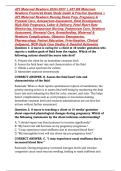
ATI Maternal Newborn 2026/2027 | ATI RN Maternal-
Newborn Proctored Exam Study Guide & Practice Questions |
ATI Maternal Newborn Nursing Exam Prep, Pregnancy &
Prenatal Care, Antepartum Assessment, Fetal Development,
High-Risk Pregnancy, Labor & Delivery, Fetal Heart Rate
Monitoring, Intrapartum Nursing, Postpartum Care, Newborn
Assessment, Neonatal Care, Breastfeeding, Maternal &
Newborn Complications, Obstetric Emergencies,
Pharmacology, Patient Education, Prioritization, Clinical
Judgment, NGN-Style Case Studies & Detailed Rationales
Question 1: A nurse is caring for a client at 38 weeks' gestation who
reports a sudden gush of fluid from the vagina. Which of the
following actions should the nurse take first?
A. Prepare the client for an immediate cesarean birth
B. Assess the fetal heart rate and characteristics of the fluid
C. Obtain a urine specimen for culture
D. Administer oxytocin intravenously
CORRECT ANSWER: B. Assess the fetal heart rate and
characteristics of the fluid
Rationale: When a client reports spontaneous rupture of membranes, the
priority nursing action is to assess fetal well-being by monitoring the fetal
heart rate and evaluating the fluid for color, amount, and odor. This helps
detect complications such as cord prolapse or meconium staining.
Immediate cesarean birth and oxytocin administration are not first-line
actions without further assessment.
Question 2: A nurse is teaching a client at 10 weeks' gestation
about expected physiological changes during pregnancy. Which of
the following statements by the client indicates understanding?
A. "I should expect my blood pressure to increase significantly."
B. "My heart rate will decrease as my pregnancy progresses."
C. "I may experience nasal stuffiness due to increased blood flow."
D. "My hemoglobin level will rise above my pre-pregnancy level."
CORRECT ANSWER: C. "I may experience nasal stuffiness due to
increased blood flow."
Rationale: During pregnancy, increased estrogen levels and vascular
congestion cause nasal mucosa swelling, leading to nasal stuffiness and
,epistaxis. Blood pressure typically remains stable or slightly decreases,
heart rate increases, and hemoglobin levels decrease due to hemodilution.
Question 3: A nurse is assessing a newborn immediately after birth.
Which of the following findings should the nurse report to the
provider?
A. Heart rate of 130/min
B. Respiratory rate of 50/min
C. Central cyanosis
D. Acrocyanosis
CORRECT ANSWER: C. Central cyanosis
Rationale: Central cyanosis involving the trunk and mucous membranes
indicates inadequate oxygenation and requires immediate intervention.
Acrocyanosis (bluish extremities) is a normal finding in the first hours after
birth. A heart rate of 130/min and respiratory rate of 50/min are within
normal newborn ranges.
Question 4: A nurse is caring for a client in the first stage of labor
who is experiencing contractions every 3 minutes lasting 60
seconds. The client reports intense pain. Which of the following
nonpharmacological interventions should the nurse suggest first?
A. Administer an epidural
B. Encourage slow, patterned breathing
C. Provide IV opioid analgesia
D. Restrict oral intake
CORRECT ANSWER: B. Encourage slow, patterned breathing
Rationale: Slow, patterned breathing is a nonpharmacological comfort
measure that promotes relaxation and reduces pain perception during
labor. Epidurals and IV opioids are pharmacological interventions.
Restricting oral intake does not address pain.
Question 5: A nurse is reviewing the medical record of a client at 36
weeks' gestation. Which of the following findings should the nurse
identify as a risk factor for postpartum hemorrhage?
A. Previous vaginal delivery
B. History of placenta previa
,C. Maternal age of 25 years
D. Singleton pregnancy
CORRECT ANSWER: B. History of placenta previa
Rationale: Placenta previa increases the risk of postpartum hemorrhage
due to abnormal placental implantation and potential uterine atony.
Previous vaginal delivery, maternal age of 25, and singleton pregnancy are
not significant risk factors for postpartum hemorrhage.
Question 6: A nurse is teaching a postpartum client about
breastfeeding. Which of the following statements indicates a need
for further teaching?
A. "I should feed my baby every 2 to 3 hours."
B. "I will ensure a deep latch to prevent nipple pain."
C. "I should supplement with formula to ensure adequate intake."
D. "I will wake my baby if they sleep longer than 4 hours."
CORRECT ANSWER: C. "I should supplement with formula to
ensure adequate intake."
Rationale: Routine formula supplementation is not recommended for
breastfeeding newborns unless medically indicated, as it can interfere with
milk supply and breastfeeding success. Feeding every 2 to 3 hours, ensuring
a deep latch, and waking a sleepy newborn are appropriate breastfeeding
practices.
Question 7: A nurse is assessing a client 2 hours after a
spontaneous vaginal delivery. Which of the following findings
requires immediate intervention?
A. Fundus firm at the umbilicus
B. Saturated perineal pad within 15 minutes
C. Lochia rubra with small clots
D. Blood pressure of 110/70 mm Hg
CORRECT ANSWER: B. Saturated perineal pad within 15 minutes
Rationale: Saturating a perineal pad within 15 minutes indicates excessive
bleeding and possible postpartum hemorrhage, requiring immediate
intervention. A firm fundus at the umbilicus, small clots with lochia rubra,
and a blood pressure of 110/70 mm Hg are expected findings.
, Question 8: A nurse is caring for a client at 32 weeks' gestation who
is diagnosed with gestational hypertension. Which of the following
findings should the nurse report immediately?
A. Blood pressure of 140/90 mm Hg
B. 1+ proteinuria
C. Severe headache unrelieved by acetaminophen
D. Mild ankle edema
CORRECT ANSWER: C. Severe headache unrelieved by
acetaminophen
Rationale: A severe headache unrelieved by acetaminophen may indicate
worsening preeclampsia or impending eclampsia and requires immediate
reporting. Blood pressure of 140/90 mm Hg, 1+ proteinuria, and mild ankle
edema are consistent with gestational hypertension but are not emergent.
Question 9: A nurse is preparing to administer Rh immune globulin
to a client who is Rh-negative and gave birth to an Rh-positive
newborn. Which of the following actions should the nurse take?
A. Administer the medication within 72 hours of birth
B. Administer the medication only if the newborn is Rh-negative
C. Withhold the medication if the client had a previous miscarriage
D. Administer the medication intramuscularly into the deltoid
CORRECT ANSWER: A. Administer the medication within 72 hours
of birth
Rationale: Rh immune globulin must be administered within 72 hours of
birth to prevent sensitization in an Rh-negative mother who delivered an
Rh-positive newborn. It is not withheld based on previous miscarriage, and
the newborn's Rh status determines the need. The medication is typically
given in the deltoid or gluteal muscle, but timing is the priority.
Question 10: A nurse is assessing a newborn at 1 minute after birth
using the Apgar score. The newborn has a heart rate of 110/min,
slow irregular respirations, some flexion of extremities, grimace
with stimulation, and a pink body with blue extremities. What is
the Apgar score?
A. 5
B. 6
Newborn Proctored Exam Study Guide & Practice Questions |
ATI Maternal Newborn Nursing Exam Prep, Pregnancy &
Prenatal Care, Antepartum Assessment, Fetal Development,
High-Risk Pregnancy, Labor & Delivery, Fetal Heart Rate
Monitoring, Intrapartum Nursing, Postpartum Care, Newborn
Assessment, Neonatal Care, Breastfeeding, Maternal &
Newborn Complications, Obstetric Emergencies,
Pharmacology, Patient Education, Prioritization, Clinical
Judgment, NGN-Style Case Studies & Detailed Rationales
Question 1: A nurse is caring for a client at 38 weeks' gestation who
reports a sudden gush of fluid from the vagina. Which of the
following actions should the nurse take first?
A. Prepare the client for an immediate cesarean birth
B. Assess the fetal heart rate and characteristics of the fluid
C. Obtain a urine specimen for culture
D. Administer oxytocin intravenously
CORRECT ANSWER: B. Assess the fetal heart rate and
characteristics of the fluid
Rationale: When a client reports spontaneous rupture of membranes, the
priority nursing action is to assess fetal well-being by monitoring the fetal
heart rate and evaluating the fluid for color, amount, and odor. This helps
detect complications such as cord prolapse or meconium staining.
Immediate cesarean birth and oxytocin administration are not first-line
actions without further assessment.
Question 2: A nurse is teaching a client at 10 weeks' gestation
about expected physiological changes during pregnancy. Which of
the following statements by the client indicates understanding?
A. "I should expect my blood pressure to increase significantly."
B. "My heart rate will decrease as my pregnancy progresses."
C. "I may experience nasal stuffiness due to increased blood flow."
D. "My hemoglobin level will rise above my pre-pregnancy level."
CORRECT ANSWER: C. "I may experience nasal stuffiness due to
increased blood flow."
Rationale: During pregnancy, increased estrogen levels and vascular
congestion cause nasal mucosa swelling, leading to nasal stuffiness and
,epistaxis. Blood pressure typically remains stable or slightly decreases,
heart rate increases, and hemoglobin levels decrease due to hemodilution.
Question 3: A nurse is assessing a newborn immediately after birth.
Which of the following findings should the nurse report to the
provider?
A. Heart rate of 130/min
B. Respiratory rate of 50/min
C. Central cyanosis
D. Acrocyanosis
CORRECT ANSWER: C. Central cyanosis
Rationale: Central cyanosis involving the trunk and mucous membranes
indicates inadequate oxygenation and requires immediate intervention.
Acrocyanosis (bluish extremities) is a normal finding in the first hours after
birth. A heart rate of 130/min and respiratory rate of 50/min are within
normal newborn ranges.
Question 4: A nurse is caring for a client in the first stage of labor
who is experiencing contractions every 3 minutes lasting 60
seconds. The client reports intense pain. Which of the following
nonpharmacological interventions should the nurse suggest first?
A. Administer an epidural
B. Encourage slow, patterned breathing
C. Provide IV opioid analgesia
D. Restrict oral intake
CORRECT ANSWER: B. Encourage slow, patterned breathing
Rationale: Slow, patterned breathing is a nonpharmacological comfort
measure that promotes relaxation and reduces pain perception during
labor. Epidurals and IV opioids are pharmacological interventions.
Restricting oral intake does not address pain.
Question 5: A nurse is reviewing the medical record of a client at 36
weeks' gestation. Which of the following findings should the nurse
identify as a risk factor for postpartum hemorrhage?
A. Previous vaginal delivery
B. History of placenta previa
,C. Maternal age of 25 years
D. Singleton pregnancy
CORRECT ANSWER: B. History of placenta previa
Rationale: Placenta previa increases the risk of postpartum hemorrhage
due to abnormal placental implantation and potential uterine atony.
Previous vaginal delivery, maternal age of 25, and singleton pregnancy are
not significant risk factors for postpartum hemorrhage.
Question 6: A nurse is teaching a postpartum client about
breastfeeding. Which of the following statements indicates a need
for further teaching?
A. "I should feed my baby every 2 to 3 hours."
B. "I will ensure a deep latch to prevent nipple pain."
C. "I should supplement with formula to ensure adequate intake."
D. "I will wake my baby if they sleep longer than 4 hours."
CORRECT ANSWER: C. "I should supplement with formula to
ensure adequate intake."
Rationale: Routine formula supplementation is not recommended for
breastfeeding newborns unless medically indicated, as it can interfere with
milk supply and breastfeeding success. Feeding every 2 to 3 hours, ensuring
a deep latch, and waking a sleepy newborn are appropriate breastfeeding
practices.
Question 7: A nurse is assessing a client 2 hours after a
spontaneous vaginal delivery. Which of the following findings
requires immediate intervention?
A. Fundus firm at the umbilicus
B. Saturated perineal pad within 15 minutes
C. Lochia rubra with small clots
D. Blood pressure of 110/70 mm Hg
CORRECT ANSWER: B. Saturated perineal pad within 15 minutes
Rationale: Saturating a perineal pad within 15 minutes indicates excessive
bleeding and possible postpartum hemorrhage, requiring immediate
intervention. A firm fundus at the umbilicus, small clots with lochia rubra,
and a blood pressure of 110/70 mm Hg are expected findings.
, Question 8: A nurse is caring for a client at 32 weeks' gestation who
is diagnosed with gestational hypertension. Which of the following
findings should the nurse report immediately?
A. Blood pressure of 140/90 mm Hg
B. 1+ proteinuria
C. Severe headache unrelieved by acetaminophen
D. Mild ankle edema
CORRECT ANSWER: C. Severe headache unrelieved by
acetaminophen
Rationale: A severe headache unrelieved by acetaminophen may indicate
worsening preeclampsia or impending eclampsia and requires immediate
reporting. Blood pressure of 140/90 mm Hg, 1+ proteinuria, and mild ankle
edema are consistent with gestational hypertension but are not emergent.
Question 9: A nurse is preparing to administer Rh immune globulin
to a client who is Rh-negative and gave birth to an Rh-positive
newborn. Which of the following actions should the nurse take?
A. Administer the medication within 72 hours of birth
B. Administer the medication only if the newborn is Rh-negative
C. Withhold the medication if the client had a previous miscarriage
D. Administer the medication intramuscularly into the deltoid
CORRECT ANSWER: A. Administer the medication within 72 hours
of birth
Rationale: Rh immune globulin must be administered within 72 hours of
birth to prevent sensitization in an Rh-negative mother who delivered an
Rh-positive newborn. It is not withheld based on previous miscarriage, and
the newborn's Rh status determines the need. The medication is typically
given in the deltoid or gluteal muscle, but timing is the priority.
Question 10: A nurse is assessing a newborn at 1 minute after birth
using the Apgar score. The newborn has a heart rate of 110/min,
slow irregular respirations, some flexion of extremities, grimace
with stimulation, and a pink body with blue extremities. What is
the Apgar score?
A. 5
B. 6


