
CWEA Electrical/Instrumentation Technologist Grade 1
Practice Exam Questions And Correct Answers (Verified
Answers) Plus Rationales
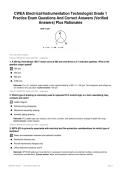
Ohm's law reference diagram
PUBLICLY REPORTED / RECALLED ITEM — paraphrased
1. A 500 hp, three-phase, 460 V motor turns at 900 rpm and drives a 5:1 reduction gearbox. What is the
gearbox output speed?
180 rpm
450 rpm
900 rpm
4,500 rpm
Rationale: For a 5:1 reduction, output speed is motor speed divided by 5: 900 ÷ 5 = 180 rpm. The horsepower and voltage are
not needed for this calculation. Correct answer: 180 rpm.
PUBLICLY REPORTED / RECALLED ITEM — paraphrased
2. Which type of drawing is commonly used to represent PLC control logic in a form resembling relay
contacts and coils?
Ladder diagram
Pictorial wiring photograph
Mechanical assembly drawing
Isometric piping drawing
Rationale: PLC ladder logic uses contacts, coils, timers, counters, and related instructions arranged in ladder-like rungs.
Correct answer: Ladder diagram.
PUBLICLY REPORTED / RECALLED ITEM — paraphrased
3. NFPA 820 is primarily associated with electrical and fire-protection considerations for which type of
facilities?
Water and wastewater treatment and collection facilities
Residential kitchens only
Aircraft maintenance hangars only
Office telecommunications rooms
Rationale: NFPA 820 addresses fire protection in wastewater treatment plants and collection facilities, including electrical
classification considerations. Correct answer: Water and wastewater treatment and collection facilities.
CWEA EIT Grade 1 — 250-question practice set Page 1
, PUBLICLY REPORTED / RECALLED ITEM — paraphrased
4. For a motor insulation-resistance test, when is the motor normally at its lowest insulation reading if
moisture and temperature are changing after shutdown?
Immediately after shutdown
After several days of dry operation
Only while the motor is running
Only before the motor is ever energized
Rationale: The commonly reported exam item asks about the immediate post-shutdown condition; the intended answer is
immediately after shutdown. Actual field testing must follow the equipment, manufacturer, and site procedure. Correct answer:
Immediately after shutdown.
PUBLICLY REPORTED / RECALLED ITEM — paraphrased
5. In a start/stop control circuit, where should additional STOP pushbuttons normally be placed so any
one can interrupt the seal-in circuit?
In series with the existing STOP contacts
In parallel with the START contacts
Across the motor terminals
In parallel with the overload heaters
Rationale: Normally closed STOP contacts are placed in series so opening any one of them interrupts the control circuit and
drops out the starter. Correct answer: In series with the existing STOP contacts.
6. A 12 V DC source is connected to a 6 Ω resistor. What current flows?
2.0 A
4.0 A
1.0 A
72 A
Rationale: By Ohm's law, I = V/R = 12/6 = 2.0 A. Correct answer: 2.0 A.
7. A 24 V DC source is connected to a 6 Ω resistor. What current flows?
4.0 A
8.0 A
2.0 A
144 A
Rationale: By Ohm's law, I = V/R = 24/6 = 4.0 A. Correct answer: 4.0 A.
8. A 48 V DC source is connected to a 6 Ω resistor. What current flows?
8.0 A
16.0 A
4.0 A
288 A
Rationale: By Ohm's law, I = V/R = 48/6 = 8.0 A. Correct answer: 8.0 A.
CWEA EIT Grade 1 — 250-question practice set Page 2
, 9. A 120 V DC source is connected to a 6 Ω resistor. What current flows?
20.0 A
40.0 A
10.0 A
720 A
Rationale: By Ohm's law, I = V/R = 120/6 = 20.0 A. Correct answer: 20.0 A.
10. A 230 V DC source is connected to a 6 Ω resistor. What current flows?
38.3 A
76.7 A
19.2 A
1380 A
Rationale: By Ohm's law, I = V/R = 230/6 = 38.3 A. Correct answer: 38.3 A.
11. A 24 V circuit has a 2 Ω load. What is the load current?
12.0 A
24.0 A
0.08 A
26 A
Rationale: Using I = V/R, I = 24/2 = 12.0 A. Correct answer: 12.0 A.
12. A 24 V circuit has a 4 Ω load. What is the load current?
6.0 A
12.0 A
0.17 A
28 A
Rationale: Using I = V/R, I = 24/4 = 6.0 A. Correct answer: 6.0 A.
13. A 24 V circuit has a 8 Ω load. What is the load current?
3.0 A
6.0 A
0.33 A
32 A
Rationale: Using I = V/R, I = 24/8 = 3.0 A. Correct answer: 3.0 A.
14. A 24 V circuit has a 10 Ω load. What is the load current?
2.4 A
4.8 A
0.42 A
34 A
Rationale: Using I = V/R, I = 24/10 = 2.4 A. Correct answer: 2.4 A.
CWEA EIT Grade 1 — 250-question practice set Page 3
, 15. A 24 V circuit has a 20 Ω load. What is the load current?
1.2 A
2.4 A
0.83 A
44 A
Rationale: Using I = V/R, I = 24/20 = 1.2 A. Correct answer: 1.2 A.
16. A resistive load operates at 120 V and draws 5 A. What is its approximate real power?
0.60 kW
0.02 kW
125.00 kW
600000 kW
Rationale: For a resistive DC-equivalent load, P = VI = 120 × 5 = 600 W = 0.60 kW. Correct answer: 0.60 kW.
17. A resistive load operates at 240 V and draws 10 A. What is its approximate real power?
2.40 kW
0.02 kW
250.00 kW
2400000 kW
Rationale: For a resistive DC-equivalent load, P = VI = 240 × 10 = 2400 W = 2.40 kW. Correct answer: 2.40 kW.
18. A resistive load operates at 24 V and draws 2 A. What is its approximate real power?
0.05 kW
0.01 kW
26.00 kW
48000 kW
Rationale: For a resistive DC-equivalent load, P = VI = 24 × 2 = 48 W = 0.05 kW. Correct answer: 0.05 kW.
19. A resistive load operates at 480 V and draws 20 A. What is its approximate real power?
9.60 kW
0.02 kW
500.00 kW
9600000 kW
Rationale: For a resistive DC-equivalent load, P = VI = 480 × 20 = 9600 W = 9.60 kW. Correct answer: 9.60 kW.
20. A resistive load operates at 230 V and draws 4 A. What is its approximate real power?
0.92 kW
0.06 kW
234.00 kW
920000 kW
Rationale: For a resistive DC-equivalent load, P = VI = 230 × 4 = 920 W = 0.92 kW. Correct answer: 0.92 kW.
CWEA EIT Grade 1 — 250-question practice set Page 4
Practice Exam Questions And Correct Answers (Verified
Answers) Plus Rationales
Ohm's law reference diagram
PUBLICLY REPORTED / RECALLED ITEM — paraphrased
1. A 500 hp, three-phase, 460 V motor turns at 900 rpm and drives a 5:1 reduction gearbox. What is the
gearbox output speed?
180 rpm
450 rpm
900 rpm
4,500 rpm
Rationale: For a 5:1 reduction, output speed is motor speed divided by 5: 900 ÷ 5 = 180 rpm. The horsepower and voltage are
not needed for this calculation. Correct answer: 180 rpm.
PUBLICLY REPORTED / RECALLED ITEM — paraphrased
2. Which type of drawing is commonly used to represent PLC control logic in a form resembling relay
contacts and coils?
Ladder diagram
Pictorial wiring photograph
Mechanical assembly drawing
Isometric piping drawing
Rationale: PLC ladder logic uses contacts, coils, timers, counters, and related instructions arranged in ladder-like rungs.
Correct answer: Ladder diagram.
PUBLICLY REPORTED / RECALLED ITEM — paraphrased
3. NFPA 820 is primarily associated with electrical and fire-protection considerations for which type of
facilities?
Water and wastewater treatment and collection facilities
Residential kitchens only
Aircraft maintenance hangars only
Office telecommunications rooms
Rationale: NFPA 820 addresses fire protection in wastewater treatment plants and collection facilities, including electrical
classification considerations. Correct answer: Water and wastewater treatment and collection facilities.
CWEA EIT Grade 1 — 250-question practice set Page 1
, PUBLICLY REPORTED / RECALLED ITEM — paraphrased
4. For a motor insulation-resistance test, when is the motor normally at its lowest insulation reading if
moisture and temperature are changing after shutdown?
Immediately after shutdown
After several days of dry operation
Only while the motor is running
Only before the motor is ever energized
Rationale: The commonly reported exam item asks about the immediate post-shutdown condition; the intended answer is
immediately after shutdown. Actual field testing must follow the equipment, manufacturer, and site procedure. Correct answer:
Immediately after shutdown.
PUBLICLY REPORTED / RECALLED ITEM — paraphrased
5. In a start/stop control circuit, where should additional STOP pushbuttons normally be placed so any
one can interrupt the seal-in circuit?
In series with the existing STOP contacts
In parallel with the START contacts
Across the motor terminals
In parallel with the overload heaters
Rationale: Normally closed STOP contacts are placed in series so opening any one of them interrupts the control circuit and
drops out the starter. Correct answer: In series with the existing STOP contacts.
6. A 12 V DC source is connected to a 6 Ω resistor. What current flows?
2.0 A
4.0 A
1.0 A
72 A
Rationale: By Ohm's law, I = V/R = 12/6 = 2.0 A. Correct answer: 2.0 A.
7. A 24 V DC source is connected to a 6 Ω resistor. What current flows?
4.0 A
8.0 A
2.0 A
144 A
Rationale: By Ohm's law, I = V/R = 24/6 = 4.0 A. Correct answer: 4.0 A.
8. A 48 V DC source is connected to a 6 Ω resistor. What current flows?
8.0 A
16.0 A
4.0 A
288 A
Rationale: By Ohm's law, I = V/R = 48/6 = 8.0 A. Correct answer: 8.0 A.
CWEA EIT Grade 1 — 250-question practice set Page 2
, 9. A 120 V DC source is connected to a 6 Ω resistor. What current flows?
20.0 A
40.0 A
10.0 A
720 A
Rationale: By Ohm's law, I = V/R = 120/6 = 20.0 A. Correct answer: 20.0 A.
10. A 230 V DC source is connected to a 6 Ω resistor. What current flows?
38.3 A
76.7 A
19.2 A
1380 A
Rationale: By Ohm's law, I = V/R = 230/6 = 38.3 A. Correct answer: 38.3 A.
11. A 24 V circuit has a 2 Ω load. What is the load current?
12.0 A
24.0 A
0.08 A
26 A
Rationale: Using I = V/R, I = 24/2 = 12.0 A. Correct answer: 12.0 A.
12. A 24 V circuit has a 4 Ω load. What is the load current?
6.0 A
12.0 A
0.17 A
28 A
Rationale: Using I = V/R, I = 24/4 = 6.0 A. Correct answer: 6.0 A.
13. A 24 V circuit has a 8 Ω load. What is the load current?
3.0 A
6.0 A
0.33 A
32 A
Rationale: Using I = V/R, I = 24/8 = 3.0 A. Correct answer: 3.0 A.
14. A 24 V circuit has a 10 Ω load. What is the load current?
2.4 A
4.8 A
0.42 A
34 A
Rationale: Using I = V/R, I = 24/10 = 2.4 A. Correct answer: 2.4 A.
CWEA EIT Grade 1 — 250-question practice set Page 3
, 15. A 24 V circuit has a 20 Ω load. What is the load current?
1.2 A
2.4 A
0.83 A
44 A
Rationale: Using I = V/R, I = 24/20 = 1.2 A. Correct answer: 1.2 A.
16. A resistive load operates at 120 V and draws 5 A. What is its approximate real power?
0.60 kW
0.02 kW
125.00 kW
600000 kW
Rationale: For a resistive DC-equivalent load, P = VI = 120 × 5 = 600 W = 0.60 kW. Correct answer: 0.60 kW.
17. A resistive load operates at 240 V and draws 10 A. What is its approximate real power?
2.40 kW
0.02 kW
250.00 kW
2400000 kW
Rationale: For a resistive DC-equivalent load, P = VI = 240 × 10 = 2400 W = 2.40 kW. Correct answer: 2.40 kW.
18. A resistive load operates at 24 V and draws 2 A. What is its approximate real power?
0.05 kW
0.01 kW
26.00 kW
48000 kW
Rationale: For a resistive DC-equivalent load, P = VI = 24 × 2 = 48 W = 0.05 kW. Correct answer: 0.05 kW.
19. A resistive load operates at 480 V and draws 20 A. What is its approximate real power?
9.60 kW
0.02 kW
500.00 kW
9600000 kW
Rationale: For a resistive DC-equivalent load, P = VI = 480 × 20 = 9600 W = 9.60 kW. Correct answer: 9.60 kW.
20. A resistive load operates at 230 V and draws 4 A. What is its approximate real power?
0.92 kW
0.06 kW
234.00 kW
920000 kW
Rationale: For a resistive DC-equivalent load, P = VI = 230 × 4 = 920 W = 0.92 kW. Correct answer: 0.92 kW.
CWEA EIT Grade 1 — 250-question practice set Page 4


