
Page 1 of 112
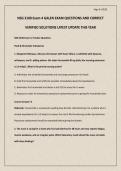
NSG 3100 Exam 4 GALEN EXAM QUESTIONS AND CORRECT
VERIFIED SOLUTIONS LATEST UPDATE THIS YEAR
NSG 3100 Exam 4: Practice Questions
Fluid & Electrolyte Imbalances
1. Margaret Holloway, a 68-year-old woman with heart failure, is admitted with dyspnea,
orthopnea, and 2+ pitting edema. She takes furosemide 40 mg daily. Her morning potassium
is 3.0 mEq/L. What is the priority nursing action?
A. Administer the scheduled furosemide and encourage potassium-rich foods
B. Hold the furosemide and notify the provider immediately about the hypokalemia
C. Administer the furosemide and obtain a stat ECG to assess for U waves
D. Request an order for intravenous potassium replacement prior to giving the furosemide dose
Correct Answer: D
Rationale: Furosemide is a potassium-wasting loop diuretic. Administering it to a patient who is
already hypokalemic (K+ 3.0 mEq/L) increases the risk of life-threatening cardiac dysrhythmias.
Potassium replacement should be requested before giving the diuretic .
2. The nurse is caring for a client who has had diarrhea for 48 hours and now reports fatigue,
muscle weakness, and an irregular pulse. Which laboratory result should the nurse correlate
with these findings?
, Page 2 of 112
A. Serum phosphate 4 mEq/L
B. Serum magnesium 2 mEq/L
C. Serum calcium 9.5 mEq/L
D. Serum potassium 2.8 mEq/L
Correct Answer: D
Rationale: A potassium level of 2.8 mEq/L indicates hypokalemia, which can occur after
prolonged diarrhea due to potassium loss. Hypokalemia causes fatigue, muscle weakness, and
cardiac dysrhythmias .
3. When the client's serum sodium level is 120 mEq/L, the priority nursing assessment is to
monitor the status of which body system?
A. Cardiovascular
B. Neurological
C. Respiratory
D. Gastrointestinal
Correct Answer: B
Rationale: A sodium level of 120 mEq/L indicates severe hyponatremia. The priority assessment
is neurological status because sodium is critical for nerve impulse transmission and cerebral
function .
4. One of the first indications of fluid volume deficit is:
, Page 3 of 112
A. Bradycardia
B. Tachycardia
C. Hypertension
D. Bounding pulses
Correct Answer: B
Rationale: Tachycardia is one of the first compensatory responses to fluid volume deficit as the
heart attempts to maintain cardiac output .
5. For a client with a vitamin D deficiency and inadequate calcium intake, the nurse observes
for:
A. Trousseau sign
B. Chvostek sign
C. Brudzinski sign
D. Kernig sign
Correct Answer: B
Rationale: Chvostek sign is an abnormal reaction to stimulation of the facial nerve, indicating
hypocalcemia associated with vitamin D deficiency .
6. The nurse recognizes that a client requires fluid replacement with an isotonic solution.
Which of the following may be ordered?
A. 0.45% NaCl
B. 3% NaCl
, Page 4 of 112
C. Lactated Ringer's solution
D. 0.33% NaCl
Correct Answer: C
Rationale: Lactated Ringer's is an isotonic solution. 0.45% and 0.33% NaCl are hypotonic; 3%
NaCl is hypertonic .
7. The majority of body fluid is located in which area?
A. Intravascular space
B. Interstitial space
C. Intracellular space
D. Transcellular space
Correct Answer: C
Rationale: Approximately two-thirds of total body water is located intracellularly, making it the
largest fluid compartment .
8. What are the normal levels of potassium?
A. 136-145 mEq/L
B. 3.5-5 mEq/L
C. 9-10.5 mg/dL
D. 1.3-2.1 mEq/L
NSG 3100 Exam 4 GALEN EXAM QUESTIONS AND CORRECT
VERIFIED SOLUTIONS LATEST UPDATE THIS YEAR
NSG 3100 Exam 4: Practice Questions
Fluid & Electrolyte Imbalances
1. Margaret Holloway, a 68-year-old woman with heart failure, is admitted with dyspnea,
orthopnea, and 2+ pitting edema. She takes furosemide 40 mg daily. Her morning potassium
is 3.0 mEq/L. What is the priority nursing action?
A. Administer the scheduled furosemide and encourage potassium-rich foods
B. Hold the furosemide and notify the provider immediately about the hypokalemia
C. Administer the furosemide and obtain a stat ECG to assess for U waves
D. Request an order for intravenous potassium replacement prior to giving the furosemide dose
Correct Answer: D
Rationale: Furosemide is a potassium-wasting loop diuretic. Administering it to a patient who is
already hypokalemic (K+ 3.0 mEq/L) increases the risk of life-threatening cardiac dysrhythmias.
Potassium replacement should be requested before giving the diuretic .
2. The nurse is caring for a client who has had diarrhea for 48 hours and now reports fatigue,
muscle weakness, and an irregular pulse. Which laboratory result should the nurse correlate
with these findings?
, Page 2 of 112
A. Serum phosphate 4 mEq/L
B. Serum magnesium 2 mEq/L
C. Serum calcium 9.5 mEq/L
D. Serum potassium 2.8 mEq/L
Correct Answer: D
Rationale: A potassium level of 2.8 mEq/L indicates hypokalemia, which can occur after
prolonged diarrhea due to potassium loss. Hypokalemia causes fatigue, muscle weakness, and
cardiac dysrhythmias .
3. When the client's serum sodium level is 120 mEq/L, the priority nursing assessment is to
monitor the status of which body system?
A. Cardiovascular
B. Neurological
C. Respiratory
D. Gastrointestinal
Correct Answer: B
Rationale: A sodium level of 120 mEq/L indicates severe hyponatremia. The priority assessment
is neurological status because sodium is critical for nerve impulse transmission and cerebral
function .
4. One of the first indications of fluid volume deficit is:
, Page 3 of 112
A. Bradycardia
B. Tachycardia
C. Hypertension
D. Bounding pulses
Correct Answer: B
Rationale: Tachycardia is one of the first compensatory responses to fluid volume deficit as the
heart attempts to maintain cardiac output .
5. For a client with a vitamin D deficiency and inadequate calcium intake, the nurse observes
for:
A. Trousseau sign
B. Chvostek sign
C. Brudzinski sign
D. Kernig sign
Correct Answer: B
Rationale: Chvostek sign is an abnormal reaction to stimulation of the facial nerve, indicating
hypocalcemia associated with vitamin D deficiency .
6. The nurse recognizes that a client requires fluid replacement with an isotonic solution.
Which of the following may be ordered?
A. 0.45% NaCl
B. 3% NaCl
, Page 4 of 112
C. Lactated Ringer's solution
D. 0.33% NaCl
Correct Answer: C
Rationale: Lactated Ringer's is an isotonic solution. 0.45% and 0.33% NaCl are hypotonic; 3%
NaCl is hypertonic .
7. The majority of body fluid is located in which area?
A. Intravascular space
B. Interstitial space
C. Intracellular space
D. Transcellular space
Correct Answer: C
Rationale: Approximately two-thirds of total body water is located intracellularly, making it the
largest fluid compartment .
8. What are the normal levels of potassium?
A. 136-145 mEq/L
B. 3.5-5 mEq/L
C. 9-10.5 mg/dL
D. 1.3-2.1 mEq/L


