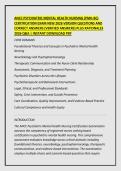
ANCC PSYCHIATRIC MENTAL HEALTH NURSING (PMH-BC)
CERTIFICATION EXAM NEW 2026 VERSION QUESTIONS AND
CORRECT ANSWERS (VERIFIED ANSWERS) PLUS RATIONALES
2026 Q&A | INSTANT DOWNLOAD PDF
CORE DOMAINS
Foundational Theories and Concepts in Psychiatric-Mental Health
Nursing
Neurobiology and Psychopharmacology
Therapeutic Communication and the Nurse-Client Relationship
Assessment, Diagnosis, and Treatment Planning
Psychiatric Disorders Across the Lifespan
Psychotherapeutic and Behavioral Interventions
Legal, Ethical, and Professional Standards
Safety, Crisis Intervention, and Suicide Prevention
Care Coordination, Quality Improvement, and Evidence-Based Practice
Cultural Competence and Health Equity
INTRODUCTION
The ANCC Psychiatric-Mental Health Nursing Certification Examination
assesses the competency of registered nurses seeking board
certification in psychiatric-mental health nursing. This comprehensive
assessment evaluates knowledge across critical domains including
foundational theories, neurobiology, psychopharmacology, therapeutic
communication, and evidence-based interventions. The examination
employs multiple-choice and scenario-based questions that require
,candidates to demonstrate applied clinical judgment and decision-
making skills essential for advanced psychiatric nursing practice.
Emphasis is placed on safety, recovery-oriented care, and culturally
responsive practice. Successful completion validates the candidate's
readiness to practice as a board-certified psychiatric-mental health
nurse.
SECTION ONE: QUESTIONS 1–100
Question 1
An 18-year-old patient diagnosed with bipolar disorder wants to enter a
research study that will test an experimental drug. The psychiatric-
mental health nurse practitioner's initial response is:
A. "All drug treatments are too risky for you at this time in your illness."
B. "Let's discuss the risks of potentially changing your medications."
C. "We will have to see if you meet the inclusion criteria for this
research study."
D. "You will have only a small chance of receiving the experimental
drug."
B. "Let's discuss the risks of potentially changing your medications."
RATIONALE: The initial response should explore the patient's
interest while ensuring informed consent by discussing risks and
benefits. This facilitates shared decision-making and respects patient
autonomy .
,Question 2
A 14-year-old patient has nonspecific reports of pain in their legs. The
physical examination is unremarkable. Laboratory results are within
normal limits except for a markedly elevated alkaline phosphatase
level. The psychiatric-mental health nurse practitioner:
A. interprets the findings as normally occurring during a rapid
adolescent growth spurt.
B. obtains a rheumatoid profile because elevated alkaline phosphatase
is a sign of early rheumatic fever.
C. orders a repeat blood test.
D. suspects that the patient has acute pancreatitis.
A. interprets the findings as normally occurring during a rapid
adolescent growth spurt.
RATIONALE: Elevated alkaline phosphatase is common during
adolescent growth spurts due to rapid bone turnover. This is a normal
physiological finding, not a pathological one .
Question 3
Laboratory findings for a patient with an alcohol use disorder indicate
increased liver function values and:
A. decreased mean corpuscular volume (MCV) and normal triglyceride
levels.
B. elevated potassium and chloride levels.
C. increased MCV and elevated triglyceride levels.
D. increased urine and serum creatinine levels.
, C. increased MCV and elevated triglyceride levels.
RATIONALE: Chronic alcohol use commonly causes macrocytosis
(increased MCV) and hypertriglyceridemia due to alcohol's effects on
bone marrow and lipid metabolism .
Question 4
A new patient arrives at the office for treatment for depression. The
patient reports taking simvastatin (Zocor) and lisinopril (Zestril). When
selecting an antidepressant, the psychiatric-mental health nurse
practitioner eliminates fluoxetine hydrochloride (Prozac), based on the
knowledge that the combination can lead to increased plasma levels of
the statin, resulting in an increased risk of muscle damage and
rhabdomyolysis. What is the nurse practitioner's rationale?
A. Both medications are CYP450 3A4 inhibitors.
B. Both medications are CYP450 3A4 substrates.
C. One medication is a CYP450 3A4 substrate and one is a CYP450 3A4
inducer.
D. One medication is a CYP450 3A4 substrate and one is a CYP450 3A4
inhibitor.
D. One medication is a CYP450 3A4 substrate and one is a CYP450
3A4 inhibitor.
RATIONALE: Simvastatin is a CYP3A4 substrate, and fluoxetine is a
CYP3A4 inhibitor. This interaction increases simvastatin levels, raising
the risk of rhabdomyolysis .
CERTIFICATION EXAM NEW 2026 VERSION QUESTIONS AND
CORRECT ANSWERS (VERIFIED ANSWERS) PLUS RATIONALES
2026 Q&A | INSTANT DOWNLOAD PDF
CORE DOMAINS
Foundational Theories and Concepts in Psychiatric-Mental Health
Nursing
Neurobiology and Psychopharmacology
Therapeutic Communication and the Nurse-Client Relationship
Assessment, Diagnosis, and Treatment Planning
Psychiatric Disorders Across the Lifespan
Psychotherapeutic and Behavioral Interventions
Legal, Ethical, and Professional Standards
Safety, Crisis Intervention, and Suicide Prevention
Care Coordination, Quality Improvement, and Evidence-Based Practice
Cultural Competence and Health Equity
INTRODUCTION
The ANCC Psychiatric-Mental Health Nursing Certification Examination
assesses the competency of registered nurses seeking board
certification in psychiatric-mental health nursing. This comprehensive
assessment evaluates knowledge across critical domains including
foundational theories, neurobiology, psychopharmacology, therapeutic
communication, and evidence-based interventions. The examination
employs multiple-choice and scenario-based questions that require
,candidates to demonstrate applied clinical judgment and decision-
making skills essential for advanced psychiatric nursing practice.
Emphasis is placed on safety, recovery-oriented care, and culturally
responsive practice. Successful completion validates the candidate's
readiness to practice as a board-certified psychiatric-mental health
nurse.
SECTION ONE: QUESTIONS 1–100
Question 1
An 18-year-old patient diagnosed with bipolar disorder wants to enter a
research study that will test an experimental drug. The psychiatric-
mental health nurse practitioner's initial response is:
A. "All drug treatments are too risky for you at this time in your illness."
B. "Let's discuss the risks of potentially changing your medications."
C. "We will have to see if you meet the inclusion criteria for this
research study."
D. "You will have only a small chance of receiving the experimental
drug."
B. "Let's discuss the risks of potentially changing your medications."
RATIONALE: The initial response should explore the patient's
interest while ensuring informed consent by discussing risks and
benefits. This facilitates shared decision-making and respects patient
autonomy .
,Question 2
A 14-year-old patient has nonspecific reports of pain in their legs. The
physical examination is unremarkable. Laboratory results are within
normal limits except for a markedly elevated alkaline phosphatase
level. The psychiatric-mental health nurse practitioner:
A. interprets the findings as normally occurring during a rapid
adolescent growth spurt.
B. obtains a rheumatoid profile because elevated alkaline phosphatase
is a sign of early rheumatic fever.
C. orders a repeat blood test.
D. suspects that the patient has acute pancreatitis.
A. interprets the findings as normally occurring during a rapid
adolescent growth spurt.
RATIONALE: Elevated alkaline phosphatase is common during
adolescent growth spurts due to rapid bone turnover. This is a normal
physiological finding, not a pathological one .
Question 3
Laboratory findings for a patient with an alcohol use disorder indicate
increased liver function values and:
A. decreased mean corpuscular volume (MCV) and normal triglyceride
levels.
B. elevated potassium and chloride levels.
C. increased MCV and elevated triglyceride levels.
D. increased urine and serum creatinine levels.
, C. increased MCV and elevated triglyceride levels.
RATIONALE: Chronic alcohol use commonly causes macrocytosis
(increased MCV) and hypertriglyceridemia due to alcohol's effects on
bone marrow and lipid metabolism .
Question 4
A new patient arrives at the office for treatment for depression. The
patient reports taking simvastatin (Zocor) and lisinopril (Zestril). When
selecting an antidepressant, the psychiatric-mental health nurse
practitioner eliminates fluoxetine hydrochloride (Prozac), based on the
knowledge that the combination can lead to increased plasma levels of
the statin, resulting in an increased risk of muscle damage and
rhabdomyolysis. What is the nurse practitioner's rationale?
A. Both medications are CYP450 3A4 inhibitors.
B. Both medications are CYP450 3A4 substrates.
C. One medication is a CYP450 3A4 substrate and one is a CYP450 3A4
inducer.
D. One medication is a CYP450 3A4 substrate and one is a CYP450 3A4
inhibitor.
D. One medication is a CYP450 3A4 substrate and one is a CYP450
3A4 inhibitor.
RATIONALE: Simvastatin is a CYP3A4 substrate, and fluoxetine is a
CYP3A4 inhibitor. This interaction increases simvastatin levels, raising
the risk of rhabdomyolysis .