
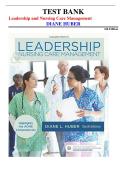
TEST BANK
Leadership and Nursing Care Management
DIANE HUBER
6th Edition
,Chapter 01: Leadership and Management Principles
Huber: Leadership & Nursing Care Management, 6th Edition
MULTIPLE CHOICE
1. Leadership is best defined as:
a. an interpersonal process of participating by encouraging fellowship.
b. delegation of authority and responsibility and the coordination of activities.
c. inspiring people to accomplish goals through support and confidence building.
d. the integration of resources through planning, organizing, and directing.
ANS: C
Leadership is the process of influencing people to accomplish goals by inspiring confidence and
support among followers.
DIF: Cognitive Level: Remember (Knowledge) TOP:
Nursing Process: Assessment
MSC: Client Needs: Safe and Effective Care Environment: Management of Care
2. A medical-surgical unit reports higher rates of patient satisfaction coupled with high rates of staff
satisfaction and productivity. Which of the following is attributed to the data findings?
a. Effective leadership
b. Management involvement
c. Mentoring
d. Rewards and recognition
ANS: A
Effective leadership is important in nursing because of the impact on nurses’ work lives, it being a
stabilizing influence during change, and for nurses’ productivity and quality of care.
DIF: Cognitive Level: Apply (Application) TOP:
Nursing Process: Assessment
MSC: Client Needs: Safe and Effective Care Environment: Management of Care
3. A staff registered nurse (RN) is leading a multidisciplinary clinical pathway team in the
development of care for patients with total knee replacement. Which of the following
statements exemplifies leadership behaviors in a clinical pathway team meeting?
a. “Nursing is responsible for pain control of the total knee replacement patient.”
b. “Our pharmacist has provided some excellent pain control literature.”
c. “Physical therapy’s expertise is in rehabilitation, not pain control.”
d. “Total knee replacement patients require optimal pain control.”
ANS: B
Leadership is the process of influencing people to accomplish goals by inspiring confidence and
support among followers. The correct answer is supportive of a team member’s work and depicts some
skill at interpersonal relationships.
DIF: Cognitive Level: Apply (Application) TOP:
Nursing Process: Assessment
MSC: Client Needs: Physiological Integrity: Pharmacological and Parenteral Therapies
2|Page
,4. Which of the following is true of management activities?
a. Inspiring a vision is a management function.
b. Management is focused on task accomplishment.
c. Management is more focused on human relationships.
d. Management is more important than leadership.
ANS: B
Management is focused on task accomplishment.
DIF: Cognitive Level: Remember (Knowledge) TOP:
Nursing Process: Assessment
MSC: Client Needs: Safe and Effective Care Environment: Management of Care
5. During a staff meeting, a group of RNs has complained that medications are not arriving to the unit
in a timely manner. The nurse manager suggests that the group resolve this issue through the
development and work of a multidisciplinary team led by one of these RNs. This scenario
demonstrates:
a. adaptation.
b. empowerment.
c. flexibility.
d. relationship management.
ANS: B
Empowerment is the giving of authority, responsibility, and the freedom to act. In this
situation, the manager has given authority, responsibility, and the freedom to act in the
investigation and resolution of this issue.
DIF: Cognitive Level: ApplyN U S N T
Rl i c atI i o nG) TOP:
( Ap p
Nursing Process: Assessment
MSC: Client Needs: Safe and Effective Care Environment: Management of Care
6. A nurse is caring for an elderly patient who was admitted after sustaining a fall at home. When creating
a care plan for the patient, she requests that the doctor order a home health visit to assess for home
safety and medication compliance. In addition, the nurse is concerned about the nutrition of the
patient and requests a dietitian evaluation. The nurse is demonstrating which of the following
leadership skills?
a. Care provider
b. Business principles
c. Care coordination
d. Change management
ANS: C
Care coordination is the delivery of nursing services that involves the organization and coordination of
complex activities. The nurse uses managerial and leadership skills to facilitate delivery of quality care.
DIF: Cognitive Level: Apply (Application) TOP: Nursing Process: Planning MSC:
Client Needs: Physiological Integrity: Reduction of Risk Potential
7. Interpersonal communication and the ability to apply are two critical skills every nurse
needs to enhance professional practice.
a. vision
3|Page
, b. supervision
c. delegation
d. problem solving
ANS: D
Every nurse needs two critical skills to enhance professional practice. One is a skill at interpersonal
relationships. This is fundamental to leadership and the work of nursing. The second skill is applying
the problem-solving process. This involves critical thinking, problem identification, and the
development of objectivity.
DIF: Cognitive Level: Remember (Knowledge) TOP:
Nursing Process: Assessment
MSC: Client Needs: Safe and Effective Care Environment: Management of Care
8. Good leaders need to be able to demonstrate an intuitive skill of empathy and expressiveness when
dealing with others in the workplace. This requires sensitivity and awareness of the emotions and
moods of others and is known as:
a. social awareness.
b. self-awareness.
c. self-management.
d. relationship management.
ANS: A
Social awareness is an intuitive skill of empathy and expressiveness in being sensitive and aware of the
emotions and moods of others.
DIF: Cognitive Level: Remember (Knowledge)
TOP: Nursing Process: A s s e s sN
m e nR
U SI GNB.CTM
t
O
MSC: Client Needs: Safe and Effective Care Environment: Management of Care
9. The personal leadership skill for nurses that consists of self-awareness, discipline, motivation, social
awareness, and relationship management is known as what?
a. Leadership.
b. Management.
c. Emotional intelligence
d. Vision
ANS: C
Among the important personal leadership skills for nurses is emotional intelligence (EI). EI traits are
emotional factors consisting of five defining attributes: self-awareness,
self-regulation or discipline, motivation, social awareness, and relationship management.
DIF: Cognitive Level: Remember (Knowledge) TOP:
Nursing Process: Implementation
MSC: Client Needs: Safe and Effective Care Environment: Management of Care
10. are vital to good leaders because they are able to take the vision of the leader and
achieve the determined goals.
a. Managers
b. Motivators
c. Visionaries
d. Followers
4|Page
Leadership and Nursing Care Management
DIANE HUBER
6th Edition
,Chapter 01: Leadership and Management Principles
Huber: Leadership & Nursing Care Management, 6th Edition
MULTIPLE CHOICE
1. Leadership is best defined as:
a. an interpersonal process of participating by encouraging fellowship.
b. delegation of authority and responsibility and the coordination of activities.
c. inspiring people to accomplish goals through support and confidence building.
d. the integration of resources through planning, organizing, and directing.
ANS: C
Leadership is the process of influencing people to accomplish goals by inspiring confidence and
support among followers.
DIF: Cognitive Level: Remember (Knowledge) TOP:
Nursing Process: Assessment
MSC: Client Needs: Safe and Effective Care Environment: Management of Care
2. A medical-surgical unit reports higher rates of patient satisfaction coupled with high rates of staff
satisfaction and productivity. Which of the following is attributed to the data findings?
a. Effective leadership
b. Management involvement
c. Mentoring
d. Rewards and recognition
ANS: A
Effective leadership is important in nursing because of the impact on nurses’ work lives, it being a
stabilizing influence during change, and for nurses’ productivity and quality of care.
DIF: Cognitive Level: Apply (Application) TOP:
Nursing Process: Assessment
MSC: Client Needs: Safe and Effective Care Environment: Management of Care
3. A staff registered nurse (RN) is leading a multidisciplinary clinical pathway team in the
development of care for patients with total knee replacement. Which of the following
statements exemplifies leadership behaviors in a clinical pathway team meeting?
a. “Nursing is responsible for pain control of the total knee replacement patient.”
b. “Our pharmacist has provided some excellent pain control literature.”
c. “Physical therapy’s expertise is in rehabilitation, not pain control.”
d. “Total knee replacement patients require optimal pain control.”
ANS: B
Leadership is the process of influencing people to accomplish goals by inspiring confidence and
support among followers. The correct answer is supportive of a team member’s work and depicts some
skill at interpersonal relationships.
DIF: Cognitive Level: Apply (Application) TOP:
Nursing Process: Assessment
MSC: Client Needs: Physiological Integrity: Pharmacological and Parenteral Therapies
2|Page
,4. Which of the following is true of management activities?
a. Inspiring a vision is a management function.
b. Management is focused on task accomplishment.
c. Management is more focused on human relationships.
d. Management is more important than leadership.
ANS: B
Management is focused on task accomplishment.
DIF: Cognitive Level: Remember (Knowledge) TOP:
Nursing Process: Assessment
MSC: Client Needs: Safe and Effective Care Environment: Management of Care
5. During a staff meeting, a group of RNs has complained that medications are not arriving to the unit
in a timely manner. The nurse manager suggests that the group resolve this issue through the
development and work of a multidisciplinary team led by one of these RNs. This scenario
demonstrates:
a. adaptation.
b. empowerment.
c. flexibility.
d. relationship management.
ANS: B
Empowerment is the giving of authority, responsibility, and the freedom to act. In this
situation, the manager has given authority, responsibility, and the freedom to act in the
investigation and resolution of this issue.
DIF: Cognitive Level: ApplyN U S N T
Rl i c atI i o nG) TOP:
( Ap p
Nursing Process: Assessment
MSC: Client Needs: Safe and Effective Care Environment: Management of Care
6. A nurse is caring for an elderly patient who was admitted after sustaining a fall at home. When creating
a care plan for the patient, she requests that the doctor order a home health visit to assess for home
safety and medication compliance. In addition, the nurse is concerned about the nutrition of the
patient and requests a dietitian evaluation. The nurse is demonstrating which of the following
leadership skills?
a. Care provider
b. Business principles
c. Care coordination
d. Change management
ANS: C
Care coordination is the delivery of nursing services that involves the organization and coordination of
complex activities. The nurse uses managerial and leadership skills to facilitate delivery of quality care.
DIF: Cognitive Level: Apply (Application) TOP: Nursing Process: Planning MSC:
Client Needs: Physiological Integrity: Reduction of Risk Potential
7. Interpersonal communication and the ability to apply are two critical skills every nurse
needs to enhance professional practice.
a. vision
3|Page
, b. supervision
c. delegation
d. problem solving
ANS: D
Every nurse needs two critical skills to enhance professional practice. One is a skill at interpersonal
relationships. This is fundamental to leadership and the work of nursing. The second skill is applying
the problem-solving process. This involves critical thinking, problem identification, and the
development of objectivity.
DIF: Cognitive Level: Remember (Knowledge) TOP:
Nursing Process: Assessment
MSC: Client Needs: Safe and Effective Care Environment: Management of Care
8. Good leaders need to be able to demonstrate an intuitive skill of empathy and expressiveness when
dealing with others in the workplace. This requires sensitivity and awareness of the emotions and
moods of others and is known as:
a. social awareness.
b. self-awareness.
c. self-management.
d. relationship management.
ANS: A
Social awareness is an intuitive skill of empathy and expressiveness in being sensitive and aware of the
emotions and moods of others.
DIF: Cognitive Level: Remember (Knowledge)
TOP: Nursing Process: A s s e s sN
m e nR
U SI GNB.CTM
t
O
MSC: Client Needs: Safe and Effective Care Environment: Management of Care
9. The personal leadership skill for nurses that consists of self-awareness, discipline, motivation, social
awareness, and relationship management is known as what?
a. Leadership.
b. Management.
c. Emotional intelligence
d. Vision
ANS: C
Among the important personal leadership skills for nurses is emotional intelligence (EI). EI traits are
emotional factors consisting of five defining attributes: self-awareness,
self-regulation or discipline, motivation, social awareness, and relationship management.
DIF: Cognitive Level: Remember (Knowledge) TOP:
Nursing Process: Implementation
MSC: Client Needs: Safe and Effective Care Environment: Management of Care
10. are vital to good leaders because they are able to take the vision of the leader and
achieve the determined goals.
a. Managers
b. Motivators
c. Visionaries
d. Followers
4|Page


