

RSC2601 – Chapter 4
Ethics in Research
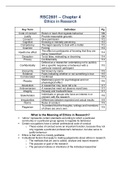
Key Term Definition Pg
Code of conduct Rule/s or law/s that regulate behaviour 109
Justify Provide reasonable grounds 109
Consent Give permission 112
Cognitive Knowing or mentally perceiving 112
Competency The legal capacity to deal with a matter 112
Coercion Forcing 112
The effect on participants of knowing that they are
Hawthorne effect 114
being “researched”
Deception To be false, misleading or deceiving 114
Privacy Confidentiality 114
Defined as a researcher undertaking not to publicly
Confidentiality link a specific response or behaviour with a 115
particular research participant
Anonymity Not known by name 115
Evidence Facts indicating whether or not something is true 115
Corroborated Confirmed 115
Medicine(s) given for psychological and not
Placebo 116
physiological effect
Absolutism A researcher may never tell a lie 117
Antinomianism A researcher need not observe moral laws 117
Integrity Honesty and trustworthiness 117
Individuals or groups who have an interest in or
Stakeholders 118
concern with the research
Irregularities Differences between expected and actual results 119
Norms Rules of conduct 119
To pretend that the thoughts, writings and inventions
Plagiarism 119
of others are one’s own
What is the Meaning of Ethics in Research?
“ethics” represents certain standards according to which a particular
community or a particular group agrees to regulate its behaviour
Certain occupations have a certain professional code of conduct
o These codes of conduct serve an important function, because they not
only regulate a particular professional’s behaviour, but also serve to
justify behaviour
Ethics is that which is morally justifiable
4 situational factors that apply to making judgements about ethics in research:
o The methods that we use to collect, analyse and report research
o The purpose or goal of the research
o The personal motives or intentions of the individual researcher
, o The consequences or effects of research, including effects on research
participants or respondents, on researchers and on the larger social
and scholarly communities
The methods, purpose, personal motives and consequences of research
ought to be regulated by the following 6 behavioural norms:
o Universalism
Research must pass peer evaluation
o Communality
Compels all researchers to share their research findings
o Disinterestedness
Personal gain shouldn’t be a researcher’s main or only reason
for doing research
o Organised skepticism
Requires researchers to be critical of work and to be honest
when they spot errors
o Honesty
o Respect
Ethical Issues in Research Relating to Human Rights
Do no harm:
o The meaning of harm should be treated in the broadest possible way,
to include anything from physical discomfort to emotional stress,
humiliation or embarrassment
o What is harmful?
o The positive benefits for society which a researcher might gain by
deliberately misleading participants must be weighed meticulously and
professionally against the facts that participants are being lied to and
the possible harm this may cause
o “Harm” cannot be quantified, we can only deal with this question by
reviewing our perceptions, values and judgements as researchers –
and ensuring that all of these are open to public review
Obtaining consent:
o Direct consent must be obtained from the people who will be involved
o Substitute consent is obtained from someone who is not personally
involved
Usually required when the actual persons concerned do not
have the cognitive or emotional capacity to give consent
o Linked to respecting participants and acknowledging their rights
o Has to meet 3 requirements:
Person’s ability
Must have cognitive capacity in order to make an
informed decision
Under 18 – parent or legal guardian
Free to stop participating at any time
Voluntariness
Information
Ensure that descriptions of what the research entails
contains all the relevant details and can be easily
understood
Ethics in Research
Key Term Definition Pg
Code of conduct Rule/s or law/s that regulate behaviour 109
Justify Provide reasonable grounds 109
Consent Give permission 112
Cognitive Knowing or mentally perceiving 112
Competency The legal capacity to deal with a matter 112
Coercion Forcing 112
The effect on participants of knowing that they are
Hawthorne effect 114
being “researched”
Deception To be false, misleading or deceiving 114
Privacy Confidentiality 114
Defined as a researcher undertaking not to publicly
Confidentiality link a specific response or behaviour with a 115
particular research participant
Anonymity Not known by name 115
Evidence Facts indicating whether or not something is true 115
Corroborated Confirmed 115
Medicine(s) given for psychological and not
Placebo 116
physiological effect
Absolutism A researcher may never tell a lie 117
Antinomianism A researcher need not observe moral laws 117
Integrity Honesty and trustworthiness 117
Individuals or groups who have an interest in or
Stakeholders 118
concern with the research
Irregularities Differences between expected and actual results 119
Norms Rules of conduct 119
To pretend that the thoughts, writings and inventions
Plagiarism 119
of others are one’s own
What is the Meaning of Ethics in Research?
“ethics” represents certain standards according to which a particular
community or a particular group agrees to regulate its behaviour
Certain occupations have a certain professional code of conduct
o These codes of conduct serve an important function, because they not
only regulate a particular professional’s behaviour, but also serve to
justify behaviour
Ethics is that which is morally justifiable
4 situational factors that apply to making judgements about ethics in research:
o The methods that we use to collect, analyse and report research
o The purpose or goal of the research
o The personal motives or intentions of the individual researcher
, o The consequences or effects of research, including effects on research
participants or respondents, on researchers and on the larger social
and scholarly communities
The methods, purpose, personal motives and consequences of research
ought to be regulated by the following 6 behavioural norms:
o Universalism
Research must pass peer evaluation
o Communality
Compels all researchers to share their research findings
o Disinterestedness
Personal gain shouldn’t be a researcher’s main or only reason
for doing research
o Organised skepticism
Requires researchers to be critical of work and to be honest
when they spot errors
o Honesty
o Respect
Ethical Issues in Research Relating to Human Rights
Do no harm:
o The meaning of harm should be treated in the broadest possible way,
to include anything from physical discomfort to emotional stress,
humiliation or embarrassment
o What is harmful?
o The positive benefits for society which a researcher might gain by
deliberately misleading participants must be weighed meticulously and
professionally against the facts that participants are being lied to and
the possible harm this may cause
o “Harm” cannot be quantified, we can only deal with this question by
reviewing our perceptions, values and judgements as researchers –
and ensuring that all of these are open to public review
Obtaining consent:
o Direct consent must be obtained from the people who will be involved
o Substitute consent is obtained from someone who is not personally
involved
Usually required when the actual persons concerned do not
have the cognitive or emotional capacity to give consent
o Linked to respecting participants and acknowledging their rights
o Has to meet 3 requirements:
Person’s ability
Must have cognitive capacity in order to make an
informed decision
Under 18 – parent or legal guardian
Free to stop participating at any time
Voluntariness
Information
Ensure that descriptions of what the research entails
contains all the relevant details and can be easily
understood


