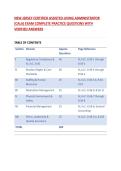
NEW JERSEY CERTIFIED ASSISTED LIVING ADMINISTRATOR
(CALA) EXAM COMPLETE PRACTICE QUESTIONS WITH
VERIFIED ANSWERS
TABLE OF CONTENTS
Section Domain Approx. Page Reference
Questions
I Regulatory Compliance & 40 N.J.A.C. 8:36-1 through
N.J.A.C. 8:36 8:36-3
II Resident Rights & Care 40 N.J.A.C. 8:36-4 through
Standards 8:36-5
III Staffing & Human 25 N.J.A.C. 8:36-5.6, 8:36-
Resources 23.9
IV Medication Management 25 N.J.A.C. 8:36-9, 8:36-11
V Physical Environment & 20 N.J.A.C. 8:36-7 through
Safety 8:36-8
VI Financial Management 25 N.J.A.C. 8:36-6, General
Accounting
VII Ethics, Leadership & 25 N.J.A.C. 8:36-3.4, 8:43E
Quality Assurance
TOTAL 200
,SECTION I: REGULATORY COMPLIANCE & N.J.A.C. 8:36
Question 1: Under N.J.A.C. 8:36, an assisted living resident who
requires intermittent nursing services but does not require 24-hour
skilled nursing care:
A. Must be transferred to a nursing home within 7 days
B. May continue to reside in assisted living with appropriate services
and documentation
C. Requires a physician's order for transfer to a hospital
D. Automatically qualifies for the Assisted Living Program (ALP) without
additional assessment
Correct Answer: B
Rationale: N.J.A.C. 8:36-4.1(b) supports aging in place; residents may
receive intermittent nursing services as long as the facility can meet
their needs safely and document the care plan. A is incorrect because
NJ does not mandate automatic transfer for intermittent nursing
needs—only when needs exceed facility capacity. C is incorrect because
hospital transfer requires clinical indication, not merely nursing need. D
is incorrect because ALP eligibility requires additional financial eligibility
determination through Medicaid and clinical assessment beyond basic
assisted living admission.
Question 2: Which of the following is a required component of the
assisted living facility's written admission agreement under N.J.A.C.
8:36-4.2?
A. A guarantee that the resident will never be discharged
,B. The facility's policy on room changes and the circumstances under
which they may occur
C. A waiver of the resident's right to appeal discharge decisions
D. A fixed monthly rate that cannot be adjusted for any reason
Correct Answer: B
Rationale: N.J.A.C. 8:36-4.2(c) specifically requires disclosure of policies
regarding room changes, including circumstances and notice
requirements. A is incorrect because facilities cannot guarantee against
discharge when residents' needs exceed facility capabilities. C is
incorrect because waivers of statutory rights are void under NJ law, and
N.J.A.C. 8:36-4.7 guarantees appeal rights. D is incorrect because rates
may be adjusted with proper notice for changes in care levels or cost
increases.
Question 3: Under N.J.A.C. 8:36, the minimum square footage
requirement for a single-occupancy resident room in an assisted living
facility is:
A. 100 square feet
B. 150 square feet
C. 200 square feet
D. 250 square feet
Correct Answer: B
Rationale: N.J.A.C. 8:36-9.2(a)1 requires single-occupancy resident
rooms to provide a minimum of 150 square feet of floor space,
, excluding closets and private bathroom areas. A is below the minimum
standard. C and D exceed the minimum requirement but are not the
regulatory floor.
Question 4: An assisted living facility in New Jersey must provide how
many hours of dementia-specific training for all direct care staff who
work in an Alzheimer's special care unit?
A. 4 hours annually
B. 8 hours initially and 4 hours annually
C. 16 hours initially and 8 hours annually
D. 24 hours initially with no ongoing requirement
Correct Answer: B
Rationale: N.J.A.C. 8:36-5.2(h) requires 8 hours of initial dementia-
specific training for special care unit staff and 4 hours of annual
continuing education. A is insufficient for initial training. C and D exceed
the regulatory requirement.
Question 5: Which state agency is responsible for licensing and
regulating Assisted Living Residences in New Jersey?
A. Department of Community Affairs
B. Department of Health
C. Department of Human Services
D. Department of Labor
(CALA) EXAM COMPLETE PRACTICE QUESTIONS WITH
VERIFIED ANSWERS
TABLE OF CONTENTS
Section Domain Approx. Page Reference
Questions
I Regulatory Compliance & 40 N.J.A.C. 8:36-1 through
N.J.A.C. 8:36 8:36-3
II Resident Rights & Care 40 N.J.A.C. 8:36-4 through
Standards 8:36-5
III Staffing & Human 25 N.J.A.C. 8:36-5.6, 8:36-
Resources 23.9
IV Medication Management 25 N.J.A.C. 8:36-9, 8:36-11
V Physical Environment & 20 N.J.A.C. 8:36-7 through
Safety 8:36-8
VI Financial Management 25 N.J.A.C. 8:36-6, General
Accounting
VII Ethics, Leadership & 25 N.J.A.C. 8:36-3.4, 8:43E
Quality Assurance
TOTAL 200
,SECTION I: REGULATORY COMPLIANCE & N.J.A.C. 8:36
Question 1: Under N.J.A.C. 8:36, an assisted living resident who
requires intermittent nursing services but does not require 24-hour
skilled nursing care:
A. Must be transferred to a nursing home within 7 days
B. May continue to reside in assisted living with appropriate services
and documentation
C. Requires a physician's order for transfer to a hospital
D. Automatically qualifies for the Assisted Living Program (ALP) without
additional assessment
Correct Answer: B
Rationale: N.J.A.C. 8:36-4.1(b) supports aging in place; residents may
receive intermittent nursing services as long as the facility can meet
their needs safely and document the care plan. A is incorrect because
NJ does not mandate automatic transfer for intermittent nursing
needs—only when needs exceed facility capacity. C is incorrect because
hospital transfer requires clinical indication, not merely nursing need. D
is incorrect because ALP eligibility requires additional financial eligibility
determination through Medicaid and clinical assessment beyond basic
assisted living admission.
Question 2: Which of the following is a required component of the
assisted living facility's written admission agreement under N.J.A.C.
8:36-4.2?
A. A guarantee that the resident will never be discharged
,B. The facility's policy on room changes and the circumstances under
which they may occur
C. A waiver of the resident's right to appeal discharge decisions
D. A fixed monthly rate that cannot be adjusted for any reason
Correct Answer: B
Rationale: N.J.A.C. 8:36-4.2(c) specifically requires disclosure of policies
regarding room changes, including circumstances and notice
requirements. A is incorrect because facilities cannot guarantee against
discharge when residents' needs exceed facility capabilities. C is
incorrect because waivers of statutory rights are void under NJ law, and
N.J.A.C. 8:36-4.7 guarantees appeal rights. D is incorrect because rates
may be adjusted with proper notice for changes in care levels or cost
increases.
Question 3: Under N.J.A.C. 8:36, the minimum square footage
requirement for a single-occupancy resident room in an assisted living
facility is:
A. 100 square feet
B. 150 square feet
C. 200 square feet
D. 250 square feet
Correct Answer: B
Rationale: N.J.A.C. 8:36-9.2(a)1 requires single-occupancy resident
rooms to provide a minimum of 150 square feet of floor space,
, excluding closets and private bathroom areas. A is below the minimum
standard. C and D exceed the minimum requirement but are not the
regulatory floor.
Question 4: An assisted living facility in New Jersey must provide how
many hours of dementia-specific training for all direct care staff who
work in an Alzheimer's special care unit?
A. 4 hours annually
B. 8 hours initially and 4 hours annually
C. 16 hours initially and 8 hours annually
D. 24 hours initially with no ongoing requirement
Correct Answer: B
Rationale: N.J.A.C. 8:36-5.2(h) requires 8 hours of initial dementia-
specific training for special care unit staff and 4 hours of annual
continuing education. A is insufficient for initial training. C and D exceed
the regulatory requirement.
Question 5: Which state agency is responsible for licensing and
regulating Assisted Living Residences in New Jersey?
A. Department of Community Affairs
B. Department of Health
C. Department of Human Services
D. Department of Labor