
BUTTERCUPS MODULE 3 COMPREHENSIVE EXAM
PREPARATION QUESTIONS COMPLETE WITH VERIFIED
ANSWERS AND RATIONALES
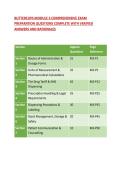
Section Approx. Page
Questions Reference
Section Routes of Administration & 25 M3-P1
1 Dosage Forms
Section Units of Measurement & 35 M3-P5
2 Pharmaceutical Calculations
Section The Drug Tariff & NHS 45 M3-P12
3 Dispensing
Section Prescription Handling & Legal 35 M3-P25
4 Requirements
Section Dispensing Procedures & 30 M3-P35
5 Labelling
Section Stock Management, Storage & 20 M3-P45
6 Safety
Section Patient Communication & 10 M3-P50
7 Counselling
,Section 1: Routes of Administration & Dosage Forms
1. Which of the following describes the subcutaneous route of
administration?
A. Injection into a vein
B. Injection into the fatty layer under the skin
C. Injection into the muscle tissue
D. Application to the skin surface
Correct Answer: B
Rationale: Subcutaneous (SC) injections are administered into the fatty
tissue just beneath the skin, allowing for slower absorption than
intramuscular or intravenous routes.
2. What is an injected route of administration?
A. The medication is injected into a vein, a muscle or the skin.
Injections can be solutions, suspensions or powders requiring
reconstitution.
B. The medication is swallowed and absorbed through the
gastrointestinal tract.
C. The medication is inhaled into the lungs.
D. The medication is applied topically to the skin.
Correct Answer: A
Rationale: This aligns with the provided source material, describing
injections as parenteral routes involving veins, muscles, or skin, utilizing
various formulations.
3. Which dosage form is typically intended for inhalation?
A. Suppository
B. Pessary
C. Aerosol inhaler
,D. Effervescent tablet
Correct Answer: C
Rationale: Aerosol inhalers deliver medication directly to the lungs for
local or systemic absorption.
4. What is the primary characteristic of an oral solution?
A. It is a solid dosage form.
B. It is a liquid preparation containing a dissolved drug.
C. It is a suspension of solid particles in a liquid.
D. It is a semi-solid preparation for topical use.
Correct Answer: B
Rationale: Oral solutions are liquid preparations where the active
pharmaceutical ingredient is completely dissolved in a suitable solvent.
5. Which route bypasses the first-pass metabolism?
A. Oral
B. Rectal
C. Sublingual
D. Enteral
Correct Answer: C
Rationale: Sublingual administration allows the drug to diffuse directly
into the bloodstream through the mucous membranes under the
tongue, bypassing the liver's first-pass metabolism.
6. What is a suppository?
A. A small tablet swallowed with water.
B. A solid dosage form intended for insertion into the rectum, vagina,
or urethra.
C. A liquid injected into a muscle.
D. A powder inhaled through the nose.
, Correct Answer: B
Rationale: Suppositories are solid, shaped masses designed to melt or
dissolve at body temperature after insertion into a body cavity.
7. Which of the following is an example of a parenteral route?
A. Oral
B. Topical
C. Intravenous
D. Inhalation
Correct Answer: C
Rationale: Parenteral routes refer to administration by injection, which
includes intravenous, intramuscular, and subcutaneous routes.
8. What does the term "topical" refer to?
A. Administration into the bloodstream.
B. Application to a specific surface of the body, such as the skin or
mucous membranes.
C. Administration by swallowing.
D. Administration via the rectum.
Correct Answer: B
Rationale: Topical medications are applied directly to the skin or
mucous membranes for localized effects.
9. Which formulation requires reconstitution before administration?
A. A ready-to-use injection
B. A powder for injection
C. An oral tablet
D. A topical cream
Correct Answer: B
PREPARATION QUESTIONS COMPLETE WITH VERIFIED
ANSWERS AND RATIONALES
Section Approx. Page
Questions Reference
Section Routes of Administration & 25 M3-P1
1 Dosage Forms
Section Units of Measurement & 35 M3-P5
2 Pharmaceutical Calculations
Section The Drug Tariff & NHS 45 M3-P12
3 Dispensing
Section Prescription Handling & Legal 35 M3-P25
4 Requirements
Section Dispensing Procedures & 30 M3-P35
5 Labelling
Section Stock Management, Storage & 20 M3-P45
6 Safety
Section Patient Communication & 10 M3-P50
7 Counselling
,Section 1: Routes of Administration & Dosage Forms
1. Which of the following describes the subcutaneous route of
administration?
A. Injection into a vein
B. Injection into the fatty layer under the skin
C. Injection into the muscle tissue
D. Application to the skin surface
Correct Answer: B
Rationale: Subcutaneous (SC) injections are administered into the fatty
tissue just beneath the skin, allowing for slower absorption than
intramuscular or intravenous routes.
2. What is an injected route of administration?
A. The medication is injected into a vein, a muscle or the skin.
Injections can be solutions, suspensions or powders requiring
reconstitution.
B. The medication is swallowed and absorbed through the
gastrointestinal tract.
C. The medication is inhaled into the lungs.
D. The medication is applied topically to the skin.
Correct Answer: A
Rationale: This aligns with the provided source material, describing
injections as parenteral routes involving veins, muscles, or skin, utilizing
various formulations.
3. Which dosage form is typically intended for inhalation?
A. Suppository
B. Pessary
C. Aerosol inhaler
,D. Effervescent tablet
Correct Answer: C
Rationale: Aerosol inhalers deliver medication directly to the lungs for
local or systemic absorption.
4. What is the primary characteristic of an oral solution?
A. It is a solid dosage form.
B. It is a liquid preparation containing a dissolved drug.
C. It is a suspension of solid particles in a liquid.
D. It is a semi-solid preparation for topical use.
Correct Answer: B
Rationale: Oral solutions are liquid preparations where the active
pharmaceutical ingredient is completely dissolved in a suitable solvent.
5. Which route bypasses the first-pass metabolism?
A. Oral
B. Rectal
C. Sublingual
D. Enteral
Correct Answer: C
Rationale: Sublingual administration allows the drug to diffuse directly
into the bloodstream through the mucous membranes under the
tongue, bypassing the liver's first-pass metabolism.
6. What is a suppository?
A. A small tablet swallowed with water.
B. A solid dosage form intended for insertion into the rectum, vagina,
or urethra.
C. A liquid injected into a muscle.
D. A powder inhaled through the nose.
, Correct Answer: B
Rationale: Suppositories are solid, shaped masses designed to melt or
dissolve at body temperature after insertion into a body cavity.
7. Which of the following is an example of a parenteral route?
A. Oral
B. Topical
C. Intravenous
D. Inhalation
Correct Answer: C
Rationale: Parenteral routes refer to administration by injection, which
includes intravenous, intramuscular, and subcutaneous routes.
8. What does the term "topical" refer to?
A. Administration into the bloodstream.
B. Application to a specific surface of the body, such as the skin or
mucous membranes.
C. Administration by swallowing.
D. Administration via the rectum.
Correct Answer: B
Rationale: Topical medications are applied directly to the skin or
mucous membranes for localized effects.
9. Which formulation requires reconstitution before administration?
A. A ready-to-use injection
B. A powder for injection
C. An oral tablet
D. A topical cream
Correct Answer: B


