
COS3721 — Operating Systems and Architecture
Original Study Mastery Workbook — 2026
UNISA NQF Level 7 module — independently authored revision resource
UNISA describes COS3721 as a 12-credit, NQF Level 7 year module covering operating-system functionality including CPU
scheduling, process coordination and concurrency, deadlocks, memory management, protection/security, and distributed systems.
This workbook is an original study resource. It does not reproduce the linked paid Stuvia notes, assignments, past-exam questions,
or answer keys.
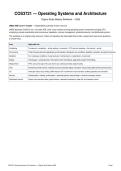
Area High-yield rule
Scheduling Turnaround = completion − arrival; waiting = turnaround − CPU service; response = first service − arrival.
Concurrency Protect shared state with appropriate synchronization; distinguish race conditions, deadlock, starvation, and priority inversion.
Deadlock Four necessary conditions: mutual exclusion, hold-and-wait, no preemption, circular wait.
Paging Virtual page → physical frame; TLB caches recent translations; page faults require OS handling.
Replacement FIFO uses arrival age; LRU uses recent use; working-set ideas exploit locality.
Files Directories provide names; metadata structures describe objects; allocation and journaling affect performance/recovery.
I/O Interrupts reduce busy waiting; DMA reduces CPU involvement in bulk transfers; buffering absorbs rate mismatch.
Security Authentication = identity; authorization = permitted actions; least privilege = minimum necessary access.
Distributed systems Expect communication delay, partial failures, replication/consistency trade-offs, and imperfect clocks.
COS3721 Operating Systems & Architecture — Original Study Mastery 2026 Page 1
, 1. Operating-System Foundations
1. OS role — Which statement best describes an operating system?
A. A program used only to edit files
B. Software that manages hardware/resources and provides services to applications
C. A compiler only
D. A physical memory module
Answer: B. Software that manages hardware/resources and provides services to applications
Rationale: An OS manages resources such as CPU time, memory, storage, and devices while providing abstractions and services
to programs.
2. System calls — Why are system calls important?
A. They provide a controlled interface through which programs request OS services
B. They replace all hardware
C. They increase RAM physically
D. They eliminate process states
Answer: A. They provide a controlled interface through which programs request OS services
Rationale: System calls provide the controlled interface between user programs and privileged operating-system services.
3. Dual mode — What is the main purpose of user mode and kernel mode?
A. Prevent all interrupts
B. Separate application privileges from privileged OS operations
C. Make every program a kernel
D. Remove memory protection
Answer: B. Separate application privileges from privileged OS operations
Rationale: Dual-mode operation limits privileged instructions and sensitive resources to trusted kernel code.
4. Interrupts — An interrupt is useful because it can:
A. Notify the CPU that an event needs attention
B. Permanently stop the CPU
C. Delete the scheduler
D. Disable all devices
Answer: A. Notify the CPU that an event needs attention
Rationale: Interrupts let hardware or software events request processor attention without continuous polling.
5. Multiprogramming — The principal goal of multiprogramming is to:
A. Keep the CPU productive when another job waits
B. Run only one process
C. Disable I/O
D. Eliminate memory management
Answer: A. Keep the CPU productive when another job waits
Rationale: Multiprogramming overlaps computation and waiting to improve resource utilization.
COS3721 Operating Systems & Architecture — Original Study Mastery 2026 Page 2
, 6. Protection — Protection in an OS primarily concerns:
A. Controlling access to resources
B. Increasing clock frequency
C. Formatting displays
D. Replacing scheduling
Answer: A. Controlling access to resources
Rationale: Protection mechanisms control which subjects may access which resources and under what conditions.
7. Microkernel — A microkernel design generally aims to:
A. Put every service in one monolithic kernel
B. Keep a small privileged core and move more services outside it
C. Eliminate IPC
D. Eliminate process isolation
Answer: B. Keep a small privileged core and move more services outside it
Rationale: Microkernels minimize kernel-resident functionality and commonly rely on IPC for communication between components.
8. Process definition — A process is best described as:
A. A program in execution together with its execution context/resources
B. A source-code comment
C. A disk sector
D. A CPU register only
Answer: A. A program in execution together with its execution context/resources
Rationale: A process includes executable code plus execution state and associated resources.
2. Processes and Process Coordination
9. PCB — Which information is commonly stored in a process control block?
A. Process state, program counter, registers, scheduling and accounting information
B. Only source code
C. Only file names
D. Only network addresses
Answer: A. Process state, program counter, registers, scheduling and accounting information
Rationale: The PCB stores information needed to manage and resume a process.
10. Blocked state — A running process requesting I/O will typically move to:
A. Ready
B. Waiting/blocked
C. New forever
D. Terminated immediately
Answer: B. Waiting/blocked
Rationale: A process waiting for I/O cannot continue execution and therefore becomes blocked.
COS3721 Operating Systems & Architecture — Original Study Mastery 2026 Page 3
Original Study Mastery Workbook — 2026
UNISA NQF Level 7 module — independently authored revision resource
UNISA describes COS3721 as a 12-credit, NQF Level 7 year module covering operating-system functionality including CPU
scheduling, process coordination and concurrency, deadlocks, memory management, protection/security, and distributed systems.
This workbook is an original study resource. It does not reproduce the linked paid Stuvia notes, assignments, past-exam questions,
or answer keys.
Area High-yield rule
Scheduling Turnaround = completion − arrival; waiting = turnaround − CPU service; response = first service − arrival.
Concurrency Protect shared state with appropriate synchronization; distinguish race conditions, deadlock, starvation, and priority inversion.
Deadlock Four necessary conditions: mutual exclusion, hold-and-wait, no preemption, circular wait.
Paging Virtual page → physical frame; TLB caches recent translations; page faults require OS handling.
Replacement FIFO uses arrival age; LRU uses recent use; working-set ideas exploit locality.
Files Directories provide names; metadata structures describe objects; allocation and journaling affect performance/recovery.
I/O Interrupts reduce busy waiting; DMA reduces CPU involvement in bulk transfers; buffering absorbs rate mismatch.
Security Authentication = identity; authorization = permitted actions; least privilege = minimum necessary access.
Distributed systems Expect communication delay, partial failures, replication/consistency trade-offs, and imperfect clocks.
COS3721 Operating Systems & Architecture — Original Study Mastery 2026 Page 1
, 1. Operating-System Foundations
1. OS role — Which statement best describes an operating system?
A. A program used only to edit files
B. Software that manages hardware/resources and provides services to applications
C. A compiler only
D. A physical memory module
Answer: B. Software that manages hardware/resources and provides services to applications
Rationale: An OS manages resources such as CPU time, memory, storage, and devices while providing abstractions and services
to programs.
2. System calls — Why are system calls important?
A. They provide a controlled interface through which programs request OS services
B. They replace all hardware
C. They increase RAM physically
D. They eliminate process states
Answer: A. They provide a controlled interface through which programs request OS services
Rationale: System calls provide the controlled interface between user programs and privileged operating-system services.
3. Dual mode — What is the main purpose of user mode and kernel mode?
A. Prevent all interrupts
B. Separate application privileges from privileged OS operations
C. Make every program a kernel
D. Remove memory protection
Answer: B. Separate application privileges from privileged OS operations
Rationale: Dual-mode operation limits privileged instructions and sensitive resources to trusted kernel code.
4. Interrupts — An interrupt is useful because it can:
A. Notify the CPU that an event needs attention
B. Permanently stop the CPU
C. Delete the scheduler
D. Disable all devices
Answer: A. Notify the CPU that an event needs attention
Rationale: Interrupts let hardware or software events request processor attention without continuous polling.
5. Multiprogramming — The principal goal of multiprogramming is to:
A. Keep the CPU productive when another job waits
B. Run only one process
C. Disable I/O
D. Eliminate memory management
Answer: A. Keep the CPU productive when another job waits
Rationale: Multiprogramming overlaps computation and waiting to improve resource utilization.
COS3721 Operating Systems & Architecture — Original Study Mastery 2026 Page 2
, 6. Protection — Protection in an OS primarily concerns:
A. Controlling access to resources
B. Increasing clock frequency
C. Formatting displays
D. Replacing scheduling
Answer: A. Controlling access to resources
Rationale: Protection mechanisms control which subjects may access which resources and under what conditions.
7. Microkernel — A microkernel design generally aims to:
A. Put every service in one monolithic kernel
B. Keep a small privileged core and move more services outside it
C. Eliminate IPC
D. Eliminate process isolation
Answer: B. Keep a small privileged core and move more services outside it
Rationale: Microkernels minimize kernel-resident functionality and commonly rely on IPC for communication between components.
8. Process definition — A process is best described as:
A. A program in execution together with its execution context/resources
B. A source-code comment
C. A disk sector
D. A CPU register only
Answer: A. A program in execution together with its execution context/resources
Rationale: A process includes executable code plus execution state and associated resources.
2. Processes and Process Coordination
9. PCB — Which information is commonly stored in a process control block?
A. Process state, program counter, registers, scheduling and accounting information
B. Only source code
C. Only file names
D. Only network addresses
Answer: A. Process state, program counter, registers, scheduling and accounting information
Rationale: The PCB stores information needed to manage and resume a process.
10. Blocked state — A running process requesting I/O will typically move to:
A. Ready
B. Waiting/blocked
C. New forever
D. Terminated immediately
Answer: B. Waiting/blocked
Rationale: A process waiting for I/O cannot continue execution and therefore becomes blocked.
COS3721 Operating Systems & Architecture — Original Study Mastery 2026 Page 3


