

Russia and the Curse of Geography, From Ivan the Terrible to Vladimir Putin - The Atlantic 12/11/15, 11:06 AM
Russia and the Curse of
Geography
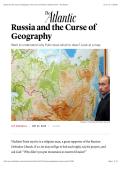
Want to understand why Putin does what he does? Look at a map.
Reuters / Presidential Press Service
TIM MARSHALL | OCT 31, 2015 | GLOBAL
Vladimir Putin says he is a religious man, a great supporter of the Russian
Orthodox Church. If so, he may well go to bed each night, say his prayers, and
ask God: “Why didn’t you put mountains in eastern Ukraine?”
http://www.theatlantic.com/international/archive/2015/10/russia-geography-ukraine-syria/413248/ Page 1 of 10
, Russia and the Curse of Geography, From Ivan the Terrible to Vladimir Putin - The Atlantic 12/11/15, 11:06 AM
If God had built mountains in eastern Ukraine, then the great expanse of flatland
that is the European Plain would not have been such inviting territory for the
invaders who have attacked Russia from there repeatedly through history. As
things stand, Putin, like Russian leaders before him, likely feels he has no choice
but to at least try to control the flatlands to Russia’s west. So it is with landscapes
around the world—their physical features imprison political leaders, constraining
their choices and room for maneuver. These rules of geography are especially
clear in Russia, where power is hard to defend, and where for centuries leaders
have compensated by pushing outward.
Western leaders seem to have difficulty deciphering
ELATED STORY Putin’s motives, especially when it comes to his actions
in Ukraine and Syria; Russia’s current leader has been
described in terms that evoke Winston Churchill’s
famous 1939 observation that Russia “is a riddle
wrapped in a mystery inside of an enigma.” But it’s
helpful to look at Putin’s military interventions abroad
in the context of Russian leaders’ longstanding
he Link Between Putin’s Military attempts to deal with geography. What if Putin’s
ampaigns in Syria and Ukraine
motives aren’t so mysterious after all? What if you can
read them clearly on a map?
For Russia, the world’s largest country by landmass, which bestrides Europe and
Asia and encompasses forests, lakes, rivers, frozen steppes, and mountains, the
problems come by land as well as by sea. In the past 500 years, Russia has been
invaded several times from the west. The Poles came across the European Plain
in 1605, followed by the Swedes under Charles XII in 1707, the French under
Napoleon in 1812, and the Germans—twice, in both world wars, in 1914 and
1941. In Poland, the plain is only 300 miles wide—from the Baltic Sea in the
http://www.theatlantic.com/international/archive/2015/10/russia-geography-ukraine-syria/413248/ Page 2 of 10
Russia and the Curse of
Geography
Want to understand why Putin does what he does? Look at a map.
Reuters / Presidential Press Service
TIM MARSHALL | OCT 31, 2015 | GLOBAL
Vladimir Putin says he is a religious man, a great supporter of the Russian
Orthodox Church. If so, he may well go to bed each night, say his prayers, and
ask God: “Why didn’t you put mountains in eastern Ukraine?”
http://www.theatlantic.com/international/archive/2015/10/russia-geography-ukraine-syria/413248/ Page 1 of 10
, Russia and the Curse of Geography, From Ivan the Terrible to Vladimir Putin - The Atlantic 12/11/15, 11:06 AM
If God had built mountains in eastern Ukraine, then the great expanse of flatland
that is the European Plain would not have been such inviting territory for the
invaders who have attacked Russia from there repeatedly through history. As
things stand, Putin, like Russian leaders before him, likely feels he has no choice
but to at least try to control the flatlands to Russia’s west. So it is with landscapes
around the world—their physical features imprison political leaders, constraining
their choices and room for maneuver. These rules of geography are especially
clear in Russia, where power is hard to defend, and where for centuries leaders
have compensated by pushing outward.
Western leaders seem to have difficulty deciphering
ELATED STORY Putin’s motives, especially when it comes to his actions
in Ukraine and Syria; Russia’s current leader has been
described in terms that evoke Winston Churchill’s
famous 1939 observation that Russia “is a riddle
wrapped in a mystery inside of an enigma.” But it’s
helpful to look at Putin’s military interventions abroad
in the context of Russian leaders’ longstanding
he Link Between Putin’s Military attempts to deal with geography. What if Putin’s
ampaigns in Syria and Ukraine
motives aren’t so mysterious after all? What if you can
read them clearly on a map?
For Russia, the world’s largest country by landmass, which bestrides Europe and
Asia and encompasses forests, lakes, rivers, frozen steppes, and mountains, the
problems come by land as well as by sea. In the past 500 years, Russia has been
invaded several times from the west. The Poles came across the European Plain
in 1605, followed by the Swedes under Charles XII in 1707, the French under
Napoleon in 1812, and the Germans—twice, in both world wars, in 1914 and
1941. In Poland, the plain is only 300 miles wide—from the Baltic Sea in the
http://www.theatlantic.com/international/archive/2015/10/russia-geography-ukraine-syria/413248/ Page 2 of 10


