

SECTION
Objectives
5 Step-by-Step
Instruction
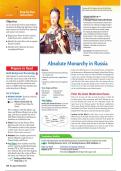
The palace (left) of Catherine the Great (far left) reflects
both European and traditional Russian architectural styles.
WITNESS HISTORY AUDIO
A Foreign Princess Takes the Throne
For twenty years, the German princess Catherine lived
As you teach this section, keep students at the Russian court, enduring an unhappy marriage to
focused on the following objectives to help the Russian heir apparent, who was widely considered
them answer the Section Focus Question to be insane. She filled her time reading, studying
and master core content. French philosophy, building alliances behind the
scenes, and biding her time. When her husband
■ Explain how Peter the Great tried to became emperor in 1762, she called on her allies to
make Russia into a modern state. act. Within a few months he had been deposed and
■ Identify the steps Peter took to expand Catherine proclaimed empress of Russia. Like Peter the
Russia’s borders. Great before her, Catherine would rule with
intelligence, a firm hand, and a mind set on
■ Describe how Catherine the Great modernization.
strengthened Russia.
Focus Question How did Peter the Great and
Catherine the Great strengthen Russia and expand
its territory?
Absolute Monarchy in Russia
Prepare to Read Objectives In the early 1600s, Russia was still a medieval state, untouched by
the Renaissance or Reformation and largely isolated from Western
Build Background Knowledge L3 • Explain how Peter the Great tried to make Russia
Europe. As you have read, the “Time of Troubles” had plunged the
into a modern state.
Ask students to recall what they know • Identify the steps Peter took to expand Russia’s country into a period of disorder and foreign invasions. The reign
about the tsars, boyars, and serfs of Rus- borders. of the first Romanov tsar in 1613 restored a measure of order. Not
sia. Ask them to predict whether Russia’s • Describe how Catherine the Great strengthened until the end of the century, however, did a tsar emerge who was
rulers during this time would act simi- Russia. strong enough to regain the absolute power of earlier tsars. Peter
larly to or differently from absolute mon- the Great, as he came to be called, used his power to put Russia
archs elsewhere in Europe. Terms, People, and Places on the road to becoming a great modern power.
Peter the Great warm-water port
Set a Purpose L3 westernization St. Petersburg
Peter the Great Modernizes Russia
autocratic Catherine the Great
■ WITNESS HISTORY Read the selection boyar partition Peter, just 10 years old when he took the throne in 1682, did
aloud or play the audio. not take control of the government until 1689. Although he was
AUDIO Witness History Audio CD, not well educated, the young tsar was immensely curious. He
A Foreign Princess Takes the Reading Skill: Identify Main Ideas As you read spent hours in the “German quarter,” the Moscow neighborhood
this section, make a Venn diagram like the one where many Dutch, Scottish, English, and other foreign artisans
Throne
below to compare events in the reigns of Peter the and soldiers lived. There, he heard of the new technology that was
Have students study the photos, cap- Great and Catherine the Great.
helping Western European monarchs forge powerful empires.
tions, and Witness History text on this
page. Ask them to predict the role of Journey to the West In 1697, Peter set out to learn about
both Western European and Russian Peter Catherine Western ways for himself. He spent hours walking the streets of
• Visited • Established European cities, noting the manners and homes of the people. He
traditions on Catherine’s rule. European
Adopted
port on
countries
Western ideas Black Sea
visited factories and art galleries, learned anatomy from a doctor,
■ Focus Point out the Section Focus • • and even had a dentist teach him how to pull teeth. In England,
Question and write it on the board. Peter was impressed by Parliament. “It is good,” he said, “to hear
Tell students to refer to this question subjects speaking truthfully and openly to their king.”
as they read. (Answer appears with
Section 5 Assessment answers.)
■ Preview Have students preview the Vocabulary Builder
Section Objectives and the list of
Terms, People, and Places. Use the information below and the following resources to teach the high-use word from this section.
■ Have students read this Teaching Resources, Unit 3, p. 68; Teaching Resources, Skills Handbook, p. 3
section using the Guided Questioning High-Use Word Definition and Sample Sentence
strategy (TE, p. T20). As they read,
stipulate, p. 531 v. to make a specific demand
have students fill in the Venn diagram The contract stipulated that the buyer had to pay in cash.
with details about the reigns of Peter
the Great and Catherine the Great.
Reading and Note Taking
Study Guide, p. 156
530 The Age of Absolutism
, Peter brought to Russia a group of technical experts, teachers, and
soldiers he had recruited in Europe. He then embarked on a policy of Teach
westernization, that is, the adoption of Western ideas, technology, and
culture. But persuading fellow Russians to change their way of life proved
difficult. To impose his will, Peter became the most autocratic of Europe’s Peter the Great
absolute monarchs, meaning that he ruled with unlimited authority. Modernizes Russia L3
Controlling the Church and the Nobles Peter pursued several Instruct
related goals. He wanted to strengthen the military, expand Russian bor-
ders, and centralize royal power. To achieve his ends, he brought all Rus- ■ Introduce: Vocabulary Builder
sian institutions under his control, including the Russian Orthodox Have students read the Vocabulary
Church. He also forced the haughty boyars, or landowning nobles, to Builder term and definition. Ask what
serve the state in civilian or military positions. monarchs usually stipulated that
Some changes had a symbolic meaning. For example, after returning Vocabulary Builder lords should do, and what Peter
from the West, Peter stipulated that boyars shave their beards. He also stipulated—(STIP yuh layt ud) v. made a stipulated that the boyars should do.
forced them to replace their old-fashioned robes with Western-style specific demand
■ Teach Describe Peter’s goals for mod-
clothes. To end the practice of secluding upper-class women in separate
quarters, he held grand parties at which women and men were expected
ernization. Ask What aspects of the
to dance together. Russian nobles opposed this radical mixing of the West did Peter choose to emulate?
sexes in public, but they had to comply. (technology, clothes, shaving of beards,
Peter knew that nobles would serve the state only if their own inter- women’s social roles, education, mer-
ests were protected. Therefore, he passed laws ensuring that nobles cantilism, manufacturing, trading, bet-
retained control over their lands, including the serfs on those lands. In ter armies) In what aspects did he
doing so, Peter strengthened serfdom. Under his rule serfdom spread in differ from the West? (keeping and
Russia, long after it had died out in Western Europe. Further, he forced strengthening serfdom) How did he
some serfs to become soldiers or to work as laborers on roads, canals, and handle people who opposed him in
other government projects. A Russian cartoon shows Russia? (with severe repression)
Peter the great
Modernizing With Force Using autocratic methods, Peter pushed personally cutting off the
through social and economic reforms. He imported Western technology, beard of a boyar. Independent Practice
improved education, simplified the Russian alphabet, and set up acade- Ask students to choose one of the follow-
mies for the study of mathematics, science, and engineering. To pay for ing: boyar, upper-class woman, serf,
his sweeping reforms, Peter adopted mercantilist policies, such as church leader, merchant, palace guard, or
encouraging exports. He improved waterways and canals, developed person who knew Peter in Europe. Have
mining and textile manufacturing, and backed new trading companies. students write a dialogue between Peter
Peter had no mercy for any who resisted the new order. When elite and the person they selected.
palace guards revolted, he had over 1,000 of the rebels tortured and
executed. Then, as an example of his power, he left their rotting
corpses outside the palace walls for months.
Monitor Progress
As students fill in their Venn diagram,
What rewards and punishments did Peter use
circulate to make sure they are accu-
to solidify his control over the nobles?
rately comparing the reigns of Peter and
Catherine. For a completed version of the
Peter Expands Russia’s Borders Venn diagram, see
From his earliest days as tsar, Peter worked to build Russia’s Note Taking Transparencies, 119
military power. He created the largest standing army in
Europe, built a world-class navy from scratch, and set out to
extend Russian borders to the west and south.
Seeking a Warm-Water Port Russian seaports, located
along the Arctic Ocean, were frozen over during the winter. To
increase Russia’s ability to trade with the West, Peter desper-
ately wanted a warm-water port—one that would be free of
ice all year round.
Solutions for All Learners
L1 Special Needs L2 English Language Learners L2 Less Proficient Readers
Help students use the map on the next page to better Use the following resources to help students acquire
understand Russian expansion. Point out how much basic skills: Answer
of Russia is in Asia (east of the Ural Mountains). Have Adapted Reading and Note Taking
pairs of students answer the following: How did Rus- Study Guide Rewards: laws that favored the nobles, for
sia differ from other European nations? Why was the ■ Adapted Note Taking Study Guide, p. 156 example by strengthening serfdom. Punish-
land added to the East so important? What was the ■ Adapted Section Summary, p. 157 ments: stipulating that they change their cus-
significance of St. Petersburg’s location? Why was toms; requiring them to serve the state.
Bering’s exploration important for Russia?
Chapter 16 Section 5 531
Objectives
5 Step-by-Step
Instruction
The palace (left) of Catherine the Great (far left) reflects
both European and traditional Russian architectural styles.
WITNESS HISTORY AUDIO
A Foreign Princess Takes the Throne
For twenty years, the German princess Catherine lived
As you teach this section, keep students at the Russian court, enduring an unhappy marriage to
focused on the following objectives to help the Russian heir apparent, who was widely considered
them answer the Section Focus Question to be insane. She filled her time reading, studying
and master core content. French philosophy, building alliances behind the
scenes, and biding her time. When her husband
■ Explain how Peter the Great tried to became emperor in 1762, she called on her allies to
make Russia into a modern state. act. Within a few months he had been deposed and
■ Identify the steps Peter took to expand Catherine proclaimed empress of Russia. Like Peter the
Russia’s borders. Great before her, Catherine would rule with
intelligence, a firm hand, and a mind set on
■ Describe how Catherine the Great modernization.
strengthened Russia.
Focus Question How did Peter the Great and
Catherine the Great strengthen Russia and expand
its territory?
Absolute Monarchy in Russia
Prepare to Read Objectives In the early 1600s, Russia was still a medieval state, untouched by
the Renaissance or Reformation and largely isolated from Western
Build Background Knowledge L3 • Explain how Peter the Great tried to make Russia
Europe. As you have read, the “Time of Troubles” had plunged the
into a modern state.
Ask students to recall what they know • Identify the steps Peter took to expand Russia’s country into a period of disorder and foreign invasions. The reign
about the tsars, boyars, and serfs of Rus- borders. of the first Romanov tsar in 1613 restored a measure of order. Not
sia. Ask them to predict whether Russia’s • Describe how Catherine the Great strengthened until the end of the century, however, did a tsar emerge who was
rulers during this time would act simi- Russia. strong enough to regain the absolute power of earlier tsars. Peter
larly to or differently from absolute mon- the Great, as he came to be called, used his power to put Russia
archs elsewhere in Europe. Terms, People, and Places on the road to becoming a great modern power.
Peter the Great warm-water port
Set a Purpose L3 westernization St. Petersburg
Peter the Great Modernizes Russia
autocratic Catherine the Great
■ WITNESS HISTORY Read the selection boyar partition Peter, just 10 years old when he took the throne in 1682, did
aloud or play the audio. not take control of the government until 1689. Although he was
AUDIO Witness History Audio CD, not well educated, the young tsar was immensely curious. He
A Foreign Princess Takes the Reading Skill: Identify Main Ideas As you read spent hours in the “German quarter,” the Moscow neighborhood
this section, make a Venn diagram like the one where many Dutch, Scottish, English, and other foreign artisans
Throne
below to compare events in the reigns of Peter the and soldiers lived. There, he heard of the new technology that was
Have students study the photos, cap- Great and Catherine the Great.
helping Western European monarchs forge powerful empires.
tions, and Witness History text on this
page. Ask them to predict the role of Journey to the West In 1697, Peter set out to learn about
both Western European and Russian Peter Catherine Western ways for himself. He spent hours walking the streets of
• Visited • Established European cities, noting the manners and homes of the people. He
traditions on Catherine’s rule. European
Adopted
port on
countries
Western ideas Black Sea
visited factories and art galleries, learned anatomy from a doctor,
■ Focus Point out the Section Focus • • and even had a dentist teach him how to pull teeth. In England,
Question and write it on the board. Peter was impressed by Parliament. “It is good,” he said, “to hear
Tell students to refer to this question subjects speaking truthfully and openly to their king.”
as they read. (Answer appears with
Section 5 Assessment answers.)
■ Preview Have students preview the Vocabulary Builder
Section Objectives and the list of
Terms, People, and Places. Use the information below and the following resources to teach the high-use word from this section.
■ Have students read this Teaching Resources, Unit 3, p. 68; Teaching Resources, Skills Handbook, p. 3
section using the Guided Questioning High-Use Word Definition and Sample Sentence
strategy (TE, p. T20). As they read,
stipulate, p. 531 v. to make a specific demand
have students fill in the Venn diagram The contract stipulated that the buyer had to pay in cash.
with details about the reigns of Peter
the Great and Catherine the Great.
Reading and Note Taking
Study Guide, p. 156
530 The Age of Absolutism
, Peter brought to Russia a group of technical experts, teachers, and
soldiers he had recruited in Europe. He then embarked on a policy of Teach
westernization, that is, the adoption of Western ideas, technology, and
culture. But persuading fellow Russians to change their way of life proved
difficult. To impose his will, Peter became the most autocratic of Europe’s Peter the Great
absolute monarchs, meaning that he ruled with unlimited authority. Modernizes Russia L3
Controlling the Church and the Nobles Peter pursued several Instruct
related goals. He wanted to strengthen the military, expand Russian bor-
ders, and centralize royal power. To achieve his ends, he brought all Rus- ■ Introduce: Vocabulary Builder
sian institutions under his control, including the Russian Orthodox Have students read the Vocabulary
Church. He also forced the haughty boyars, or landowning nobles, to Builder term and definition. Ask what
serve the state in civilian or military positions. monarchs usually stipulated that
Some changes had a symbolic meaning. For example, after returning Vocabulary Builder lords should do, and what Peter
from the West, Peter stipulated that boyars shave their beards. He also stipulated—(STIP yuh layt ud) v. made a stipulated that the boyars should do.
forced them to replace their old-fashioned robes with Western-style specific demand
■ Teach Describe Peter’s goals for mod-
clothes. To end the practice of secluding upper-class women in separate
quarters, he held grand parties at which women and men were expected
ernization. Ask What aspects of the
to dance together. Russian nobles opposed this radical mixing of the West did Peter choose to emulate?
sexes in public, but they had to comply. (technology, clothes, shaving of beards,
Peter knew that nobles would serve the state only if their own inter- women’s social roles, education, mer-
ests were protected. Therefore, he passed laws ensuring that nobles cantilism, manufacturing, trading, bet-
retained control over their lands, including the serfs on those lands. In ter armies) In what aspects did he
doing so, Peter strengthened serfdom. Under his rule serfdom spread in differ from the West? (keeping and
Russia, long after it had died out in Western Europe. Further, he forced strengthening serfdom) How did he
some serfs to become soldiers or to work as laborers on roads, canals, and handle people who opposed him in
other government projects. A Russian cartoon shows Russia? (with severe repression)
Peter the great
Modernizing With Force Using autocratic methods, Peter pushed personally cutting off the
through social and economic reforms. He imported Western technology, beard of a boyar. Independent Practice
improved education, simplified the Russian alphabet, and set up acade- Ask students to choose one of the follow-
mies for the study of mathematics, science, and engineering. To pay for ing: boyar, upper-class woman, serf,
his sweeping reforms, Peter adopted mercantilist policies, such as church leader, merchant, palace guard, or
encouraging exports. He improved waterways and canals, developed person who knew Peter in Europe. Have
mining and textile manufacturing, and backed new trading companies. students write a dialogue between Peter
Peter had no mercy for any who resisted the new order. When elite and the person they selected.
palace guards revolted, he had over 1,000 of the rebels tortured and
executed. Then, as an example of his power, he left their rotting
corpses outside the palace walls for months.
Monitor Progress
As students fill in their Venn diagram,
What rewards and punishments did Peter use
circulate to make sure they are accu-
to solidify his control over the nobles?
rately comparing the reigns of Peter and
Catherine. For a completed version of the
Peter Expands Russia’s Borders Venn diagram, see
From his earliest days as tsar, Peter worked to build Russia’s Note Taking Transparencies, 119
military power. He created the largest standing army in
Europe, built a world-class navy from scratch, and set out to
extend Russian borders to the west and south.
Seeking a Warm-Water Port Russian seaports, located
along the Arctic Ocean, were frozen over during the winter. To
increase Russia’s ability to trade with the West, Peter desper-
ately wanted a warm-water port—one that would be free of
ice all year round.
Solutions for All Learners
L1 Special Needs L2 English Language Learners L2 Less Proficient Readers
Help students use the map on the next page to better Use the following resources to help students acquire
understand Russian expansion. Point out how much basic skills: Answer
of Russia is in Asia (east of the Ural Mountains). Have Adapted Reading and Note Taking
pairs of students answer the following: How did Rus- Study Guide Rewards: laws that favored the nobles, for
sia differ from other European nations? Why was the ■ Adapted Note Taking Study Guide, p. 156 example by strengthening serfdom. Punish-
land added to the East so important? What was the ■ Adapted Section Summary, p. 157 ments: stipulating that they change their cus-
significance of St. Petersburg’s location? Why was toms; requiring them to serve the state.
Bering’s exploration important for Russia?
Chapter 16 Section 5 531


