

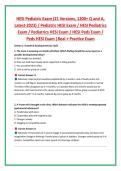
HESI Pediatric Exam (21 Versions, 1200+ Q and A,
Latest-2023) / Pediatric HESI Exam / HESI Pediatrics
Exam / Pediatrics HESI Exam / HESI Peds Exam /
Peds HESI Exam |Real + Practice Exam
Section 1: Growth & Development (Q1–Q15)
1. The nurse is assessing a 6-month-old infant. Which finding should the nurse report as a
possible developmental delay?
A. Birth weight has doubled
B. Does not hold head steady when supported in sitting position
C. Has a positive Moro reflex
D. Uses a palmar grasp on a rattle
Correct Answer: B
Rationale: Head control should be established by 4 months. Lack of head control at 6
months is a red flag for developmental delay. Birth weight doubling by 5–6 months is normal.
The Moro reflex disappears by 3–4 months, so a positive Moro at 6 months would also be
abnormal—but head control is the classic milestone expected. Palmar grasp is present at birth
and persists until ~3–4 months, replaced by pincer grasp by 9 months.
2. A 4-year-old is brought to the clinic. Which behavior indicates the child is meeting expected
psychosocial milestones?
A. Parallel play with peers
B. Cooperative play and imaginary play
C. Stranger anxiety
D. Engaging in competitive sports
Correct Answer: B
Rationale: Preschoolers (3–5 years) engage in associative/cooperative play and have vivid
imaginations (magical thinking). Parallel play is typical of toddlers. Stranger anxiety peaks at 6–8
months. Competitive sports are more typical of school-age children.
,3. The nurse is teaching parents about toilet training. Which statement indicates correct
understanding?
A. "We should start training at 12 months."
B. "We should begin when our child shows signs of readiness, usually around 18–24 months."
C. "Punishment helps speed up the process."
D. "Nighttime dryness always occurs before daytime dryness."
Correct Answer: B
Rationale: Toilet training readiness typically occurs at 18–24 months (some sources 22–30
months), when the child can communicate needs, stay dry for 2 hours, and show interest.
Daytime control usually precedes nighttime control. Punishment is contraindicated.
4. Which of the following is the priority nursing action when a hospitalized 2-year-old cries
and clings to the parent during a procedure?
A. Ask the parent to leave the room
B. Allow the parent to remain and comfort the child
C. Restrain the child without explanation
D. Tell the child "big kids don't cry"
Correct Answer: B
Rationale: Toddlers experience separation anxiety and fear of intrusive procedures. Allowing
the parent to stay provides security and reduces distress. Removing the parent increases
anxiety. Restraint without explanation is traumatic and unethical. Belittling the child's feelings is
inappropriate.
5. The nurse is assessing a 9-month-old. Which finding is expected?
A. Pincer grasp
B. Walking independently
C. Speaking 10–15 words
D. Stacking 6 blocks
Correct Answer: A
Rationale: Pincer grasp develops around 9 months. Independent walking occurs at 12–15
months. 10–15 words is expected around 18 months. Stacking 6 blocks is a 2-year milestone.
,6. A 15-month-old is seen for a well-child visit. Which immunization is due at this age?
A. MMR and Varicella
B. DTaP and Hib
C. Hepatitis B only
D. IPV only
Correct Answer: A
Rationale: MMR and Varicella are given at 12–15 months. DTaP and Hib are given at 2, 4, 6,
and 15–18 months (DTaP) and 2, 4, 6 months (Hib). Hep B is at birth, 1–2 months, and 6–18
months. IPV is at 2, 4, 6–18 months, and 4–6 years.
7. Which statement by a parent of a 5-year-old indicates a need for further teaching about
normal development?
A. "My child can hop on one foot."
B. "My child can tie shoelaces."
C. "My child can draw a person with 6 parts."
D. "My child can count 10 objects."
Correct Answer: B
Rationale: Tying shoelaces is typically mastered at 6–7 years. Hopping on one foot, drawing
a person with 6 parts, and counting 10 objects are all 5-year milestones.
8. The nurse is assessing a 3-month-old infant. Which reflex should be present?
A. Moro reflex
B. Parachute reflex
C. Landau reflex
D. Rooting reflex
Correct Answer: A (and D)
Rationale: The Moro and rooting reflexes are present at birth and disappear around 3–4
months. The parachute reflex appears at 6–9 months. The Landau reflex appears at 3–4 months.
Since the question asks which reflex "should be present" at 3 months, both Moro and rooting
are correct—this is a single-best-answer question, so A (Moro) is the classic answer, as it is still
present at 3 months and disappears by 4 months. (Note: If this were SATA, A and D would both
be correct.)
, 9. A parent asks when a child should be able to ride a tricycle. The nurse responds:
A. 18 months
B. 2 years
C. 3 years
D. 5 years
Correct Answer: C
Rationale: Riding a tricycle is a 3-year milestone. At 2 years, the child can kick a ball. At 5
years, the child can ride a bicycle with training wheels.
10. The nurse is teaching a parent about injury prevention for a 6-month-old. Which
instruction is most important?
A. "Place the baby in a walker for exercise."
B. "Use a rear-facing car seat in the back seat."
C. "Give small hard candies for teething."
D. "Place the baby on the stomach to sleep."
Correct Answer: B
Rationale: Rear-facing car seats in the back seat are essential until at least 2 years or until
the child outgrows the seat. Walkers are not recommended (injury risk). Hard candies are a
choking hazard. Infants should sleep on their backs to prevent SIDS.
11. Which finding in a 4-year-old indicates a possible vision problem?
A. Holds books close to the face
B. Has 20/20 vision
C. Can identify colors
D. Can catch a ball
Correct Answer: A
Rationale: Holding books very close, squinting, tilting the head, or frequent eye rubbing may
indicate refractive errors. 20/20 vision, color identification, and catching a ball are normal at 4
years.
12. The nurse is assessing a 12-year-old. Which statement indicates the child is developing
normally?
A. "I want to be just like my mom."
Latest-2023) / Pediatric HESI Exam / HESI Pediatrics
Exam / Pediatrics HESI Exam / HESI Peds Exam /
Peds HESI Exam |Real + Practice Exam
Section 1: Growth & Development (Q1–Q15)
1. The nurse is assessing a 6-month-old infant. Which finding should the nurse report as a
possible developmental delay?
A. Birth weight has doubled
B. Does not hold head steady when supported in sitting position
C. Has a positive Moro reflex
D. Uses a palmar grasp on a rattle
Correct Answer: B
Rationale: Head control should be established by 4 months. Lack of head control at 6
months is a red flag for developmental delay. Birth weight doubling by 5–6 months is normal.
The Moro reflex disappears by 3–4 months, so a positive Moro at 6 months would also be
abnormal—but head control is the classic milestone expected. Palmar grasp is present at birth
and persists until ~3–4 months, replaced by pincer grasp by 9 months.
2. A 4-year-old is brought to the clinic. Which behavior indicates the child is meeting expected
psychosocial milestones?
A. Parallel play with peers
B. Cooperative play and imaginary play
C. Stranger anxiety
D. Engaging in competitive sports
Correct Answer: B
Rationale: Preschoolers (3–5 years) engage in associative/cooperative play and have vivid
imaginations (magical thinking). Parallel play is typical of toddlers. Stranger anxiety peaks at 6–8
months. Competitive sports are more typical of school-age children.
,3. The nurse is teaching parents about toilet training. Which statement indicates correct
understanding?
A. "We should start training at 12 months."
B. "We should begin when our child shows signs of readiness, usually around 18–24 months."
C. "Punishment helps speed up the process."
D. "Nighttime dryness always occurs before daytime dryness."
Correct Answer: B
Rationale: Toilet training readiness typically occurs at 18–24 months (some sources 22–30
months), when the child can communicate needs, stay dry for 2 hours, and show interest.
Daytime control usually precedes nighttime control. Punishment is contraindicated.
4. Which of the following is the priority nursing action when a hospitalized 2-year-old cries
and clings to the parent during a procedure?
A. Ask the parent to leave the room
B. Allow the parent to remain and comfort the child
C. Restrain the child without explanation
D. Tell the child "big kids don't cry"
Correct Answer: B
Rationale: Toddlers experience separation anxiety and fear of intrusive procedures. Allowing
the parent to stay provides security and reduces distress. Removing the parent increases
anxiety. Restraint without explanation is traumatic and unethical. Belittling the child's feelings is
inappropriate.
5. The nurse is assessing a 9-month-old. Which finding is expected?
A. Pincer grasp
B. Walking independently
C. Speaking 10–15 words
D. Stacking 6 blocks
Correct Answer: A
Rationale: Pincer grasp develops around 9 months. Independent walking occurs at 12–15
months. 10–15 words is expected around 18 months. Stacking 6 blocks is a 2-year milestone.
,6. A 15-month-old is seen for a well-child visit. Which immunization is due at this age?
A. MMR and Varicella
B. DTaP and Hib
C. Hepatitis B only
D. IPV only
Correct Answer: A
Rationale: MMR and Varicella are given at 12–15 months. DTaP and Hib are given at 2, 4, 6,
and 15–18 months (DTaP) and 2, 4, 6 months (Hib). Hep B is at birth, 1–2 months, and 6–18
months. IPV is at 2, 4, 6–18 months, and 4–6 years.
7. Which statement by a parent of a 5-year-old indicates a need for further teaching about
normal development?
A. "My child can hop on one foot."
B. "My child can tie shoelaces."
C. "My child can draw a person with 6 parts."
D. "My child can count 10 objects."
Correct Answer: B
Rationale: Tying shoelaces is typically mastered at 6–7 years. Hopping on one foot, drawing
a person with 6 parts, and counting 10 objects are all 5-year milestones.
8. The nurse is assessing a 3-month-old infant. Which reflex should be present?
A. Moro reflex
B. Parachute reflex
C. Landau reflex
D. Rooting reflex
Correct Answer: A (and D)
Rationale: The Moro and rooting reflexes are present at birth and disappear around 3–4
months. The parachute reflex appears at 6–9 months. The Landau reflex appears at 3–4 months.
Since the question asks which reflex "should be present" at 3 months, both Moro and rooting
are correct—this is a single-best-answer question, so A (Moro) is the classic answer, as it is still
present at 3 months and disappears by 4 months. (Note: If this were SATA, A and D would both
be correct.)
, 9. A parent asks when a child should be able to ride a tricycle. The nurse responds:
A. 18 months
B. 2 years
C. 3 years
D. 5 years
Correct Answer: C
Rationale: Riding a tricycle is a 3-year milestone. At 2 years, the child can kick a ball. At 5
years, the child can ride a bicycle with training wheels.
10. The nurse is teaching a parent about injury prevention for a 6-month-old. Which
instruction is most important?
A. "Place the baby in a walker for exercise."
B. "Use a rear-facing car seat in the back seat."
C. "Give small hard candies for teething."
D. "Place the baby on the stomach to sleep."
Correct Answer: B
Rationale: Rear-facing car seats in the back seat are essential until at least 2 years or until
the child outgrows the seat. Walkers are not recommended (injury risk). Hard candies are a
choking hazard. Infants should sleep on their backs to prevent SIDS.
11. Which finding in a 4-year-old indicates a possible vision problem?
A. Holds books close to the face
B. Has 20/20 vision
C. Can identify colors
D. Can catch a ball
Correct Answer: A
Rationale: Holding books very close, squinting, tilting the head, or frequent eye rubbing may
indicate refractive errors. 20/20 vision, color identification, and catching a ball are normal at 4
years.
12. The nurse is assessing a 12-year-old. Which statement indicates the child is developing
normally?
A. "I want to be just like my mom."


