
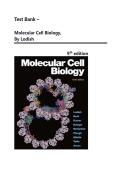
Test Bank –
Molecular Cell Biology,
By Lodish
9th edition
,Table of contents
Chapter 1 Evolution: Molecules, Genes, Cells, and Organisms
Chapter 2 Chemical Foundations
Chapter 3 Protein Structure and Function
Chapter 4 Culturing and Visualizing Cells
Chapter 5 Fundamental Molecular Genetic Mechanisms
Chapter 6 Molecular Genetic Techniques
Chapter 7 Genes, Chromatin, and Chromosomes
Chapter 8 Transcriptional Control of Gene Expression
Chapter 9 Post-Transcriptional Gene Control
Chapter 10 Biomembrane Structure
Chapter 11 Transmembrane Transport of Ions and Small Molecules
Chapter 12 Cellular Energetics
Chapter 13 Moving Proteins into Membranes and Organelles
Chapter 14 Vesicular Traffic, Secretion, and Endocytosis
Chapter 16 Growth Factor and Cytokine Signaling Pathways That Control Gene Expression
Chapter 17 Cell Organization and Movement I: Microfilaments
Chapter 18 Cell Organization and Movement II: Microtubules and Intermediate Filaments
Chapter 19 The Eukaryotic Cell Cycle
Chapter 20 Integrating Cells into Tissues
Chapter 21 Responding to the Cellular Environment
Chapter 22 Stem Cells, Cell Asymmetry, and Regulated Cell Death
Chapter 23 Cells of the Nervous System
Chapter 24 Immunology
Chapter 25 Cancer
,CHAPTER 1: Evolution: Molecules, Genes, Cells, and Organisms
Question 1
Which of the following best describes the central dogma of molecular biology?
A) DNA → RNA → Protein
B) RNA → DNA → Protein
C) Protein → RNA → DNA
D) DNA → Protein → RNA
Answer: A
The central dogma states that genetic information flows from DNA to RNA (transcription) to protein
(translation).
Question 2
All living cells share which of the following features?
A) A nucleus bounded by a double membrane
B) Plasma membrane, DNA as genetic material, and ribosomes
C) Mitochondria for energy production
D) Cell walls composed of peptidoglycan
Answer: B
All cells, whether prokaryotic or eukaryotic, possess a plasma membrane, use DNA as genetic material,
and contain ribosomes for protein synthesis.
Question 3
Approximately when did the first cells appear on Earth?
A) 1.5 billion years ago
B) 2.5 billion years ago
C) 3.5–4.0 billion years ago
D) 500 million years ago
Answer: C
Fossil evidence and molecular analyses suggest that the first prokaryotic cells appeared approximately
3.5–4.0 billion years ago.
Question 4
Which molecule is hypothesized to have served as both the genetic material and catalytic molecule in
the earliest forms of life?
A) DNA
B) Protein
C) RNA
D) Lipids
, Answer: C
The "RNA world" hypothesis proposes that RNA served both as the carrier of genetic information and as
a catalyst (ribozyme) before DNA and proteins evolved.
Question 5
Which domain of life includes organisms that often thrive in extreme environments such as hot springs
and salt lakes?
A) Bacteria
B) Eukarya
C) Archaea
D) Protista
Answer: C
Many archaea are extremophiles, living in environments with extreme temperature, salinity, or pH,
although archaea are also found in moderate environments.
Question 6
Endosymbiotic theory explains the origin of which organelles?
A) Ribosomes and lysosomes
B) Mitochondria and chloroplasts
C) Golgi apparatus and endoplasmic reticulum
D) Peroxisomes and vacuoles
Answer: B
Endosymbiotic theory proposes that mitochondria evolved from an alpha-proteobacterium and
chloroplasts from a cyanobacterium that were engulfed by ancestral eukaryotic cells.
Question 7
Which of the following provides the strongest evidence for endosymbiosis?
A) Mitochondria and chloroplasts have a single membrane
B) Mitochondria and chloroplasts contain their own DNA and replicate by binary fission
C) Mitochondria and chloroplasts lack ribosomes
D) Mitochondria and chloroplasts are found in all prokaryotes
Answer: B
Both mitochondria and chloroplasts have their own circular DNA genomes, divide by binary fission, and
have double membranes—all consistent with a bacterial origin.
Question 8
What is a model organism?
A) An organism used exclusively for industrial applications
Molecular Cell Biology,
By Lodish
9th edition
,Table of contents
Chapter 1 Evolution: Molecules, Genes, Cells, and Organisms
Chapter 2 Chemical Foundations
Chapter 3 Protein Structure and Function
Chapter 4 Culturing and Visualizing Cells
Chapter 5 Fundamental Molecular Genetic Mechanisms
Chapter 6 Molecular Genetic Techniques
Chapter 7 Genes, Chromatin, and Chromosomes
Chapter 8 Transcriptional Control of Gene Expression
Chapter 9 Post-Transcriptional Gene Control
Chapter 10 Biomembrane Structure
Chapter 11 Transmembrane Transport of Ions and Small Molecules
Chapter 12 Cellular Energetics
Chapter 13 Moving Proteins into Membranes and Organelles
Chapter 14 Vesicular Traffic, Secretion, and Endocytosis
Chapter 16 Growth Factor and Cytokine Signaling Pathways That Control Gene Expression
Chapter 17 Cell Organization and Movement I: Microfilaments
Chapter 18 Cell Organization and Movement II: Microtubules and Intermediate Filaments
Chapter 19 The Eukaryotic Cell Cycle
Chapter 20 Integrating Cells into Tissues
Chapter 21 Responding to the Cellular Environment
Chapter 22 Stem Cells, Cell Asymmetry, and Regulated Cell Death
Chapter 23 Cells of the Nervous System
Chapter 24 Immunology
Chapter 25 Cancer
,CHAPTER 1: Evolution: Molecules, Genes, Cells, and Organisms
Question 1
Which of the following best describes the central dogma of molecular biology?
A) DNA → RNA → Protein
B) RNA → DNA → Protein
C) Protein → RNA → DNA
D) DNA → Protein → RNA
Answer: A
The central dogma states that genetic information flows from DNA to RNA (transcription) to protein
(translation).
Question 2
All living cells share which of the following features?
A) A nucleus bounded by a double membrane
B) Plasma membrane, DNA as genetic material, and ribosomes
C) Mitochondria for energy production
D) Cell walls composed of peptidoglycan
Answer: B
All cells, whether prokaryotic or eukaryotic, possess a plasma membrane, use DNA as genetic material,
and contain ribosomes for protein synthesis.
Question 3
Approximately when did the first cells appear on Earth?
A) 1.5 billion years ago
B) 2.5 billion years ago
C) 3.5–4.0 billion years ago
D) 500 million years ago
Answer: C
Fossil evidence and molecular analyses suggest that the first prokaryotic cells appeared approximately
3.5–4.0 billion years ago.
Question 4
Which molecule is hypothesized to have served as both the genetic material and catalytic molecule in
the earliest forms of life?
A) DNA
B) Protein
C) RNA
D) Lipids
, Answer: C
The "RNA world" hypothesis proposes that RNA served both as the carrier of genetic information and as
a catalyst (ribozyme) before DNA and proteins evolved.
Question 5
Which domain of life includes organisms that often thrive in extreme environments such as hot springs
and salt lakes?
A) Bacteria
B) Eukarya
C) Archaea
D) Protista
Answer: C
Many archaea are extremophiles, living in environments with extreme temperature, salinity, or pH,
although archaea are also found in moderate environments.
Question 6
Endosymbiotic theory explains the origin of which organelles?
A) Ribosomes and lysosomes
B) Mitochondria and chloroplasts
C) Golgi apparatus and endoplasmic reticulum
D) Peroxisomes and vacuoles
Answer: B
Endosymbiotic theory proposes that mitochondria evolved from an alpha-proteobacterium and
chloroplasts from a cyanobacterium that were engulfed by ancestral eukaryotic cells.
Question 7
Which of the following provides the strongest evidence for endosymbiosis?
A) Mitochondria and chloroplasts have a single membrane
B) Mitochondria and chloroplasts contain their own DNA and replicate by binary fission
C) Mitochondria and chloroplasts lack ribosomes
D) Mitochondria and chloroplasts are found in all prokaryotes
Answer: B
Both mitochondria and chloroplasts have their own circular DNA genomes, divide by binary fission, and
have double membranes—all consistent with a bacterial origin.
Question 8
What is a model organism?
A) An organism used exclusively for industrial applications


