
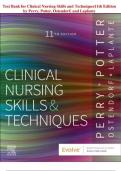
Clinical Nursing Skills & Techniques, 11th Edition — Test Bank & Study Resource
Clinical Nursing Skills & Techniques, 11th Edition — Test Bank & Study Resource Prepare for nursing skills examinations, classroom assessments, clinical check-offs, and comprehensive course review with this study and practice resource for Clinical Nursing Skills & Techniques, 11th Edition, by Anne Griffin Perry, Patricia A. Potter, Wendy Ostendorf, and others including LaPlante. Clinical nursing skills form the foundation of safe and effective patient care. Students must understand not only how to perform individual procedures, but also why each step is performed, how to maintain patient safety, how to communicate effectively, and how to recognize findings that require additional assessment or intervention. This resource is designed to help nursing students reinforce the concepts presented in the textbook through organized practice and review. It can be used alongside assigned readings, lectures, laboratory practice, instructor demonstrations, and clinical experiences. Comprehensive Nursing Skills Review The 11th edition covers a broad range of essential nursing skills and techniques. Students can use practice questions to reinforce knowledge related to: Patient assessment Nursing procedures Infection prevention and control Standard precautions Personal protective equipment Patient safety Vital signs Physical assessment Hygiene and personal care Mobility and positioning Patient transfers Nutrition and feeding Medication administration Wound care Sterile technique Specimen collection Elimination Oxygen therapy Respiratory care Cardiovascular monitoring Documentation Communication Patient education Comfort measures Pain management Emergency care Clinical judgment Practice Questions for Active Learning Practice questions allow students to actively engage with nursing concepts instead of relying entirely on passive reading. Learners can answer questions independently, review their reasoning, identify weak areas, and return to the appropriate textbook sections for additional study. Question-based learning can help reinforce important principles involving: Assessment Planning Implementation Evaluation Patient safety Infection control Clinical decision-making Prioritization Documentation Professional communication Infection Prevention and Control Infection prevention is fundamental to every area of nursing practice. Students need to understand hand hygiene, standard precautions, transmission-based precautions, personal protective equipment, aseptic technique, and environmental safety. Review questions can help learners distinguish between different infection-control practices and apply them appropriately to clinical situations. Patient Assessment and Vital Signs Accurate assessment is an essential nursing responsibility. Students can review techniques related to obtaining and interpreting vital signs, performing physical assessments, collecting patient information, and recognizing changes that may require further evaluation. Practice can reinforce concepts involving temperature, pulse, respiration, blood pressure, oxygen saturation, pain assessment, and general patient observation. Medication Administration Medication administration requires careful attention to patient identification, medication safety, calculations, routes of administration, documentation, monitoring, and patient education. A structured practice resource can help students review medication-related principles while developing greater familiarity with clinical decision-making and safety considerations. Wound Care and Sterile Technique Wound assessment and care require knowledge of tissue integrity, infection prevention, dressing procedures, assessment findings, and appropriate documentation. Students can use practice questions to reinforce principles associated with wound care, sterile procedures, surgical sites, pressure injuries, and maintaining a safe clinical environment. Mobility and Patient Safety Safe mobility is another important component of nursing care. Students can review positioning, transfers, ambulation, assistive devices, fall prevention, body mechanics, and strategies for protecting both patients and healthcare workers. Questions can help learners determine appropriate interventions for patients with different levels of mobility and functional ability. Nutrition and Elimination Nurses play an important role in monitoring nutritional status, supporting feeding, recognizing nutritional concerns, and maintaining appropriate elimination patterns. Study questions can reinforce concepts related to oral intake, enteral nutrition, fluid balance, urinary elimination, bowel elimination, specimen collection, and patient education. Oxygenation and Respiratory Care Respiratory assessment and oxygen therapy are important clinical skills. Students can review oxygen-delivery systems, respiratory assessment, airway management principles, oxygen safety, and recognition of changes in respiratory status. Practice questions encourage learners to apply assessment findings and determine appropriate nursing priorities. Communication and Documentation Effective communication is essential for safe patient care. Nurses communicate with patients, families, physicians, nurses, and interdisciplinary healthcare professionals throughout the care process. This study resource can support review of therapeutic communication, documentation principles, reporting, handoff communication, patient education, and professional interactions. Clinical Judgment and Prioritization Modern nursing education emphasizes clinical judgment and the ability to recognize changes in patient condition. Students can use practice questions to develop a structured approach to clinical scenarios. When reviewing a question, learners can consider: What information is most important? Which finding requires immediate attention? What assessment should occur first? Which intervention is safest? What should be reported? How should the patient's response be evaluated? This approach encourages students to understand the reasoning behind nursing actions rather than simply memorizing procedures. Patient-Centered Care Nursing skills should always be performed with respect for the patient's dignity, privacy, preferences, and individual needs. Students can review principles of patient-centered care, informed participation, cultural considerations, communication, comfort, privacy, and patient education. Useful for Skills Laboratory Preparation Nursing students often encounter skills check-offs and laboratory demonstrations throughout their programs. Practice questions can be used before or after skills laboratory sessions to reinforce the theoretical knowledge behind individual procedures. Students can pair question practice with hands-on demonstration and instructor feedback to strengthen both knowledge and technical performance. Helpful for Multiple Study Strategies This resource can be incorporated into many study approaches, including: Chapter-by-chapter review Nursing skills laboratory preparation Clinical preparation Flashcard creation Group study Active recall Practice examinations Remediation Pre-test review Final examination preparation Students can work through questions independently and use missed concepts to identify specific areas requiring further textbook review. Ideal for Nursing Students This resource may be useful for: Undergraduate nursing students RN students Nursing fundamentals students Nursing skills laboratory students Clinical nursing students Nursing study groups Students preparing for skills examinations Students preparing for course examinations Nursing educators using authorized assessment materials Build Confidence Through Consistent Practice Clinical nursing skills involve both knowledge and application. Consistent practice helps students become more familiar with procedures, safety principles, assessment findings, and appropriate nursing interventions. Rather than waiting until examination week, learners can incorporate practice questions into their regular study routine. Reviewing a small group of questions after each lecture or laboratory session can help reinforce recently learned material. A Supplement to Classroom and Clinical Learning The Clinical Nursing Skills & Techniques, 11th Edition study resource is intended to complement the textbook and other educational materials. It can help students organize their preparation and reinforce concepts encountered in lectures, laboratories, simulations, and clinical experiences. For best results, students should combine practice questions with textbook readings, instructor demonstrations, laboratory practice, clinical feedback, and authorized course resources. Product Information Title: Clinical Nursing Skills & Techniques Edition: 11th Edition Authors: Perry, Potter, Ostendorf & LaPlante Subject: Clinical Nursing Skills and Techniques Resource Type: Study and practice resource Focus: Nursing procedures, patient safety, assessment, infection control, medication administration, clinical skills, communication, documentation, and clinical judgment Important Note This listing describes a study and practice resource associated with Clinical Nursing Skills & Techniques, 11th Edition. It should not be represented as an official publisher resource, confidential instructor assessment, or collection of unreleased examination questions unless its authorization and provenance have been independently verified.
Document information
- Uploaded on
- September 19, 2026
- Number of pages
- 600
- Written in
- 2026/2027
- Type
- Exam (elaborations)
- Contains
- Questions & answers


